Savers will be able to continue putting up to £20,000 a year into their cash ISAs after the chancellor John Healey reversed the decision to reduce the cash ISA limit.
The government had planned to cap cash ISA contributions at £12,000 per tax year for under 65s from April 2027 in a bid to encourage Brits to invest.
It means you will be able to continue to put up to £20,000 a year into cash ISAs if you wish to – or you could split the annual ISA allowance across different types of ISA.
Start your trial of MoneyWeek today
Get unparalleled financial insight, analysis and expert opinion you can profit from.
Start your trial
Sign up for MoneyWeek’s free twice-daily newsletter.
Join more than 165,000 subscribers and keep yourself informed with latest financial news, insights and expert analysis to help you understand what really matters when it comes to your finances.
Join more than 165,000 subscribers and keep yourself informed with latest financial news, insights and expert analysis to help you understand what really matters when it comes to your finances.
As the current 2026/27 tax year was set to be the final year where you could put the full £20,000 ISA allowance into cash, some savers prioritised putting their money there instead of dividing contributions between cash ISAs and stocks and shares ISAs.
Latest Videos FromMoneyWeek
This resulted in a record £57 billion being deposited in cash ISAs in 2025, according to the Bank of England.
Now the ISA rules are set to remain the same, what should you do if you used your entire ISA allowance on cash?
Why you might be holding too much cash
Holding at least some of your savings in cash is important when you are building a safety net for yourself. It’s recommended you build an emergency fund, which holds between three and six months worth of your necessary spending in an easy to access savings account so you can cover unexpected costs.
Unlike investments, where the value of your portfolio can go up and down, any money you hold in cash cannot fall in value.
Short-term savings that will be used in the near future, perhaps to buy a car or pay for a wedding, are often best held in cash savings accounts.
But holding too much cash can hurt your long-term wealth. Andy Reed, head of behavioural economics research at investment platform Vanguard, recently told the MoneyWeek Talks podcast that you can have “too much of a good thing” when it comes to cash.
“Having cash above and beyond those short-term emergency needs means you’re incurring opportunity costs. What you’re giving up by not investing is quite a bit larger than what you might realise,” he said.
Despite this, Brits on the whole allocate most of their savings in cash. Of the almost 17 million adult ISA accounts subscribed to in the 2024/25 tax year, 10.7 million were cash ISAs, while just 4.9 million were stocks and shares ISAs.
Should you transfer money held in a cash ISA into a stocks and shares ISA?
How much money you should hold in cash will depend on your personal circumstances, but if you think your money could be working harder in the stock market than in a savings account, then you may want to consider investing.
The top five-year fixed rate cash ISA at the end of October 2026 paid an interest rate of 5.25%. If you locked £20,000 away into this account, you would earn a total of £5,989 in tax-free interest by the time the term ended.
However, a well-balanced investment portfolio could bring stronger returns. Over the last five years, the S&P 500, a stock market index that tracks the performance of 500 of the largest firms in the United States, has brought average annualised returns of around 13%.
If you had invested that same £20,000 and it had achieved that 13% average for five years, it would have grown to £38,177, an increase of £18,177 before fees. If you held that money in a stocks and shares ISA, you would not need to pay capital gains tax or dividend tax to HMRC.
While past performance is not a guarantee of future results, the discrepancy underscores the point that the stock market can drive much greater gains over long time periods. It is generally advised that you remain invested for at least five to ten years.
While the over £12,000 gap between savings interest and potential investment returns is significant, it doesn’t mean that investing is the right choice for everyone, especially if you need the money you are investing in the short term.
Helen Morrissey, head of retirement analysis at Hargreaves Lansdown said: “The decision to invest depends on your goals. If you are likely to need the money soon, say within the next three years, then it might be best to leave it in cash.
“Investment markets can be volatile, and you don’t want to be in a position where the market has dropped and you need to withdraw your money. A longer time horizon gives your money more time to grow and can make these shorter-term market movements easier to deal with, so if you don’t need the money for at least the next three years, then you should consider investing. Just make sure you are happy with what you are invested in and understand the risk.”
Can you transfer a cash ISA into a stocks and shares ISA?
You can transfer money held in a cash ISA into a stocks and shares ISA without affecting your allowance. So if you put money into a cash ISA ahead of the now-scrapped ISA changes and now would prefer to put that money into investments, you can move it.
The most important thing to remember when transferring money between ISAs is that you should not withdraw your money from your existing ISA first.
Withdrawing money from an ISA takes it entirely out of the tax-free ISA ecosystem so you will lose any annual ISA allowance you’ve used, unless you have a flexible ISA.
That means if you put £20,000 into a cash ISA in 2026/27 and then withdraw it, you will have no ISA allowance left this tax year to add it into your stocks and shares ISA.
If you want to move the money between ISAs, contact the ISA provider you want to move to and request an ISA transfer. The provider will then give you an ISA transfer form to fill in.
The process of transferring an ISA takes longer than a standard bank transfer, but it protects the tax-free status of your money.
Morrisey said: “If you have already used your entire ISA allowance for the year to a cash ISA, then you may be able to transfer some of it into a stocks and shares ISA. However, check with both the ceding and receiving provider for any restrictions.
“Be sure to follow the transfer process and don’t simply withdraw from the cash ISA and then put it into a stocks and shares ISA as that will breach your annual allowance.”
Global Banking & Finance Review® is an online platform providing news, analysis, interviews, opinions, press releases, market information and other content relating to banking, finance, insurance, investment, wealth management, fintech, financial markets, technology, regulation and related industries worldwide. The website publishes editorial content, news, press releases, contributed articles, sponsored content, advertorials, advertisements and other material…
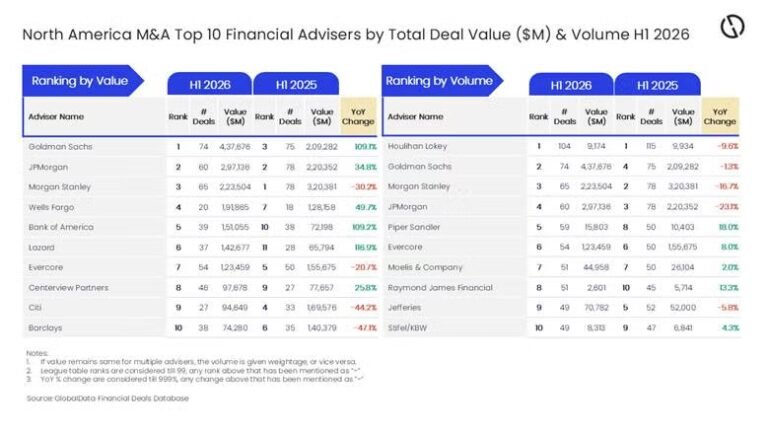
GlobalData’s latest league table for North America showed Goldman Sachs and Houlihan Lokey at the top of M&A financial adviser rankings in the first half of 2026, measured by deal value and deal count respectively. Figures from GlobalData’s Financial Deals Database indicated that Goldman Sachs advised on transactions worth $437.7bn, placing it first by value. Access deeper industry intelligence…
Shares of food delivery and quick commerce company Swiggy tanked 13.8% to their 52-week low of Rs 182.20 on the BSE on Friday after its consolidated net loss narrowed to Rs 922 crore in the second quarter, compared with Rs 1,092 crore a year earlier. However, on a sequential basis, the loss increased to Rs…
Concentration on mega-infrastructure projects masks a broader decline in foreign investments across the region. This article appears in the October issue of Global Finance Magazine. Foreign direct investment in Latin America and the Caribbean grew by just 1.7% in 2025, with the share of fixed capital at 14%. 1,326 projects were announced totaling $114.1 billion,…
Macro pulse: Europe’s economy is losing steam but inflation won’t let up !“#$%&‘()*+,–./0123456789:;<=>?@ABCDEFGHIJKLMNOPQRSTUVWXYZ[\]^_`abcdefghijklmnopqrstuvwxyz{|} !“#$%&‘()*+,–./0123456789:;<=>?@ABCDEFGHIJKLMNOPQRSTUVWXYZ[\]^_`abcdefghijklmnopqrstuvwxyz{|}