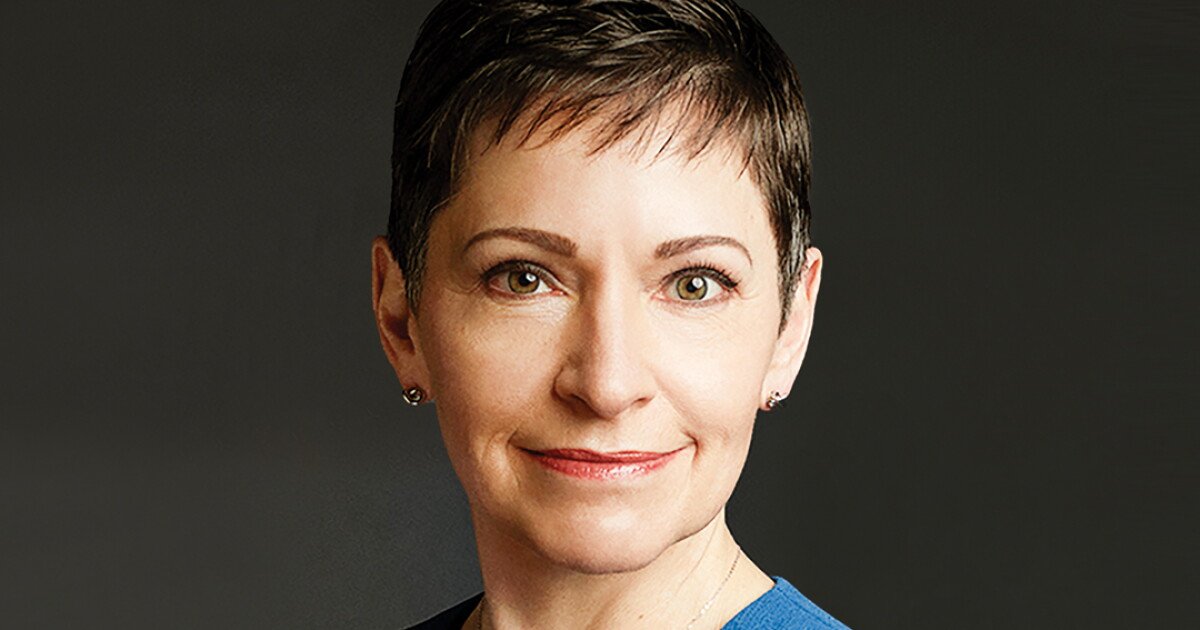
Edward Jones CEO on the $1.4B Class B share sale and her succession plans
Processing Content
- What’s at stake: Edward Jones aims to raise $1.4 billion by selling a new class of ownership shares to fund its next phase, as its top leader plans her own succession.
- Key quote: “Five years from now, I won’t be the right leader for this organization. And we will have the right person in place who will be.” — Penny Pennington, CEO and managing partner of Edward Jones
Edward Jones advisors are taking on a new type of ownership stake in the firm at roughly the pace expected, though some are waiting to see how it plays out.
That’s how Managing Partner and CEO Penny Pennington characterized advisors’ willingness to exchange their existing Edward Jones ownership stakes — known as Class A shares — for new Class B shares with payouts tied more directly to firm profits. The offer comes amid Edward Jones’ plans to raise $1.4 billion through sales of the new Class B shares to employees.
Edward Jones remains one of the few wealth managers structured as employee-owned private partnerships. With more than 20,000 advisors and roughly $2.6 trillion in client assets, it is certainly the largest.

Dan Shaw
Pennington said in an interview Tuesday that the goal of the latest capital raise is to put ownership stakes in the hands of 35,000 of her roughly 55,000 colleagues. She declined to specify how many employees have already bought new Class B shares or elected to swap their Class A shares.
“But they’re tracking right along with what we expected,” Pennington said. “And the acceptance of our partnership capital is tracking right along with historic numbers, which is very high.”
Edward Jones’ current capital raise is the largest in its 100-year-plus history and its first since 2021. To arrive at $1.4 billion, Edward Jones aims to sell 1.4 million of the new Class B shares for $1,000 apiece. The minimum purchase allowed is $5,000.
Edward Jones employees who swap their Class A shares for Class B will be giving up a guaranteed payout of 7.5% on their capital contributions. The payments on Class B shares will instead be tied to firm profits and could go even higher.
Pennington said some partners likely want to see more of a track record with the Class B shares before making the swap.
“You know, let’s see this work out for a year,” Pennington said.
Pennington, managing partner of Edward Jones since 2019, sat down with Financial Planning this week at the firm’s annual Innovation Summit near its hometown of St. Louis to discuss the reasons behind the switch to Class B shares, what Edward Jones plans to do with its capital raise and her own succession plans for the firm’s top role.
This interview has been lightly edited for clarity and length.
Financial Planning: Why did Edward Jones offer the switch to Class B shares?
Penny Pennington: It really did three things. One, it opened the partnership to even more people. We’ve established the largest offering that we’ve ever done, the [$1.4 billion] that we’re about to do. Now we plan to have an offering every couple of years. In the past, it had been every four years.
We also shifted some governance. So the managing partner has always had, along with our general partners, a 65-and-out clause. You have to be out at the end of the year that you turn 65. [Founder] Ted Jones put that in place. It just refreshes the partnership.
We’ve also established a 10-year term for the managing partner. I’ll serve 10 years if my health holds.
We also established a vote by our general partners if there were to ever be a significant transaction, such as a proposed sale or dissolution of the partnership. And I’ve been very, very clear with our entire company a number of times: This partnership has never been for sale, and it will never be for sale.
So what we did with the partnership amendment was to do everything possible to make sure that all of our colleagues know that this partnership is enduring into multiple generations.
FP: Why the new payout system for Class B shares?
PP: To get real specific about that, the Class A partnership — there was only one class of limited partnership in the past — had that provision for a 7.5% guaranteed rate. That was an interest expense, actually, on our operating statement.
Then the remainder of return that goes to the LPs [limited partners] then came out of net income. We’re switching that to Class B.
What it helps us do, frankly, is to ensure that our partnership capital looks more like partnership capital rather than part of the return looking like an interest expense.
FP: Is there an accounting reason for this?
PP: Not exactly an accounting reason. It’s because the interest expense comes out above our bonus profit line, and it was actually sub-optimizing the level of bonus for our colleagues. So if we take that interest expense line out, and just have it be part of LP returns after everything is at the bottom line, then we don’t sub-optimize the bonus any longer.
FP: Why would partners trade their Class A shares for Class B?
PP: Because anything that we’ve ever done for the partnership improves the situation for the partner. So from the standpoint of why we did this, it’s strengthening the partnership without diminishing the rate of return for the LPs. In fact, in some cases, Class B could actually be a little bit higher than Class A.
FP: The capital you’ve raised in recent years has been used to pay for some pretty big changes at Edward Jones. Where is the firm generally headed?
PP: So what we’ve been changing over the years is really moving Edward Jones from one good way of serving everybody, to more tailored, hyper-personalized, relevant ways for them across the arc of their lives, across wealth bands.
What that’s meant for us is that we’ve segmented our business. So our core clients generally have $250,000 to $3 million in assets. Now our new-to-wealth clients — those who are just getting started — will go at the beginning of next year to a digital platform with advice built in and a hybrid advisor in the background. This is brand new for Edward Jones. That’s going to attract those who are more digitally forward with slightly less complex needs.
And then on the other end, we have Edward Jones Generations and Private Wealth. We’re winning business there. They were business owners, ranchers, farmers, corporate executives. We can marshal their resources to grow into high net worth clients. Now we have the advice, the capabilities, the products to help them.
Options will be coming out at the beginning of next year. We’re already in alternatives, structured notes and IPOs. That’s a different Edward Jones than it has been in the past. But the ethos underlying it remains the same. We want to help more people improve their lives and achieve their financial fulfillment.
FP: Are there business reasons that make working with clients with $250,000 to $3 million in assets difficult? How can technology help?
PP: You know, we have always invested in this hyperlocal business model — that some would say is actually very expensive — where we put up branches all over the country in order to be where people are. Some could say that’s a sunk cost, quote unquote, in all that brick and mortar.
Now you combine that with great technology that can enable the capacity to serve more people more completely according to their needs. Then you enable a digitally forward model. Our branch teams may not be giving the very best service to some of those lower-asset clients, and a digital forward experience can actually be an even better experience for them right now.
FP: Where does AI come in?
PP: I like to focus on AI in three dimensions. Automation. So, take a business process that a human being doesn’t want to do anyway because it’s drudgery and automate it.
Then there’s augmentation. The best example is a financial advisor whose insights and judgment can be augmented by having at their fingertips insights that come from 100,000 client conversations a day. That can be dynamically imparted to them as they’re thinking about, “I’ve got a new client coming in, a single mom. She’s got a special-needs child. She’s got parents that she might be worried about caregiving for in the future. She’s worried about her retirement plan, and her business is in growth mode. How do I really help this client?”
That may be an N-of-1 for that practice, but we’ve seen that client a couple thousand times a day. So how can we augment that financial advisor’s discovery process?
Then there is addition. The example that I use most often is that 10 years ago, without the compute power that we have today, you simply could not dynamically rebalance a $100,000 portfolio in a tax-efficient way. But because of the algorithms that we have built vis-a-vis our investment model and the investment tools that we have available, our purchase of the Natixis tax overlay last year, we can dynamically rebalance a $100,000 portfolio just as easily as we can a $100 million portfolio.
FP: You also recently secured regulatory approval to have an industrial bank. How will that help the firm and its clients?
PP: Edward Jones Bank will open in January. The insight there, of course, is that clients, investors, the cognitive load of trying to put together their entire financial and life plan — it’s just too much.
They want things simplified, and so that’s the insight around the Edward Jones Bank.
We still have a partnership with U.S. Bank for checking accounts. The Edward Jones Bank will move us into lending, and then Edward Jones and our financial advisors will put all of that together for our clients. It’ll be more digitally forward than it’s ever been.
FP: What are your thoughts about advisor recruiting in the industry? Are the recruiting deals becoming too generous, and is Edward Jones placing a greater emphasis on recruiting?
PP: Our general approach is taking responsibility for growing the access to human advice. So there are 280,000 licensed producers today. There were 310,000 or 320,000 just a few years ago, and 100,000 of them are going to be gone over the next 10 or 15 years because of retirement.
So Edward Jones really takes responsibility in this, and we will continue to hire financial advisors into different tracks. We’ll hire financial advisors into teams for their career. We’ll also hire financial advisors into teams with an apprentice approach, where they learn the nature of that practice and determine if they might stay in that practice or if they might become a practitioner themselves and build their own team.
I also want to be very clear that we will continue to hire people into sole practitioner practices where it makes sense for them, for that marketplace, for the network that they have, and the practice that they want to build.
So we’re going to continue to build at the rate of 1% to 3% a year, in terms of the number of financial advisors that we’re hiring.
Now we hire some financial advisors from the industry. It’s not the lion’s share of whom we hire, and we’re always looking for folks who understand a client-led strategy for serving clients through the nature of our culture and our private partnership.
Our recruiting packages are very competitive. And when you get here, the approach at Edward Jones is more partner-like, I believe, than it is at many other firms. That’s one of the things that really attracts people.
FP: You mentioned earlier on that managing partners are now on a 10-year timeline before they have to leave and make room for someone else. How far along are you, and have you started planning for the succession?
PP: I came into this role on Jan. 1, 2019. The first notes that I took on my succession were in February of 2019. So I’ve been working on succession for eight years.
This is what good leadership does, right? It’s constantly thinking about developing the next generation of leaders and ensuring that every leadership team is stocked with people with unique perspectives, with unique backgrounds. It’s why my executive leadership team, my enterprise leadership team, has completely turned over since I became managing partner. And a third of the team has been with our firm less than five years.
In many ways, I was an unlikely CEO. I was likely in the respect that I had been a financial advisor with Edward Jones and all of our managing partners had been a financial advisor with Edward Jones, building a practice in one way or another. But I was a transplant into this industry 14 years into my career. Yeah, I am the first managing partner who never knew Ted Jones, so this was a generational transference.
So I was unlikely in some ways. But I like to think that I’ve been the right leader to match the moment. But five years from now, I won’t be the right leader for this organization. And we will have the right person in place who will be.