What Midterms Mean for Your Stocks

1. What a Democratic Congress Means for Your Portfolio
Democrats won control of Congress in Tuesday’s midterm elections, and you may be wondering what such a reshuffle means for your investments. We asked our analysts how a Democratic Congress could affect the parts of the market they follow most closely, from healthcare and energy to artificial intelligence (AI) data centers.
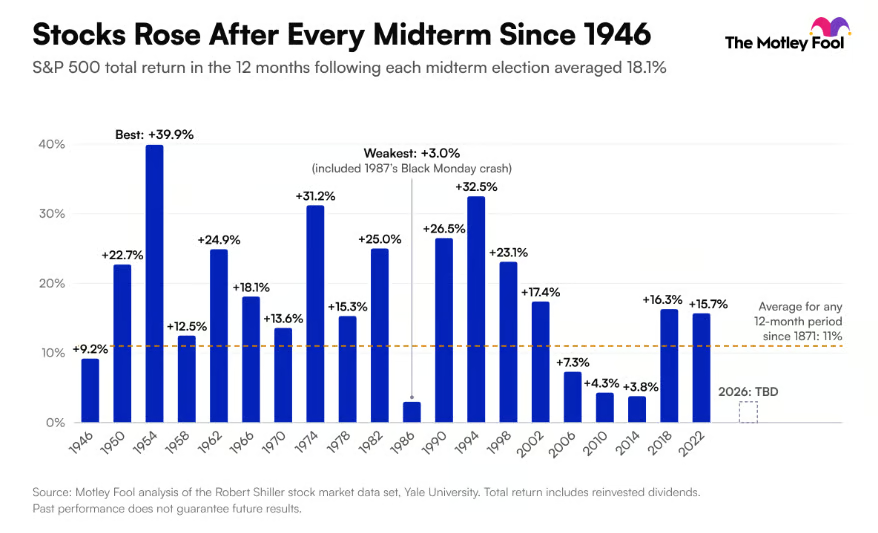
For quick background, Republicans will keep the White House for another two years while Democrats will take majority control of both the House and the Senate. When power splits this way, major legislation becomes harder to pass, so investors face fewer surprises from Washington. Markets usually welcome this stability, which helps explain why stocks rose Wednesday morning.
So what happens once the new Congress gets to work? A few themes stand out across our analysts’ answers:
- Some of the biggest forces moving markets right now (energy prices, tariffs, and interest rates) are largely outside Congress’s control.
- Healthcare, data centers, and crypto could feel lawmakers’ influence directly, since a Democratic Congress will shape federal budgets and approve who runs key regulators.
- Above all, a company’s business results tend to matter far more for its stock over time than which party is in power.
What it Means for the Big Three Cloud Providers
By Danny Vena, CPA
Team Rule Breakers
Stocks of the major cloud operators rallied on Wednesday, after the Democratic Party swept control of both the House and the Senate and its candidates won important gubernatorial races. Amazon (AMZN +6.12%), Microsoft (MSFT +6.68%), and Alphabet (GOOG +3.25%) gained 7.2%, 6.5%, and 4.1%, respectively, as of this writing.
That reaction might seem counterintuitive, since there’s been a groundswell of public opposition to data centers. Furthermore, there were an eye-opening 50 data-center-related ballot measures across 10 states, with many supporting moratoriums or stricter regulations in the space.
Gina Hinojosa, the new Democratic governor-elect for Texas, championed freezing data center construction until the state’s lawmakers can assess the impact on water, electricity, air quality, and property rights. This could delay further development until mid-2027.
According to research firm SemiAnalysis, Texas will make up roughly 41% of new data center capacity slated for 2028. Ohio, Georgia, and Arizona also elected Democrats to top offices, and each is a hotbed of data center construction and could face similar hurdles.
Hyperscalers might benefit from stricter regulations, as it could hinder additional competition. It could also serve to slow the massive capital expenditures that have big tech investors on edge.
Healthcare Gets a Seat at the Budget Table
By Karl Thiel, Team Rule Breakers
Democrats just got some political capital, but only a few places to spend it. Drug and biotech companies have largely thrived under Trump 2.0 while healthcare more broadly has been a mixed bag. Investors were initially fearful of huge tariffs and “most-favored nation” pricing, but ultimately realized that the policies mostly allow for business as usual. Don’t expect big changes there–Democrats are unlikely to unwind the price cuts Trump has negotiated. Instead, they will use MFN as a bargaining chip for other goals.
What goals? “Medicare for All”–the favored approach of some left-leaning Democrats–is a non-starter. The most likely goal of Congress will be to restore ACA subsidies and maybe provide some Medicaid relief. It will be a careful dance, though, since any proposals will have to overcome a veto threat.
For investors more interested in development-stage biotech, a bigger issue than policy will be interest rates, since plentiful, patient capital is required to make new drugs. That’s largely outside the hands of lawmakers. Stabilizing the grant process of the National Institutes of Health (NIH) may be an achievable goal, however.
Elections Fade, Fundamentals Don’t
By Anthony Schiavone, Team Hidden Gems
Every election, investors try to pick winners and losers based on who’s in charge. Energy stocks show why that rarely works.
U.S. oil production boomed after Barack Obama took office in 2009—the shale revolution didn’t wait for Washington. Yet energy was the worst-performing sector of his presidency, partly because the industry was so successful it pumped too much oil and prices collapsed in 2014-2016.
Pro-energy Donald Trump took office in 2017. Energy was the worst-performing sector of his first term.
Joe Biden took office in 2021 and signed the Inflation Reduction Act, packed with clean-energy incentives, into law. Oil & Gas stocks were the best-performing sector of his presidency. Clean energy stocks plummeted more than 60%.
Trump returned in 2025 ready to “Drill, Baby, Drill.” Energy was the worst performer in his first year back, then surged in 2026 as the war in Iran sent oil prices soaring. We’ll see where it ends up.
The point is that business fundamentals, valuations, and macro trends matter far more than who’s in office. That’s true for energy, and probably most industries. If presidents can’t steer a sector, a new Congress probably won’t either.
2. Take-Two Interactive: Buckle Up
Team Rule Breakers
Gaming publisher Take-Two Interactive (TTWO +7.13%) reports results on Monday, but most casual observers are looking out to the week after. That’s the launch of Grand Theft Auto VI, a game that fans have been speculating about for well over a decade.
Take-Two is a three-time Rule Breakers recommendation, going back almost two decades, and all three are beating the market by triple digits. But Take-Two has been lagging the broader market for over five years, and the stock is down around 25% year-to-date. If you think you’ve missed the new GTA cycle, it’s perhaps worth another look.
Our successes came from two distinct theses, both of which proved correct.
- Turnaround: The first (in 2007) was that a turnaround specialist named Strauss Zelnick – now the company’s longtime chairman and CEO – could get the business back on track after struggles with delays, accounting irregularities, and more.
- Recurring revenue: The second (in 2015) was that a new focus on recurrent online revenue could turn a feast-or-famine business based around single title releases into a steady revenue generator. It’s why GTA still accounted for 12.4% of revenue in fiscal 2026.
GTA 5 is proof that revenue from game IP can continue long after depreciation and amortization charges push down reported earnings. Expectations for GTA 6 aren’t low, but investors may still not fully appreciate the potential for long-term cash flow.
3. Today’s Question!
Now that post-midterm market moves are underway, do you plan to buy or trim any stock, or wait for the market to cool down?
Discuss with friends and family, or become a member to hear what your fellow Fools are saying!