Rising living costs put retirement security under pressure
- What’s at stake: As inflation and other factors make it harder for workers to save, advisors can help clients plan for healthcare costs and more to prepare for retirement.
- Expert quote: “The purview of the financial planner is growing broader and wider.” — Catherine Collinson, president and CEO of Transamerica Institute and Transamerica Center for Retirement Studies
High costs of living are hindering retirement saving for nearly 8 in 10 American workers, according to
Processing Content
“The purview of the financial planner is growing broader and wider,” Transamerica Institute and TCRS President and CEO Catherine Collinson told Financial Planning in an interview. She attributed the shift in part to the growing importance of “human capital” in financial advice.
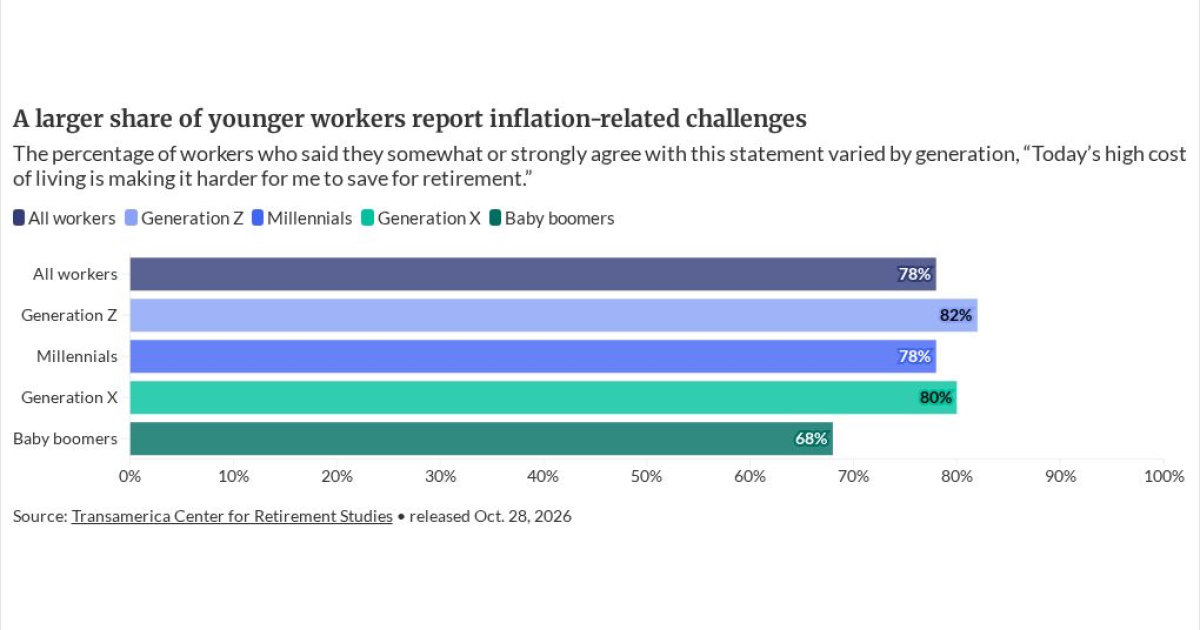
Transamerica’s study found that pressure on retirement savings is widespread, though it varies by generation, with 82% of Generation Z, 78% of millennials, 80% of Generation X and 68% of baby boomers reporting they somewhat agreed or strongly agreed that today’s high cost of living makes it difficult to save for retirement. Overall, 78% of American workers said high costs of living make it harder to save.
TCRS, a division of the nonprofit Transamerica Institute funded by contributions from the Transamerica Foundation, Transamerica Corporation and affiliates, conducts research and educates the public on retirement security.
The report also looked at how older workers expected to pay for their retirements. Of baby boomers, 27% anticipate income from 401(k)s, 403(b)s and IRAs to be their main retirement income source, while 38% of Generation X workers anticipate self-funded savings from 401(k)s, 403(b)s or IRAs to be their main source.
Forty-two percent of baby boomers and 27% of Generation X expect to mainly rely on Social Security. Seven percent of baby boomers and 11% of Generation X anticipate relying on income from continuing to work, while only 5% of each expect to rely on a company-funded pension plan.
Because Roth IRAs weren’t introduced until 1997, much of Generation X’s and baby boomers’ savings are held in tax-deferred accounts, making withdrawal strategies particularly important to avoid pushing themselves into higher tax brackets, Collinson said.
“They also have the ability to not take withdrawals all the way up to their [required minimum distribution] age,” she said. “And with an eye toward making their savings last, it is as much a tax planning exercise as a saving and investment strategy exercise.”
Working longer and retiring older is “easier said than done,” Collinson said.
At the other end of the age spectrum, cash flow for many younger households can be taken up by mortgage payments as well as insurance and upkeep costs for houses, said Andrew Palmer, Los Angeles-based senior managing director at registered investment advisor MAI Capital Management. They can have a very difficult time starting to save for retirement when they are struggling to afford housing.
“Without parents that are supporting them, I think it’s almost impossible, so they’re relegated to the rental market, and the rental market is insane,” Palmer said.
Healthcare costs
Beyond taxes and housing, healthcare is a major spending category for retirees. Collinson recommended that advisors have some knowledge of Medicare.
“Between the Medicare alphabet and the nuances of Medicare Advantage plans, just raising awareness among clients that this is a lot more complicated than [it might seem] at face value can be very helpful,” she added.
Another thorny challenge can be long-term care. Planning for those expenses can be “the hardest part of all,” Collinson said.
Advisors can help clients start thinking about what they would do if their health declined in the future, including weighing assisted living communities against aging at home, comparing the costs and saving and, if possible, insuring for those costs, Collinson said.
“Who, what, where, when and how would they turn to for such care?” she asked. “How would they fund that care? Nobody’s going to give you a loan to pay for your nursing home. You’re not a good credit risk at that point, and that sounds callous, but if somebody is aging, and if health declines … what types of options are available?”