Wait, credit unions are ‘banks’ now? Not so fast…
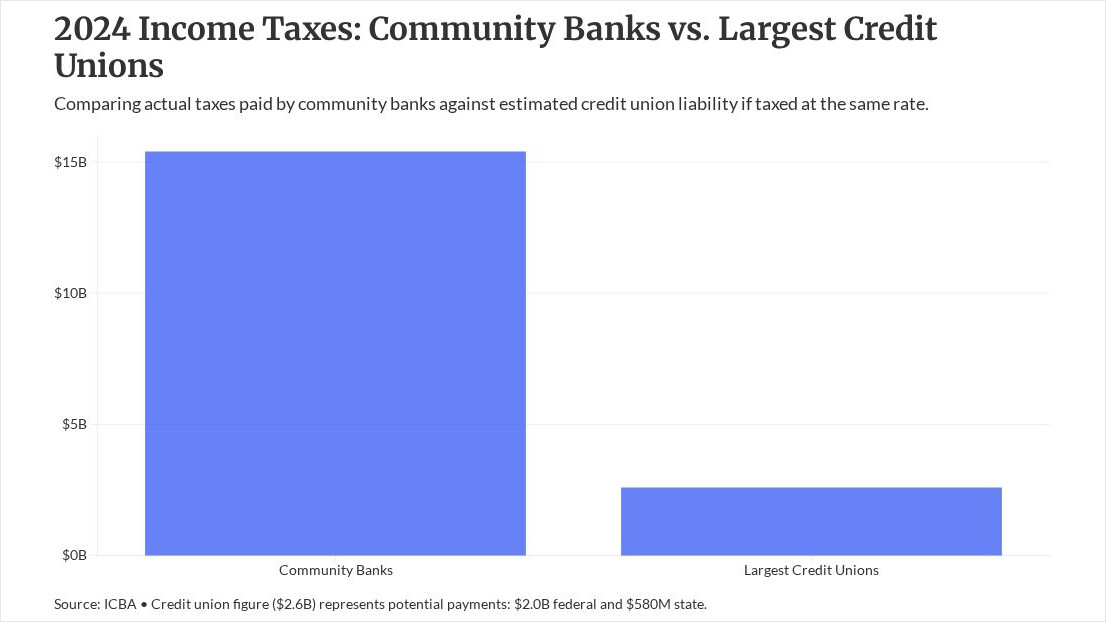
- Key insight: Given credit unions’ decades-long deviation from the statutory limits on their operations, it might feel tempting to call them “banks,” but the differences are profound.
- Supporting data: If taxed at the same rate as local community banks, tax payments from the largest credit unions would have totaled $2.6 billion in 2024 — with $580 million going to states and $2 billion to federal coffers. By contrast, community banks paid $15.4 billion in income taxes in 2024.
Community banks are flattered to serve as a model for meeting the needs of local communities
Processing Content
While
Let’s start with those credit union
While many credit unions across the nation have preserved their industry’s traditional structure and focus on local communities, the largest credit unions have evolved dramatically. At the end of 2024, credit unions over $1 billion in assets represented just 10% of all credit unions while accounting for 77% of the industry’s assets.
If taxed at the same rate as local community banks, tax payments from the largest credit unions would have totaled $2.6 billion in 2024 — with $580 million going to states and $2 billion to federal coffers. By contrast, community banks paid $15.4 billion in income taxes in 2024.
While community banks pay their share to Uncle Sam, large credit unions have increasingly used tax savings to acquire local, tax-paying institutions.
These acquisitions reached a record in 2024 and have kept pace since, often involving large credit unions that cross state lines well outside their fields of membership. For instance, a multibillion-dollar Michigan credit union
With nearly two-thirds of acquired banks experiencing an increase in net operating income in the five years leading up to their acquisition, credit unions are purchasing well-performing competitors — and eliminating tax-paying local institutions in the process.
Read more:
Apart from the impact on tax revenue, an
Home Mortgage Disclosure Act data tells the same story. In service areas affected by an acquisition, 61% experienced an increase in mortgage denial rates. Clearly, credit unions are not replicating the lending practices of the banks they acquire.
The lending impact is particularly alarming given the stark disparities between community banks and credit unions in serving lower-income areas. Since 2010, community banks represented 76.5% of SBA lending in the highest-poverty counties, while credit unions represented just 1.8%. In other words, community banks are outperforming credit unions even in the lower-income communities that credit unions receive a tax subsidy to serve.
While Congress has been slow to move on rethinking the credit union tax exemption, policymakers can take an important step toward better understanding how credit unions are using their taxpayer subsidies by aligning credit union transparency standards with other tax-exempt industries.
As the Treasury Department conducts a Form 990 Transparency Initiative to study annual reporting standards for tax-exempt organizations, credit union reporting has become a hot-button issue due to a multimillion-dollar embezzlement scandal in Mississippi. The scheme led to the
While there is no way to know whether filing a Form 990 would have flagged this nonprofit C-suite fraud sooner, annual reporting requirements provide an important layer of scrutiny for institutions that receive a tax exemption.
Ultimately, favorable credit union policies are tilting the scales in favor of a taxpayer-subsidized industry, which is why Washington should act. In addition to requiring federal credit unions to file Form 990, policymakers should eliminate the federal tax exemption for credit unions over $1 billion in assets to help ensure taxpayer dollars no longer distort the competitive marketplace, subsidize community banking consolidation, and reduce banking options for consumers and small businesses.
With even