SMBs rely on fintechs and nonbanks for a host of daily payments
Key insight: Small and medium-sized businesses (SMBs) are increasingly relying on nonbanks and fintechs for daily payments, according to an American Banker survey, resulting in fintechs capturing SMB payment volume by embedding instant settlement directly into merchants’ core daily workflows.
Processing Content
What’s at stake: Traditional commercial banks risk being cut out of direct relationships with SMBs, reducing them to background plumbing while fintechs control the brand, the software, and the profits.
Commercial banks must reclaim custody of the front-end transaction interface and embed their rails directly into merchant workflow or risk ceding direct access to the more than
Institutions are steadily losing ground across both consumer-to-business (C2B) and business-to-business (B2B) channels as SMBs overwhelmingly depend on nonbank and fintech providers for payments, according to a recent survey from American Banker’s Market Intelligence team.
SMB transactions now flow through third-party fintech platforms and nonbank payment service providers (PSPs), which have systematically replaced sluggish, fragmented administrative workflows with real-time, API-driven stacks. By pushing the logic of payment execution directly upstream into enterprise resource planning (ERP) systems, vertical SaaS platforms, and point-of-sale (POS) dashboards, these competitors have fundamentally transformed how SMBs manage supplier payables and consumer checkouts, leaving traditional banks at risk of becoming invisible balance-sheet utilities.
To counter the footprint of consumer P2P applications, banks can benefit from taking these three steps to expand and promote their own instant payment frameworks:
|
The American Banker Market Intelligence On-Chain Survey
The American Banker Market Intelligence Survey was conducted in May-June 2026. It’s the second phase of the On-Chain Survey; 501 SMBs (micro: 1–9, small: 10–99, and medium: 100–999 employees) were surveyed to evaluate digital and on-chain activity. The report assesses the tangible value of digital payments and on-chain payments across consumer and commercial sectors, measures market adoption appetite and quantifies the emerging competitive threat to traditional banks.
Three key themes were revealed from the survey:
- Widespread reliance on fintech and nonbank rails: Small and medium businesses overwhelmingly depend on third-party fintech tools, P2P platforms, and nonbank payment options over traditional banking channels for daily consumer and B2B transactions.
- Speed drives adoption, but knowledge gaps hinder emerging options: While faster access to capital is the primary catalyst for adopting digital payments, emerging options like cryptocurrency and stablecoins face adoption headwinds due to a widespread lack of understanding among smaller enterprises.
- Overall, SMBs report being satisfied with their current payment mechanisms (95%), but note persistent operational friction around costs, integration, and failed transactions: Despite general satisfaction with existing payment setups, SMBs struggle with high transaction fees, complex onboarding processes for new payment methods, and lost revenue stemming from unaccepted options or payment disputes.
| This is the first report, and covers how small and medium businesses rely on fintechs and nonbanks. The second and third report will be published in the coming weeks and each cover the remaining themes. |
Why fintechs are dominating the SMB space
While commercial banks still hold the underlying balance sheets and maintain ownership of the clearing rails, fintech and nonbank PSPs have captured SMBs payment transactions by replacing sluggish, fragmented administrative processes with real-time, API-driven software stacks.
Smaller businesses have historically faced steep structural obstacles when attempting to digitize their operations, compared to larger enterprise corporations that have the resources to commission custom ERP integrations.
Additionally, the B2B and B2C landscape is comprised of many-to-many connections that need to be made; businesses must accept an array of payment methods to ensure their customer goes through with their payment (C2B), while also carrying out different B2B payments, interacting with a variety of partners and counterparties (suppliers, vendors, payroll, etc.) to conduct daily business.
Businesses must purchase, configure and maintain an array of third-party integration tools and middleware subscriptions simply to move transactional data between their bank, their accounting software and their invoicing hubs. Different platforms record transaction metadata in disparate, non-standardized formats. When payments clear without matching remittance details, staff must manually reconcile line items using spreadsheets, re-introducing human error and administrative drag.
Additionally, high platform fees, layered software subscriptions and standard card interchange charges compound to penalize smaller firms, draining margins that could otherwise be allocated to working capital or operational growth.
As a result, SMBs must stitch together multiple incompatible software environments. A business might run inventory and operations through specialized vertical software, manage client accounts via QuickBooks and interact with upstream supply partners using SAP.
Because banks have largely failed to provide unified, plug-and-play connections between their ledger systems and these various software platforms, SMBs are forced into costly integrations to link the pieces of this sprawl.
As a result, fintechs and nonbanks have been widely successful, but in many ways integral, to enhancing the day-to-day payment operations for the thousands of small and medium-sized businesses in the United States.
SMBs’ transaction values and volumes
Both micro and small businesses have common transaction sizes, but as expected, smaller and medium sized businesses have higher monthly volumes compared to micro businesses.
For commercial and retail banks, these tiers illustrate why a one-size-fits-all merchant banking model falls short. For micro and small businesses, low average ticket values mean flat-rate interchange and traditional processing fees can impact operating margins, making lower-cost, instant-settlement alternatives like real-time payment rails or on-chain payment options increasingly attractive alternatives to conventional merchant accounts. Conversely, medium-sized businesses handling thousands of higher-value transactions require robust fraud controls, liquidity optimization, and automated reconciliation.
The survey highlights a positive relationship between business size and customer payment amounts, showing that typical transaction values expand considerably as company headcount grows. Micro businesses predominantly operate in the everyday, lower-ticket space, with the majority of transactions sitting below $250. As businesses scale into small and medium tiers, their volume shifts away from entry-level amounts toward substantial mid- and high-tier payments; medium-sized enterprises handle the largest share of four- and five-figure invoices, pulling their average payment size up to approximately $3,400. In a broad sense, this indicates that larger companies face fundamentally different payment requirements than micro sellers, moving from routine checkout retail transactions toward higher-ticket commercial billing and processing.
Across both C2B and B2B payments, SMBs are using nonbanks to carry out their day to day payments
While technical taxonomy strictly separates back-end merchant processing rails from front-end consumer interfaces, merchants view the checkout experience through the eyes of their shoppers.
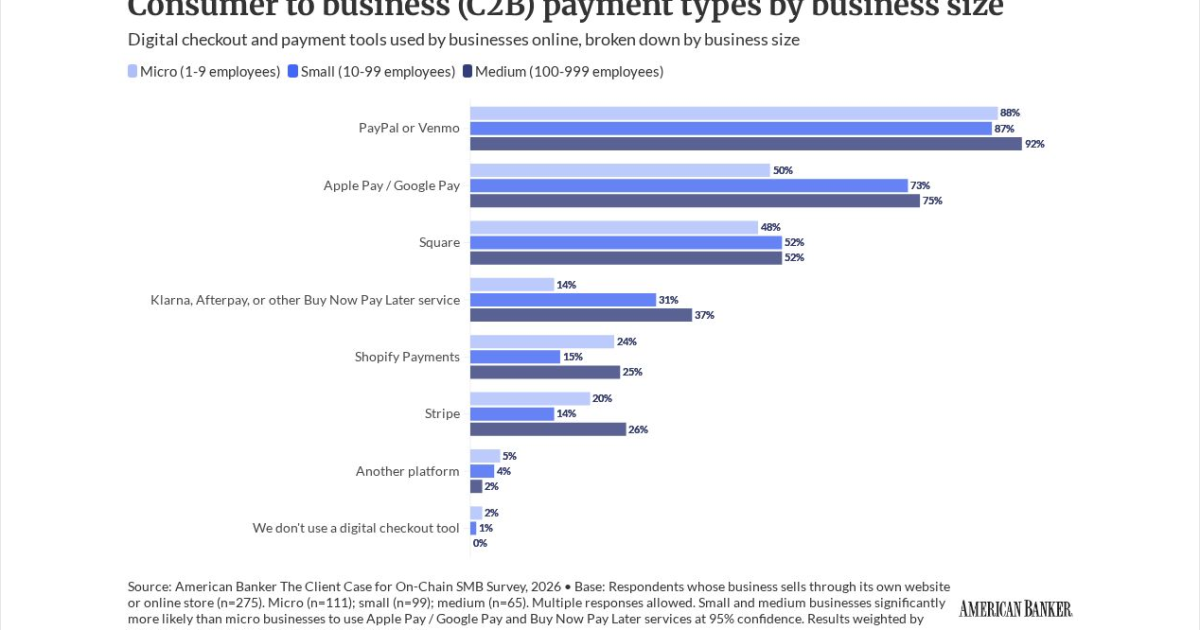
For SMBs selling online to customers (e.g., how consumers pay businesses), PayPal or Venmo are overwhelmingly the most widely adopted digital checkout options, followed by mobile wallets.
Digital wallets such as Apple Pay and Google Pay do not replace merchant acquiring infrastructure; rather, they operate directly on top of platforms like Stripe, Square, or Shopify Payments to route tokenized card credentials. Yet the overwhelming dominance of PayPal or Venmo (88%) and Apple Pay / Google Pay (58%) in the survey illustrates that SMBs prioritize removing mobile friction and preventing cart abandonment over how the transaction settles behind the scenes.
At the infrastructure level, the data also highlights a clear preference for turnkey, omnichannel convenience over developer-centric flexibility. Square leads dedicated processors with 49% adoption versus Stripe’s 18%, underscoring how non-technical merchants gravitate toward unified platforms that seamlessly bridge physical point-of-sale hardware with digital storefronts. Coupled with Shopify Payments at 22% and Buy Now, Pay Later options at 19%, the findings show that modern SMBs rely on a layered checkout stack: they anchor their business with an accessible processing platform and then switch on every high-trust wallet and financing option their customers expect to see.
When broken down by business size, PayPal and Venmo are nearly universally used by all SMB tiers. Core payment processors provide steady baseline utility—Square maintains consistent adoption regardless of headcount, while integrated platforms like Stripe and Shopify Payments see their highest concentration at the micro and medium ends of the spectrum. In contrast, consumer lending platforms, specifically BNPL services, demonstrate the clearest direct link to enterprise size, expanding from limited use among micro merchants into a mainstream checkout option for larger organizations.
How businesses get paid by other businesses
SMBs rely on an expansive mix of commercial rails, consumer-style apps and legacy settlement methods to carry out B2B payments. While digital channels lead overall, traditional paper checks and cash demonstrate stubborn staying power, virtually matching the adoption of P2P apps like PayPal and Venmo and outpacing dedicated invoicing software such as QuickBooks or Bill.com. Wire transfers capture a modest quarter share, and next-generation on-chain alternatives remain nascent. Broadly, the findings indicate that SMBs have not converged on a unified settlement standard, but rather operate omnichannel accounts-receivable workflows that accommodate whatever channel their buyers prefer. SMBs must balance changing payment habits with traditional banking infrastructure.
When broken down by business size, payment preferences begin to shift. While traditional paper checks demonstrate persistent, cross-tier endurance across all firm sizes, employee headcount directly influences the adoption of modern commercial rails. Micro businesses rely more on P2P consumer-facing apps and cash to settle invoices. Conversely, small and medium tiers tend to leverage formalized infrastructure more: these larger enterprises collect receivables via credit and virtual cards, dedicated invoicing platforms like QuickBooks and Bill.com, and core bank rails like ACH and wire transfers. Notably, wires jump as a settlement rail for mid-market businesses compared to micro businesses.
Meanwhile, emerging digital rails like cryptocurrencies and stablecoins remain in their infancy regardless of company scale. Scaling headcount and transaction volume compels businesses to graduate from ad-hoc consumer tools to integrated, automated accounts-receivable systems equipped to manage corporate treasury demands, likely because as their business and transaction volume scales, they are able to get better fee structures from traditional B2B payment providers.
Lastly, there is a pronounced gap between the payment options SMBs accept and the narrow set of channels customers actually rely on most to make purchases. While merchants maintain an expansive acceptance footprint, routinely supporting cash, online and in-person card payments, P2P apps and paper checks at high rates, customer volume concentrates heavily into traditional card rails, with online credit and debit cards standing out as the single most frequently used method. This dynamic exposes a notable disconnect for modern convenience tools: mobile contactless payments (like Apple Pay and Google Pay) and ACH bank transfers are widely enabled by businesses, yet only a small fraction of buyers utilize them as their primary checkout mechanism. Meanwhile, newer commercial financing and digital asset alternatives—including buy now, pay later, unpegged cryptocurrencies, and stablecoins—remain confined to single-digit acceptance and near-zero primary usage. In a broader industry context, the findings demonstrate that while SMBs cast a wide net to avoid checkout abandonment, consumer spending behavior remains firmly anchored to core card networks and established cash/P2P habits.
Lastly, there is a pronounced gap between the payment options SMBs accept and the channels customers use most to complete purchases. While merchants maintain an expansive acceptance footprint—routinely supporting cash, card payments, peer-to-peer (P2P) apps, and paper checks at high rates—actual customer volume concentrates heavily into traditional card rails, with online credit and debit cards standing out as the single most frequently used method. Crucially, the data reveals a divergence between technical infrastructure and merchant perception: mobile contactless payments (such as Apple Pay and Google Pay) and many P2P transfers are technically front-end digital wrappers underpinned by the very same credit and debit card networks, yet SMBs view and manage them as distinct payment mechanisms. Despite widespread merchant enablement across these separate touchpoints, convenience interfaces and ACH bank transfers capture only a small fraction of primary consumer checkout volume. Meanwhile, newer commercial financing and digital asset alternatives, including BNPL, unpegged cryptocurrencies, and stablecoins, remain confined to single-digit acceptance and near-zero primary usage. In a broader industry context, these findings demonstrate that while SMBs cast a wide net across perceived channels to prevent checkout abandonment, consumer spending behavior remains firmly anchored to foundational card networks, regardless of the front-facing format.
Looking forward
The fundamental challenge facing commercial banks is not that businesses are abandoning bank-held deposits, but that they have systematically decoupled daily payment execution from traditional banking channels. By embedding payments directly into point-of-sale environments, digital checkout dashboards and automated accounting workflows, fintechs and nonbanks have solved the practical operational frictions—from manual reconciliation and multi-step invoicing to fragmented buyer preferences—that conventional banking portals historically overlooked.
While credit cards remain the undisputed volume driver for customer checkouts and legacy settlement mechanisms like paper checks demonstrate stubborn endurance in B2B trade, the rapid migration toward turnkey software leaves banks at risk of being reduced to low-margin, invisible balance-sheet utilities.
Reclaiming relevance across the SMB sector will require financial institutions to move aggressively beyond passive account custody by modernizing core infrastructure with bi-directional instant settlement rails (RTP and FedNow) and context-rich ISO 20022 messaging. As real-time liquidity, automated reconciliation and fee optimization continue to dictate merchant loyalty, the institutions that survive will be those that integrate directly into the software environments where small and midsize businesses actually operate.