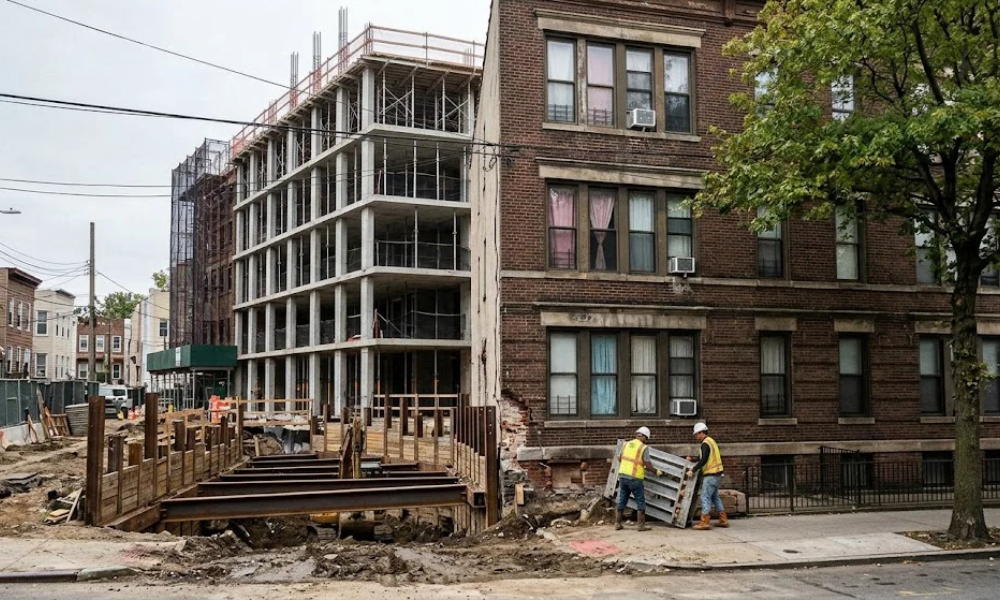
U.S. Bank alleges Brooklyn construction wrecked its mortgage collateral
U.S. Bank alleges it was required – both under the terms of its mortgage and under New York law – to pay for those emergency repairs to protect the value of its collateral. The filing says the bank “has incurred, and will continue to incur, substantial costs to shore and remediate the Property.”
The suit does not disclose the loan balance, the total spent on emergency repairs, or the current condition of the borrower’s account. What it does lay out is a lender alleging it was forced to open its checkbook because a third party’s construction project damaged the property securing its loan.
The filing brings six claims – two sets of three, mirrored against each defendant. Against Cedar Tower, the alleged project owner: strict liability under the New York City Building Code, negligence, and private nuisance. Against City Builders, the alleged general contractor: the same three.
The strict liability claims rest on the Building Code, which the filing says requires both project owners and contractors to protect neighboring properties from construction damage. Under that rule, the responsibility cannot be handed off to a subcontractor or anyone else – the filing describes it as a “non-delegable duty.” In plain terms, if the building next door gets damaged during construction, both the owner and the general contractor can be held responsible regardless of who did the actual work.
On negligence, the filing alleges Cedar Tower failed to put adequate protective measures in place, failed to supervise construction near the property, and allowed work to proceed “in a manner that foreseeably resulted in structural damage.” City Builders faces similar allegations, with the added claim that it failed to prevent “foreseeable structural movement or instability” during construction.