Amgen vs. Vertex Pharmaceuticals: Massive Pharmaceutical Scale vs. Steady Drug Revenue
Amgen: Steady Growth With Moderate Quarter-Over-Quarter Fluctuations
Amgen Inc. (AMGN +0.40%) primarily generates revenue by discovering, developing, and manufacturing therapeutic medicines for oncology and cardiovascular diseases.
It secured Food and Drug Administration (FDA) approval for an IMDELLTRA label update, and the Federal Trade Commission filed an amicus brief in a lawsuit concerning its Enbrel patents.
Vertex Pharmaceuticals: Maintaining Consistent and Gradual Revenue Growth
Vertex Pharmaceuticals (VRTX +0.03%) primarily generates revenue by discovering and marketing innovative treatments for patients with cystic fibrosis.
It finalized the acquisition of Crinetics Pharmaceuticals, while the FDA expanded the approved use of its Casgevy treatment to include patients as young as two years old.
Why Revenue Matters for Investors
Revenue here refers to the data provider’s standardized income-statement revenue line item, which helps investors track the total sales a business generates before operating expenses are deducted.

Quarterly Revenue for Amgen and Vertex Pharmaceuticals
| Calendar quarter | Amgen Revenue | Vertex Pharmaceuticals Revenue |
|---|---|---|
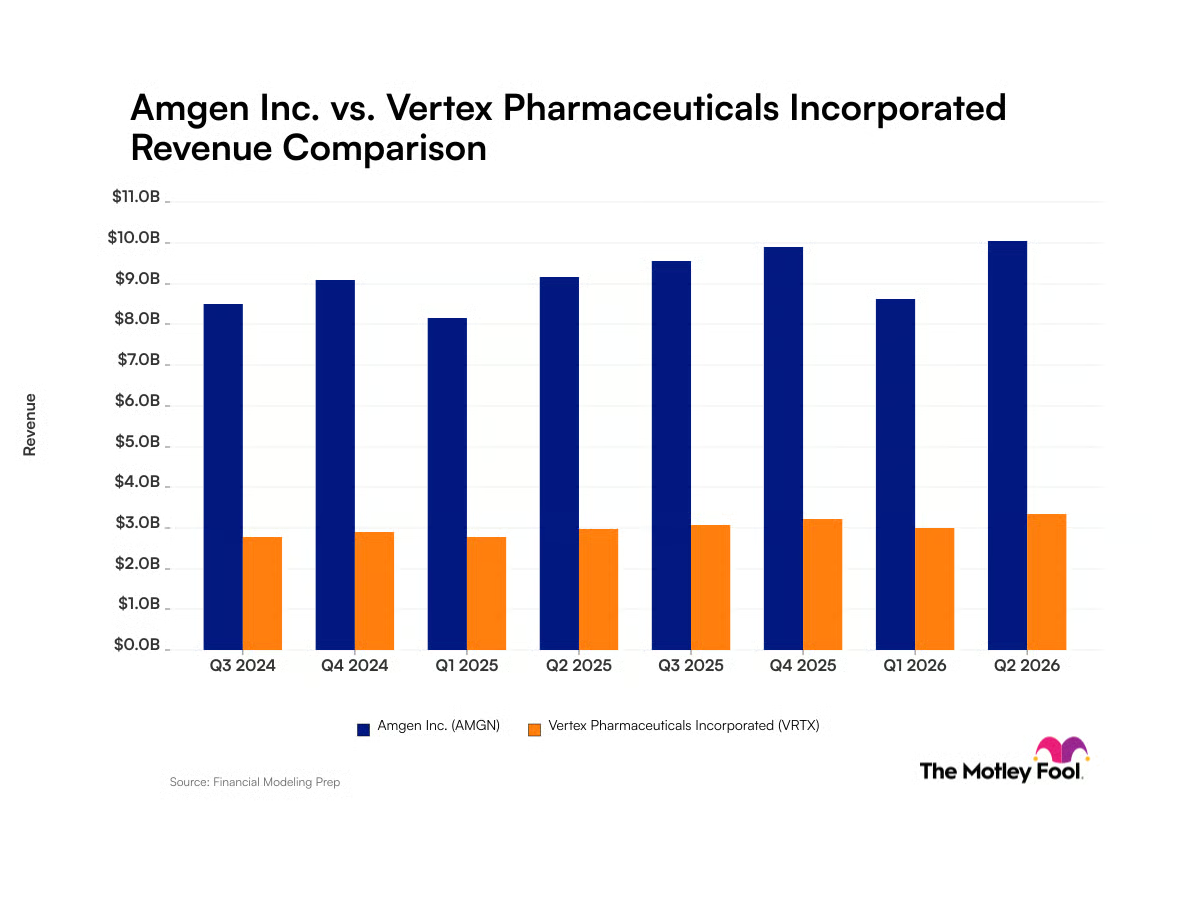
| Q3 2024 | $8.5 billion (quarter ended Sept. 30, 2024) | $2.8 billion (quarter ended Sept. 30, 2024) |
| Q4 2024 | $9.1 billion (quarter ended Dec. 31, 2024) | $2.9 billion (quarter ended Dec. 31, 2024) |
| Q1 2025 | $8.1 billion (quarter ended March 31, 2025) | $2.8 billion (quarter ended March 31, 2025) |
| Q2 2025 | $9.2 billion (quarter ended June 30, 2025) | $3.0 billion (quarter ended June 30, 2025) |
| Q3 2025 | $9.6 billion (quarter ended Sept. 30, 2025) | $3.1 billion (quarter ended Sept. 30, 2025) |
| Q4 2025 | $9.9 billion (quarter ended Dec. 31, 2025) | $3.2 billion (quarter ended Dec. 31, 2025) |
| Q1 2026 | $8.6 billion (quarter ended March 31, 2026) | $3.0 billion (quarter ended March 31, 2026) |
| Q2 2026 | $10.1 billion (quarter ended June 30, 2026) | $3.3 billion (quarter ended June 30, 2026) |
Foolish Take
The first thing to note when examining a company’s revenue trend is seasonality: some times of the year have stronger buying patterns than others. That is evident in both companies’ revenue bars in the chart, which may be surprising for pharmaceutical stocks. But the fourth quarter (in calendar years, which coincides with the fiscal years of each business here) tends to be the best for healthcare companies because consumers tend to load up on prescriptions and supplies after fulfilling their health insurance deductible before it resets in the first quarter. For most stocks, compare revenue year over year by quarter.
For fiscal 2026, Vertex Pharma sales should rise about 10% to $13.3 billion, with net income coming in roughly even with 2025.
The company continues to benefit from its focus on cystic fibrosis (CF). Its recently launched Alyftrek, a once-daily, next-in-class, triple-combination CF regimen, is seen encouragingly by investors. Alyftrek marks a notable improvement to the twice-daily dosage of Vertex’s other CF products and was approved in Australia, New Zealand, Switzerland, the European Union, the U.K., and Canada over the course of 2025, after the U.S. approved it in 2024. Plenty more jurisdictions are evaluating the treatment today. In the U.S., label extensions (the expansion of FDA approval for use) mean Vertex can treat 95% of people with cystic fibrosis in the country today.
Vertex has expanded into treating other conditions. Povetacicept, an investigational recombinant fusion protein therapeutic, continues to show best-in-class potential as a treatment for three chronic autoimmune diseases: IgA nephropathy (IgAN), primary membranous nephropathy (pMN), and generalized myasthenia gravis (gMG). The FDA has granted its Breakthrough Therapy Designation for IgAN, with potential approval by Nov. 30 this year, as well as Fast Track Designation for pMN. If approved across the IgAN, pMN, and gMG indications, peak annual sales could reach $4 billion to $7 billion, according to equity analyst firm Argus.
As the chart shows, Amgen is not a fast-growing company by sales, but, given its scale, it should be able to achieve a roughly 3% revenue increase in 2026, to around $37.8 billion.
But sizable sales, even slow-growing ones, have their benefits. For one, its billions in net income could enable Amgen to pursue future growth by acquiring other drugmakers. The business also has six drug franchises that generate $1 billion-plus in annual revenue. There is real value there.
Late last year, Amgen became one of nine companies to reach a deal with the U.S. government to lower drug prices (Bristol Myers Squibb (BMY -0.56%), Merck & Co. (MRK +0.85%), and Gilead Sciences Inc. (GILD -0.23%) are also among the companies that signed a deal). Based on this agreement, Amgen will be exempt from Trump’s pharmaceutical tariffs for three years, a positive, in exchange for the company reducing prices on its key migraine drug Aimovig and rheumatoid arthritis medicine Amjevita by about 60% and 80%, respectively, in a direct-to-consumer platform launched this month.
Data source: Financial Modeling Prep. Data as of Sept. 25, 2026.