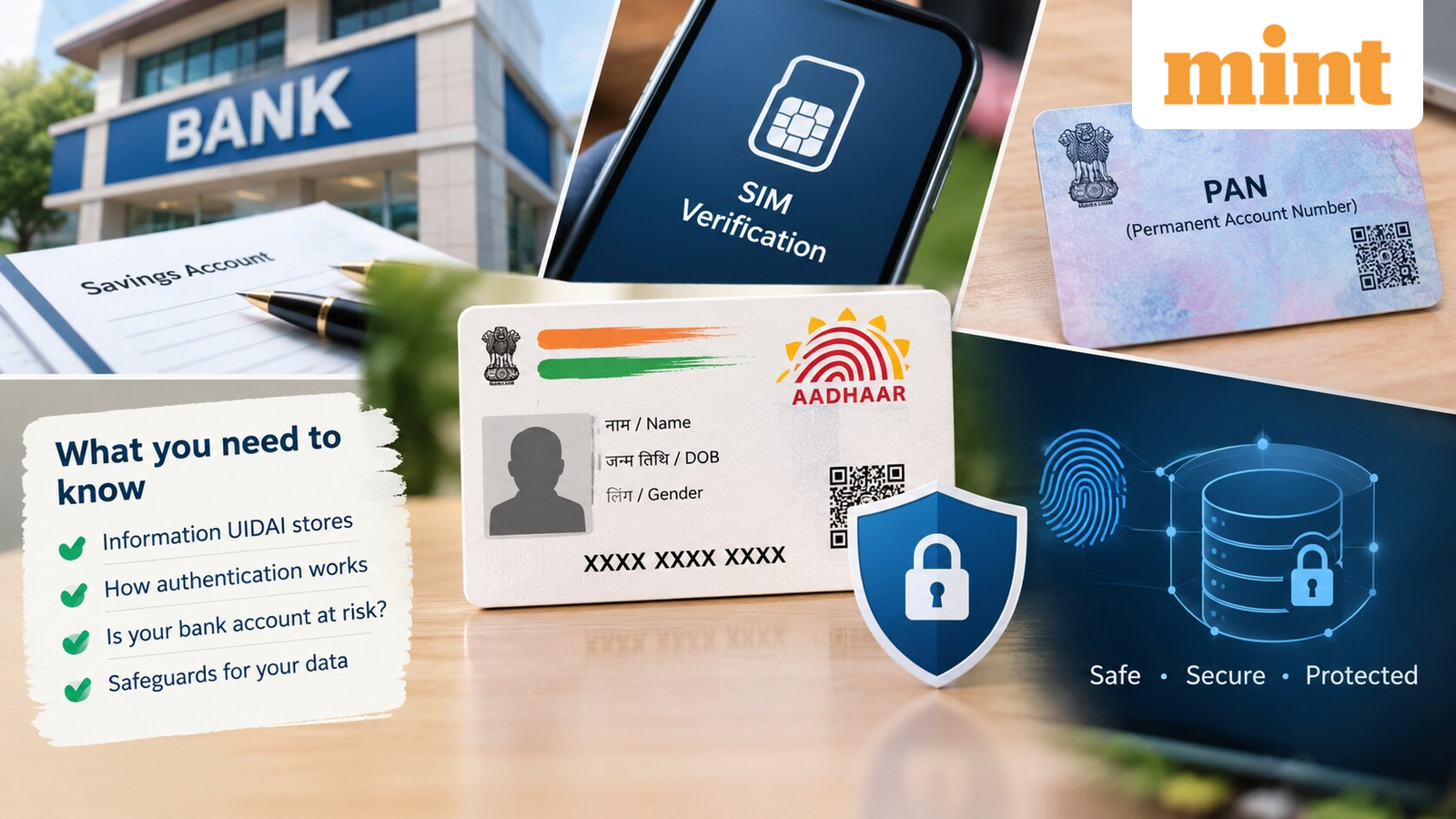
Aadhaar linked to your bank, demat account and SIM? Here’s what UIDAI knows about you | Key facts about data security
Aadhaar is used for several purposes, from opening bank accounts and completing KYC to obtaining mobile connections and linking PAN. But does sharing your Aadhaar number put your personal and financial information at risk?
In its Aadhaar Mythbusters, UIDAI clarifies common misconceptions about privacy, security, banking, SIM linking, and data protection. Here is what Aadhaar holders need to know.
Can UIDAI track your personal and financial data?
No. According to UIDAI, its database contains only limited information provided during Aadhaar enrolment or updates. These include basic demographic information such as name, gender, and date of birth (DOB), as well as biometric identifiers such as fingerprints, iris scans, and the photograph taken during enrolment. Providing a mobile number or email address is optional.
UIDAI does not have information about your bank accounts, shares, mutual funds, property, health records, insurance, family, caste, religion, education, etc.
Section 32(3) of the Aadhaar Act, 2016, also restricts UIDAI from collecting, retaining, or maintaining information about the purpose for which an individual’s identity is authenticated.
What information does UIDAI receive when you link Aadhaar to your bank account?
When you use your Aadhaar card for authentication with a bank, broker, mutual fund company, or mobile service provider, the requesting entity sends your Aadhaar number along with the required authentication data, such as encrypted biometrics or an OTP. Demographic details such as name and DOB may also be used, depending on the authentication process.
UIDAI responds to authentication requests with a ‘Yes’ or ‘No’. If an entity requests e-KYC and authentication is successful, UIDAI can share your basic KYC details, such as your name, address, and photograph, with that entity.
However, UIDAI does not receive your bank account details, demat account, investments or insurance information through this process.
Can someone hack your bank account using only your Aadhaar number?
No. UIDAI clarifies that knowing someone’s Aadhaar number alone is not enough to access their bank account and withdraw money. The number by itself cannot be used to access banking or other services.
However, you should never share your bank PINs or OTPs with anyone. Protecting these credentials is essential to safeguarding your account.
Can banks and mobile companies store your Aadhaar biometrics?
No. According to UIDAI, banks, mobile phone companies, and other requesting entities cannot store, share, or publish your fingerprints collected during Aadhaar authentication.
When you use fingerprint authentication for Aadhaar verification, your biometric data is encrypted and sent to UIDAI for verification. Regulation 17(1)(a) of the Aadhaar (Authentication) Regulations, 2016, prohibits requesting entities from retaining copies of these fingerprints.
Can the Aadhaar database be breached?
UIDAI states that Aadhaar holders’ data is securely stored in its Central Identities Data Repository (CIDR). The authority states that the Aadhaar database in CIDR has never been breached during all these years of its existence. UIDAI uses advanced security technologies to protect the data and regularly upgrades them to address emerging security threats and challenges.
Disclaimer: This article is for informational purposes only. Please visit the official UIDAI website for the latest updates.