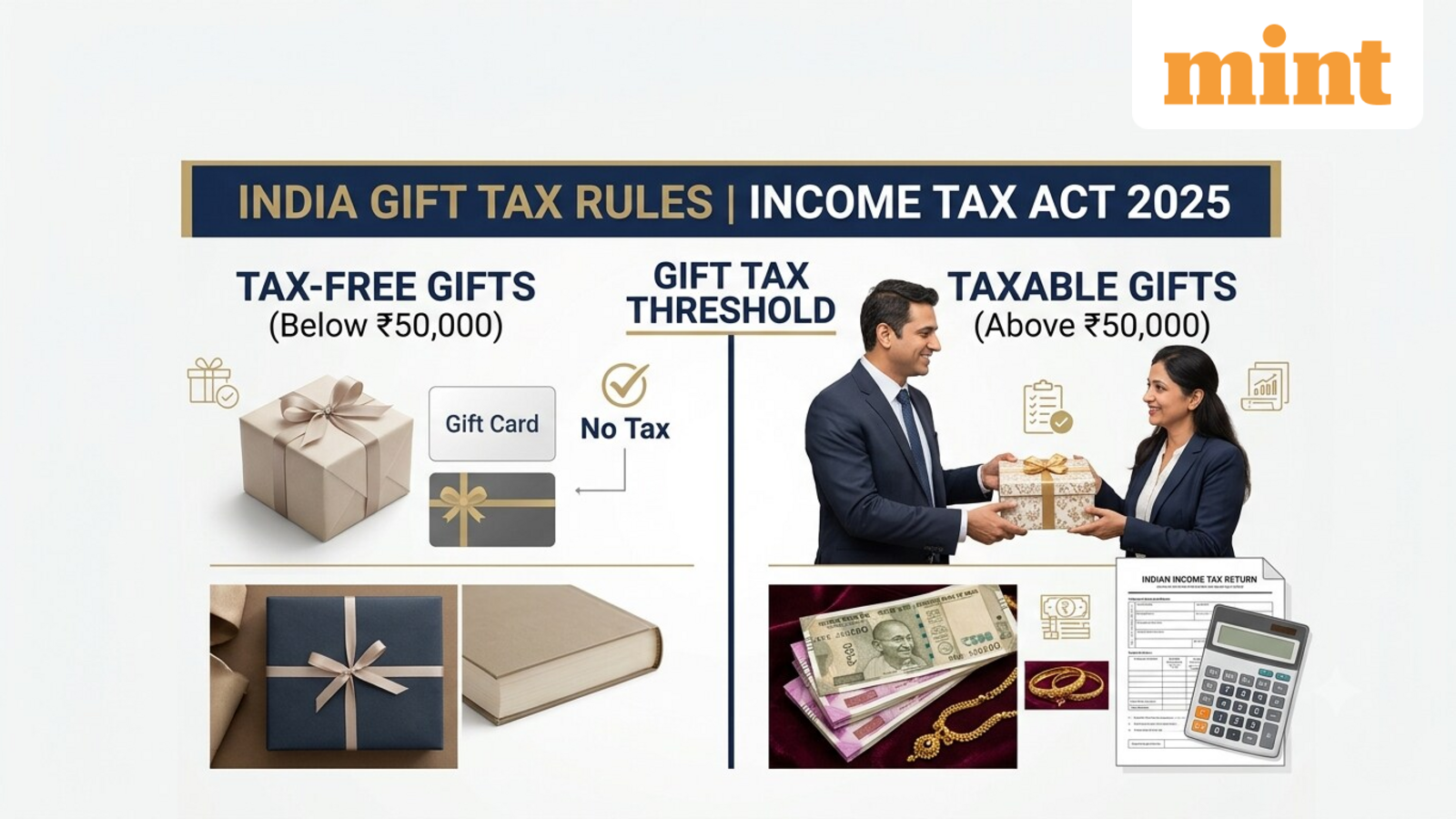
Key income tax rules explained: Gifts above ₹50,000 in a year: When is the full amount taxable? Marriage exemptions
Did you receive cash, jewellery, or other gifts from friends or relatives? While some gifts are tax-free, others may be taxable depending on their value, who gave them, and the occasion.
The FAQs on gifts received by an individual or Hindu Undivided Family (HUF) under the Income-Tax Act, 2025, explain when gifts are exempt and when they attract tax.
Which gifts are tax-free under the Income Tax Act, 2025?
Gifts received from specified relatives are exempt from tax, irrespective of their value. These include:
- Spouse: Husband or wife.
- Siblings: Your brother or sister.
- Spouse’s siblings: Your spouse’s brother or sister.
- Parents’ siblings: Your maternal or paternal uncle or aunt.
- Your direct ancestors and descendants: Parents, grandparents, children and grandchildren, on both your maternal and paternal sides.
- Your spouse’s direct ancestors and descendants: Your spouse’s parents, grandparents, children and grandchildren.
Other exempt categories include gifts received through a will or inheritance, gifts received in contemplation of the donor’s death, and certain receipts from specified authorities and registered non-profit organisations.
If you receive cash gifts worth more than ₹50,000 in a year, the entire amount is taxable if the gifts are received without consideration and are not from specified relatives. Gifts can be received in cash, by cheque, bank draft or other modes.
For example, if you receive ₹1 lakh from your father, the gift is tax-free, irrespective of the amount. However, if you receive ₹30,000 from one friend and ₹25,000 from another during the year, the entire ₹55,000 is taxable, as the total exceeds ₹50,000 and no exemption applies.
How do gifts above ₹50,000 become taxable?
If the total value of monetary gifts during a financial year (tax year) exceeds ₹50,000, the entire amount becomes taxable, not just the portion above ₹50,000.
For example, if you receive ₹30,000 from one friend and ₹25,000 from another during the same year, your total monetary gifts amount to ₹55,000. Since friends are not included in the specified list of relatives and the total amount exceeds ₹50,000, the entire ₹55,000 is taxable, provided no exemption applies.
However, if your total monetary gifts are exactly ₹50,000, they do not become taxable under this threshold rule. The same rule applies to monetary gifts received from abroad. Gifts are not automatically tax-free simply because they come from outside India.
The entire amount will be added to your taxable income and taxed at the applicable income tax slab rates.
Which gifts are exempt from the ₹50,000 threshold?
Gifts received on the occasion of an individual’s marriage are tax-free, irrespective of the amount or whether they are received in cash, jewellery, or property.
This exemption applies even if the gifts are received from friends or people who do not fall under the specified category of relatives.
Are birthday and anniversary gifts taxable?
Gifts received on birthdays, anniversaries, and other occasions are not automatically exempt from tax. Unlike marriage gifts, they do not qualify for a general occasion-based exemption.
For instance, if you receive ₹60,000 from friends on your birthday, the entire amount will be taxable under the gift rules.
Are jewellery and property received as a gift taxable?
Yes, jewellery received without consideration can be taxable if it is not received from specified relatives. If the aggregate fair market value of movable properties, including jewellery, received during the year exceeds ₹50,000, the entire value of such properties will be taxable.
For example, if you receive jewellery worth ₹84,000 as gifts from friends during the year, the full ₹84,000 will be taxable.
Disclaimer: This is for informational purposes only. Consult a qualified tax professional for advice specific to your circumstances.