Why California’s Most Valuable Coast Is So Hard To Abandon
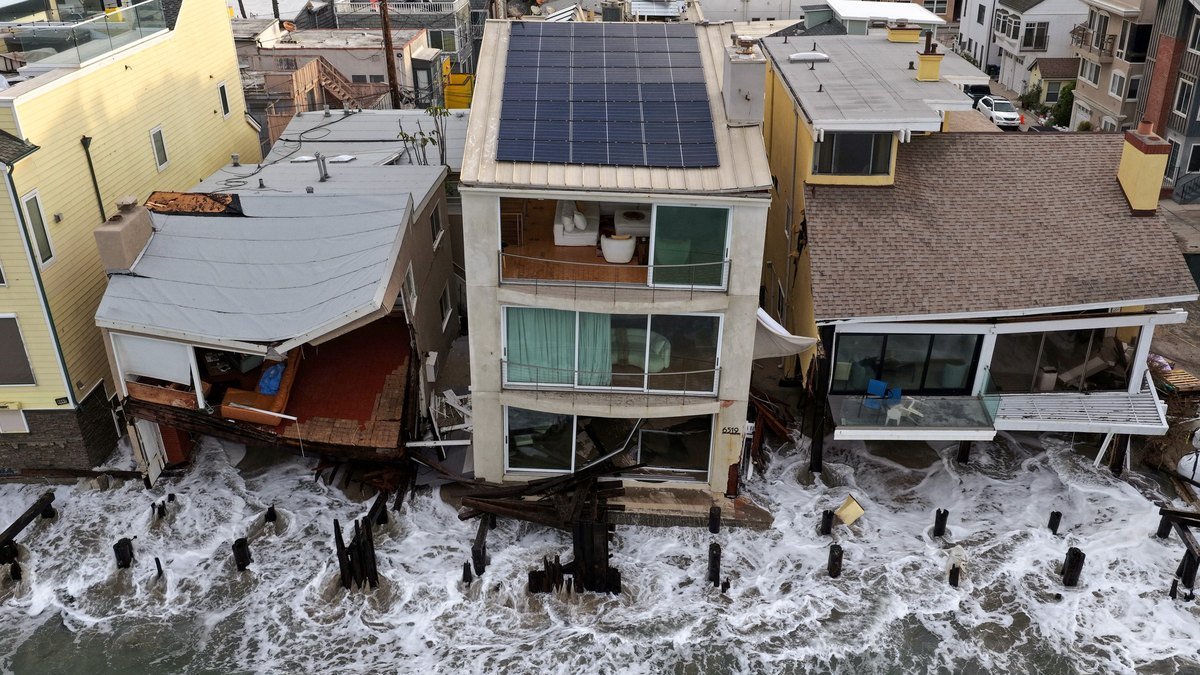
The listing for 6519 E. Seaside Walk in Long Beach, CA, still reads, in places, like an advertisement for California beachfront luxury.
The 4,880-square-foot home has four bedrooms, six bathrooms, panoramic ocean and bay views, a wine cellar, sauna, and elevator.
It hit the market in late August for $4.95 million—then the beach in front of it gave way.
Weeks after powerful surf battered the Long Beach Peninsula, 13 residences were red-tagged as unsafe, including Seaside Walk. By mid-October, the home’s asking price had fallen to $2.9 million—a $2.05 million price cut.
And now, the once idyllic listing opens with a very different sales pitch: “Property has been RED TAGGED and is LAND VALUE.”
It may be an extreme example of a problem California now expects to confront on a much larger scale.
Without intervention, 24% to 75% of the state’s beaches could disappear seasonally or permanently by 2100 as seas rise, according to models cited in California’s newly released Fifth Climate Change Assessment. It warns that “highly developed areas of Southern California [face] especially severe losses.”
The shoreline is retreating into a much more expensive housing market
A beach is sediment in motion: Waves and currents pick up and deposit sand, continually erasing and redrawing the shoreline.
Andy Carter, the listing agent for Seaside Walk, has worked in Southern California real estate for more than 20 years and is a third-generation Long Beach resident. He says erosion had worsened gradually for years—but what has happened this fall is different.
“The entire front of the house is basically slowly cracking off and falling into the Pacific,” Carter tells Realtor.com®.
Damage began with Hurricane Marie in September, worsened with Hurricane Polo, and continued in October as Tropical Storm Rachel sent another southerly swell toward the coast. Each round of surf carried away more sand, narrowing the beach that normally absorbs some of the waves’ energy before it reaches the homes behind it.
It’s the heartbreaking example of a process that is playing out en masse in coastal markets across the country.
“Erosion can often be seen as a terrible thing for buyers and homeowners, but it’s a critical part of maintaining a healthy coastal ecosystem,” Bryan McCormack, a coastal processes specialist with WHOI Sea Grant and Cape Cod Cooperative Extension, told Realtor.com in July.
U.S. Geological Survey exposure data shows how much existing property intersects modeled shoreline-change hazards—the areas where the shoreline is projected to move inland as rising seas and erosion reshape the coast.
At 1 meter, or about 3.3 feet, of sea-level rise, roughly $6.6 billion in combined land and improvement parcel value falls within those zones. At 3 meters, or about 9.8 feet, the figure grows to nearly $24.7 billion.
But those dollar figures use a 2020 reference year and parcel values—not current market prices. Since then, values have skyrocketed.
“Home sale prices have risen about 39% on average in these counties since 2020, so the actual value of exposed property is likely higher than the 2020-based assessments,” explains Hannah Jones, senior economist at Realtor.com.
But Jones cautions against simply applying those gains to the USGS total.
“Prop 13 caps assessment growth at 2% a year until a sale, so long-held coastal parcels can be assessed well below market,” she says. “The net effect is hard to read from county-level data, because at-risk properties could see flat or falling values while the county median rises.”
The surrounding markets have nevertheless become far more expensive. Orange County’s median sale price rose 61% from about $783,000 in 2020 to $1.26 million in the first seven months of 2026. San Diego County rose 53%, Los Angeles County 41%, and Santa Barbara County 83%.
The luxury end has moved even higher. Homes at the 95th percentile now begin around $4.3 million in Orange County, $4.1 million in Los Angeles County, $3.2 million in San Diego County, and $5.3 million in Santa Barbara County.
And across California’s 15 coastal counties, six now have median sale prices above $1 million and 10 have luxury thresholds above $3 million.
Who pays to hold the shoreline in place?
But there’s an important qualifier in the assessment’s projection that 24% to 75% of California’s beaches could disappear: without intervention.
Coastal communities around the country regularly take action to help preserve their shorelines. That can take the form of adding sand, restoring dunes and other natural buffers, building seawalls or rock revetments, or relocating development away from the advancing shoreline.
The initiatives can be expensive, but with billions of dollars of property exposed, there is a powerful incentive to act before the waves hit homes—and Long Beach has been doing so for years.
A California Coastal Commission report found that harbor construction, river dams, flood-control structures, and marina jetties had “essentially eliminated all sources of natural sand supply” to the eastern Peninsula. With less sand arriving naturally, the city spends roughly $1 million to $1.5 million a year moving it back.
This fall, though, those efforts weren’t enough. The recent damage has added more than $1 million in emergency public costs, and the city is now moving forward with a larger $11.4 million dredging and beach-nourishment project.
Carter argues it came too late.
“I feel it could have been prevented because every homeowner down there has been, you know, screaming about this for a very long time,” he says.
But the state’s assessment also points to a problem with some forms of intervention: Protecting the development can come at the expense of the beach.
“All of the sediment that gets eroded goes to feeding downdrift beaches and coastal habitats,” McCormack explains. “When the shoreline is armored, we interrupt this natural process, often leading to sediment-starved beaches and significant adverse impacts to the natural system.”
While a seawall or rock revetment may hold the landward edge in place, as sea level rises, the ocean keeps advancing, eventually trapping the beach between the water and fixed development—a process the assessment calls “coastal squeeze.” It warns that hard armoring can “prevent beaches from migrating inland, leading to beach loss and decreased biodiversity.”
That trade-off is already visible at scale in the Golden State. About 14% of California’s roughly 1,100-mile shoreline was armored as of 2018, according to the Surfrider Foundation, including more than a third of Southern California’s coast.
Hard to defend, harder to leave
And erosion is only one way rising seas threaten coastal property. The state’s assessment projects average sea-level rise of about 3.1 feet under its intermediate scenario to 6.6 feet under its high scenario by 2100.
With 3.3 feet of sea-level rise, coastal flooding alone could expose about 201,000 people and $78 billion in property, even without a storm. Rising groundwater could reach farther still, exposing 1.9 million coastal residents and $480 billion in property.
They are less visible risks than waves washing away a home’s foundation, but they can begin eroding its value well before it is red-tagged. In coastal Florida, sales volumes in the most exposed communities fell 16% to 20% relative to less-exposed areas before prices fully adjusted.
Yet Carter says interest in Seaside Walk is still there.
“I’m getting a ton of phone calls from builders,” he says.
Carter estimates comparable oceanfront lots along the damaged stretch remain worth roughly $2.5 million. Some developers are interested in assembling neighboring parcels and eventually replacing the damaged homes with new luxury construction.
They’re making a different calculation than the typical buyer: not that the hazard will disappear, but that oceanfront land may remain valuable enough to justify the risk—especially if the beach in front of it continues to be defended.
“Once they finally build out the beach,” Carter says, “those home values are going to go up significantly.”
It’s a perfect encapsulation of the bind facing California’s most expensive coastal communities. The more valuable the land remains, the stronger the incentive to protect it. And the more successfully the shoreline is protected, the longer that value—and the pressure to keep defending it—can persist.