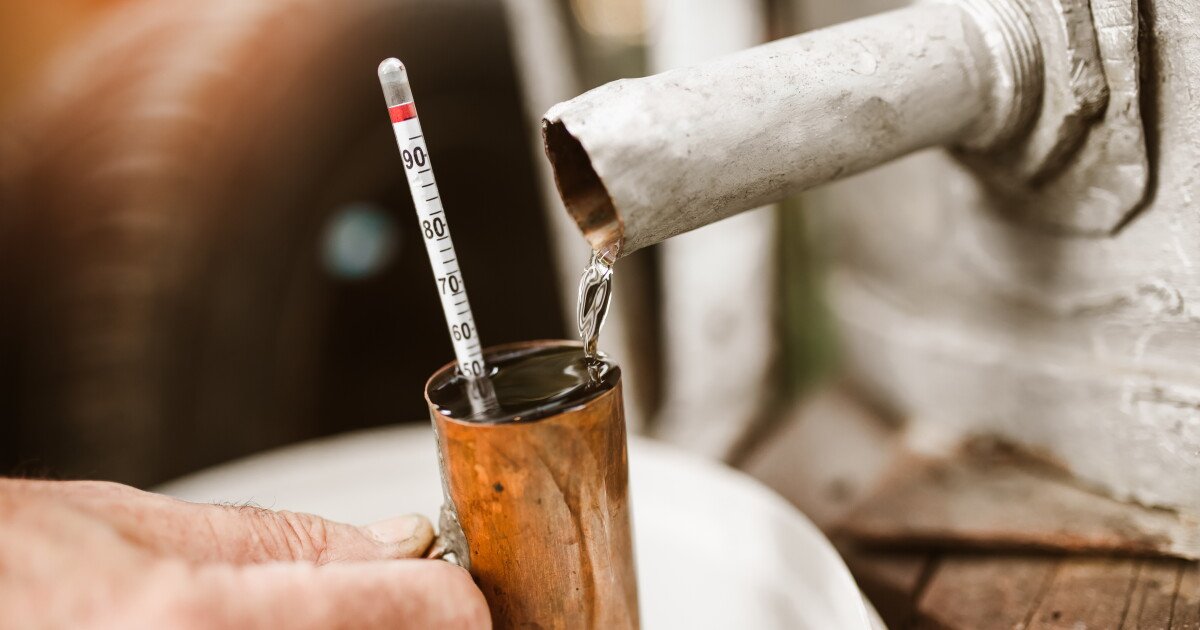
Supreme Court to hear case involving home distilleries, distilled spirit taxes

- Key insight: See why the Supreme Court is reviewing an 1868 home distilling ban.
- What’s at stake: Whether hobby distillers or the government lose authority over home-based spirits.
- Expert quote: “There is still a lot of work ahead…” — Rick Morris, Hobby Distillers Association
The Supreme Court has agreed to review a case involving an 1868 law that imposed taxes on distilled spirits while also banning home distilleries that produce whisky, bourbon and other spirits.
Processing Content
The case, Department of Justice v. McNutt, involves whether the prohibition on the production of distilled spirits in particular locations, including “in any dwelling house” or “in any shed, yard, or inclosure connected with any dwelling house,”
The case involves a distiller named Scott McNutt, who is a member of the Hobby Distillers Association. He received a letter from the Alcohol and Tobacco Tax and Trade Bureau, saying it learned that he had purchased a still or other equipment capable of producing alcohol and warning him that unlawful production of distilled spirits is a criminal offense. A district court held that the location restrictions are not a necessary and proper means of collecting the federal excise tax on distilled spirits, reasoning that the restrictions “criminalize conduct of persons not subject to the tax” and do not “touch the product to be taxed.” The court also held that the location restrictions exceed Congress’s commerce power and therefore enjoined the government from enforcing the location restrictions against McNutt, the association and the association’s members.
A federal appeals court later reversed the district court’s partial dismissal, but otherwise affirmed the injunction. The court concluded that each of the individual respondents had standing based on the government’s history of enforcing the location restrictions, including against McNutt and held that the location restrictions are not “plainly adapted” to support the government’s taxing power because they “reduce revenue by preventing individuals from making distilled spirits” that could otherwise be taxed. The court also hypothesized that upholding the location restrictions would allow Congress to “criminalize nearly any at-home conduct only because it has the possibility of concealing taxable activity.”
The Department of Justice and the Alcohol and Tobacco Tax and Trade Bureau took the case to the Supreme Court, arguing that the high court should review the case. “Despite Section 5178’s venerable history and commonsense rationale, the Fifth Circuit held that its location restrictions are unconstitutional, reasoning that they reduce otherwise-taxable conduct and therefore are not necessary and proper in carrying out Congress’s taxing power,” said the
“That is the case here,” the government petition argued. “Congress restricted home distilling because a distiller can more easily conceal a distilling operation or thwart necessary inspections — thereby evading the requisite tax — if the still is located in a dwelling-house or connected structure. The court of appeals held otherwise by focusing only on those who would decline to comply with the location restrictions. But the proper focus is instead on whether adherence to the restrictions promotes tax collection, and it does so here by channeling taxable conduct into locations where tax evasion is more difficult. Under McCulloch and its progeny, courts may not second-guess Congress’s reasonable judgment that the increased ability to collect taxes from those complying with the restrictions would offset any reduction in the tax base from others who would forgo distilling altogether. And because the location restrictions were enacted only after lengthy experience with tax evasion, upholding those restrictions would not open the door to hypothetical laws restricting other conduct lacking that history.”
The Hobby Distillers Association welcomed the Supreme Court’s granting of certiorari Monday to hear the case this term. “We have been waiting for this announcement, and now we know that our case will go before the highest court in the country,” said the association’s president, Rick Morris, on
Introductory bullet points created by AI with editorial review.