8th Pay Commission: How higher basic pay could boost your earnings over 20 years – Expert explains
The 8th Pay Commission is holding the second day of its consultations in Mumbai. The meeting began on 22 October and concludes today, 23 October 2026. It follows the commission’s 8 October meeting in Bengaluru.
The commission was constituted on 3 November 2025, so it completes one year in less than two weeks. Central government employees, unions and pensioners are still waiting for clarity on revised salaries and allowances.
Over the past few months, major unions have put their grievances and proposals before the panel on the fitment factor, basic pay, allowances, pension reforms, leave encashment and employee morale. One key issue under discussion is the proposed revision of basic pay, which affects not just monthly earnings but also increments, allowances and retirement benefits over a career. Here is how that single figure could shape an employee’s earnings over a 20-year government career.
What is basic pay?
Basic pay is the core component of a government employee’s salary and excludes allowances and other benefits. It is the base on which components such as dearness allowance (DA) and house rent allowance (HRA) are calculated, subject to the applicable rules.
What are employee unions proposing?
Prominent employee unions and associations, such as the National Council-Joint Consultative Machinery (NC-JCM), Staff Side, have put forward a minimum basic pay proposal of ₹69,000 before the 8th Pay Commission panel, along with a fitment factor multiplier of 3.833.
The Bharatiya Pratiraksha Mazdoor Sangh (BPMS) has put forward a minimum basic pay proposal of ₹72,000 and a fitment factor of 4, due to rapidly rising inflation. Both the unions have also requested an increase in annual increments from 3% to 6%. The main objective behind these proposals is to equip serving employees to combat inflation effectively. Currently, these remain demands only, not approved pay revisions.
How can a higher basic pay affect earnings over a 20-year career?
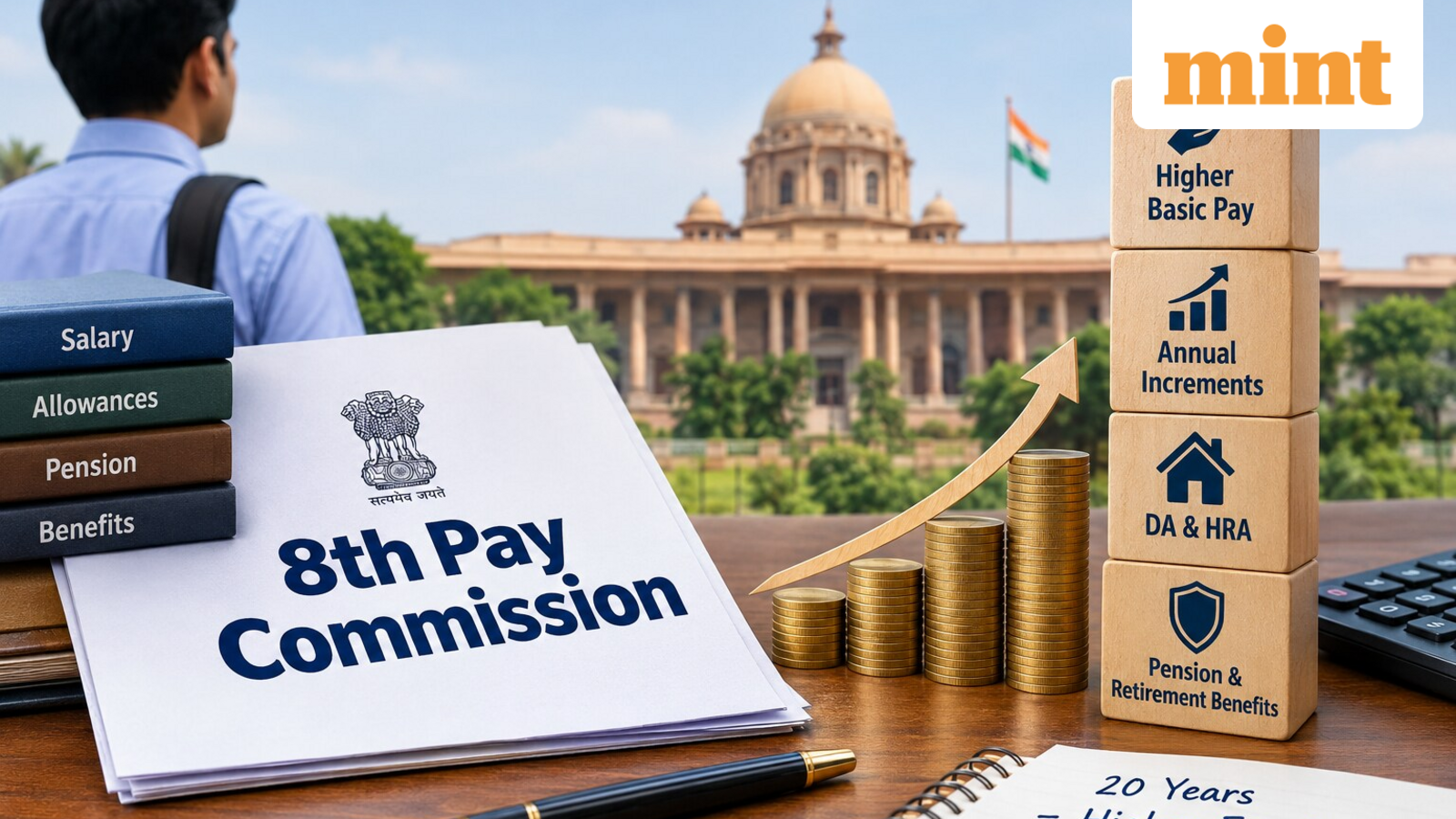
Adhil Shetty, CEO, BankBazaar, explained this in detail, stating, “A higher basic salary has a compounding effect over the course of a career. Under the 7th Pay Commission, annual increments are 3% of basic pay, so a higher starting base translates into larger increments every year.”
He further added, “Allowances such as DA and HRA are also linked to basic pay, which lifts overall earnings. Over 20 years, this gap widens significantly. A higher revised basic would also raise retirement benefits such as pension, gratuity and leave encashment, which are calculated on last drawn basic pay.”
What should central government employees and unions expect?
Therefore, as things stand today, the 3-member 8th Pay Commission panel, headed by Justice Ranjana Prakash Desai, is in its consultative and discussion phase. Its other members are Professor Pulak Ghosh and Member-Secretary Pankaj Jain. The final report of the 8th Pay Commission is tentatively due 18 months after its constitution, pointing to a deadline around May-June 2027, rather than a confirmed submission date of May-June.
Until the commission submits its recommendations and the government decides on them, employees should treat all union demands as proposals. Verified updates are available on the 8th Pay Commission website: https://8cpc.gov.in/