Intel vs. Qualcomm: A Widening Gap in Revenue
Intel: A Notable Increase in Quarterly Revenue
Intel Corp. (INTC -8.05%) primarily generates revenue by designing, developing, manufacturing, and marketing a broad array of central processing units, discrete graphics hardware, and advanced semiconductor components that serve diverse original equipment manufacturers, enterprise cloud service providers, and general consumer markets globally.
It recently closed an upsized $20 billion public offering of common stock, and it simultaneously initiated a new round of targeted workforce reductions within its data center and artificial intelligence operational groups.
Qualcomm: Experiencing Fluctuating and Declining Revenue Patterns
Qualcomm Inc. (QCOM -2.88%) earns most of its revenue by creating essential integrated circuits for modern mobile communication devices and by licensing an extensive global portfolio of fundamental wireless technology patent rights to diverse hardware manufacturers operating across international markets.
It recently completed the strategic acquisition of a specialized software platform called Modular, and it subsequently announced detailed plans for upcoming global workforce reductions to align its organizational structure with a changing corporate strategy.
Why Revenue Matters for Investors
Revenue here refers to the data provider’s standardized income-statement revenue line item, which plainly shows investors the exact total amount of financial capital a business generates from its primary day-to-day commercial operations before any operating expenses, internal overhead costs, or corporate taxes are deducted from the final recorded total.
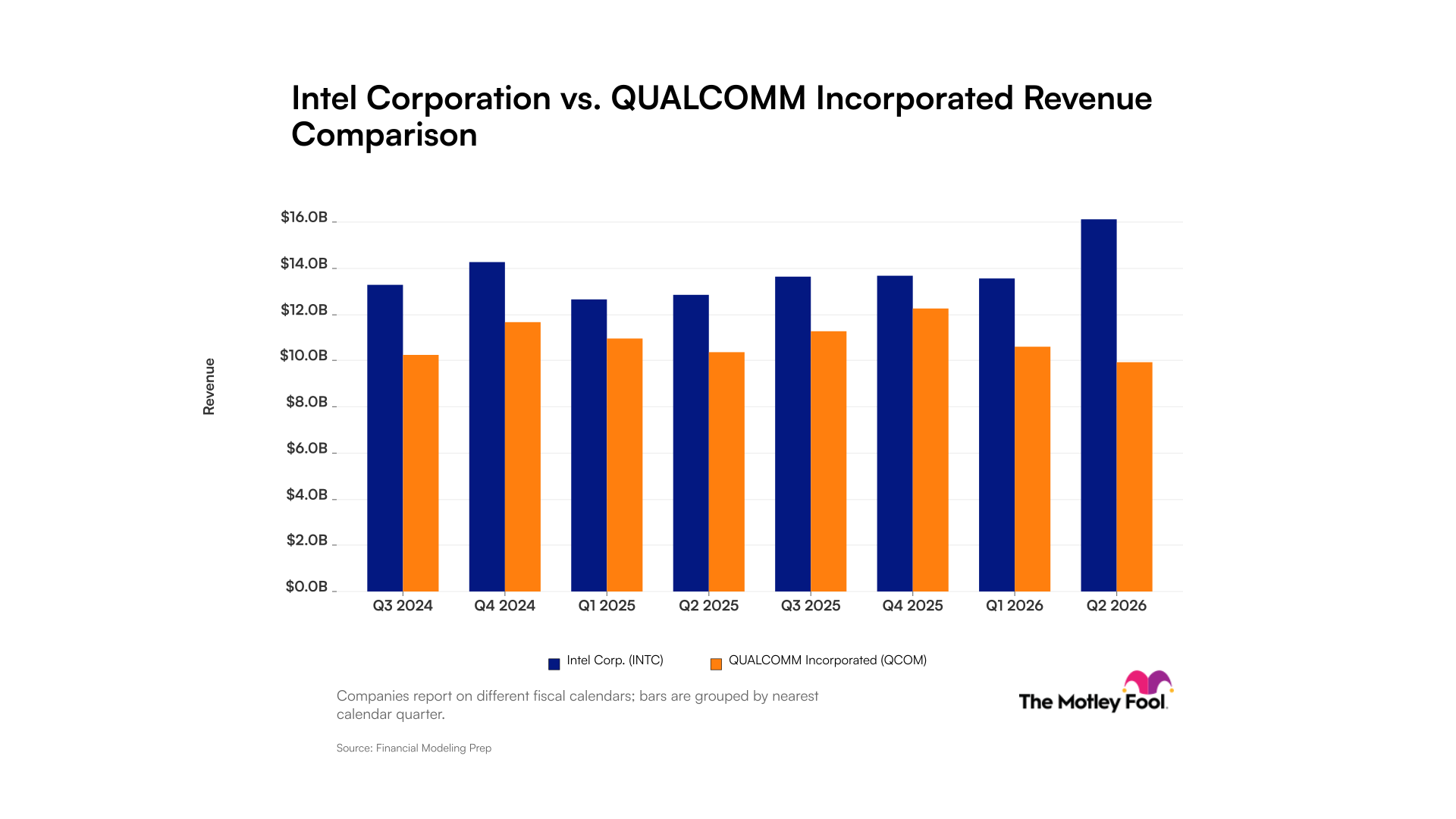
Intel vs. Qualcomm Revenue over the last 8 quarters.
Quarterly Revenue for Intel and Qualcomm
| Calendar quarter | Intel Revenue | Qualcomm Revenue |
|---|---|---|
| Q3 2024 | $13.3 billion (quarter ended Sept. 28, 2024) | $10.2 billion (quarter ended Sept. 30, 2024) |
| Q4 2024 | $14.3 billion (quarter ended Dec. 28, 2024) | $11.7 billion (quarter ended Dec. 29, 2024) |
| Q1 2025 | $12.7 billion (quarter ended March 29, 2025) | $11.0 billion (quarter ended March 30, 2025) |
| Q2 2025 | $12.9 billion (quarter ended June 28, 2025) | $10.4 billion (quarter ended June 29, 2025) |
| Q3 2025 | $13.7 billion (quarter ended Sept. 27, 2025) | $11.3 billion (quarter ended Sept. 28, 2025) |
| Q4 2025 | $13.7 billion (quarter ended Dec. 27, 2025) | $12.3 billion (quarter ended Dec. 28, 2025) |
| Q1 2026 | $13.6 billion (quarter ended March 28, 2026) | $10.6 billion (quarter ended March 29, 2026) |
| Q2 2026 | $16.1 billion (quarter ended June 27, 2026) | $9.9 billion (quarter ended June 28, 2026) |
Foolish Take
Qualcomm has grand designs on supercharging its revenue by another $20 billion by 2029, primarily through a partnership with OpenAI to produce chips for a ChatGPT-optimized mobile phone. But investors should pay attention to its current run of up-and-down quarters by revenue. Sales are the lifeblood of any business, and Qualcomm’s poor trend is a reflection of weakness in its core handset chip business. Weak Chinese demand and a scarcity of memory due to AI have caused handset-derived sales to fall below prior-year levels.
Qualcomm is in value stock territory — its price-to-sales ratio is 4.8, which is low for a tech stock–but the risks to its core handset market and the speculativeness of it being a supplier for a yet-to-be-developed ChatGPT smartphone.
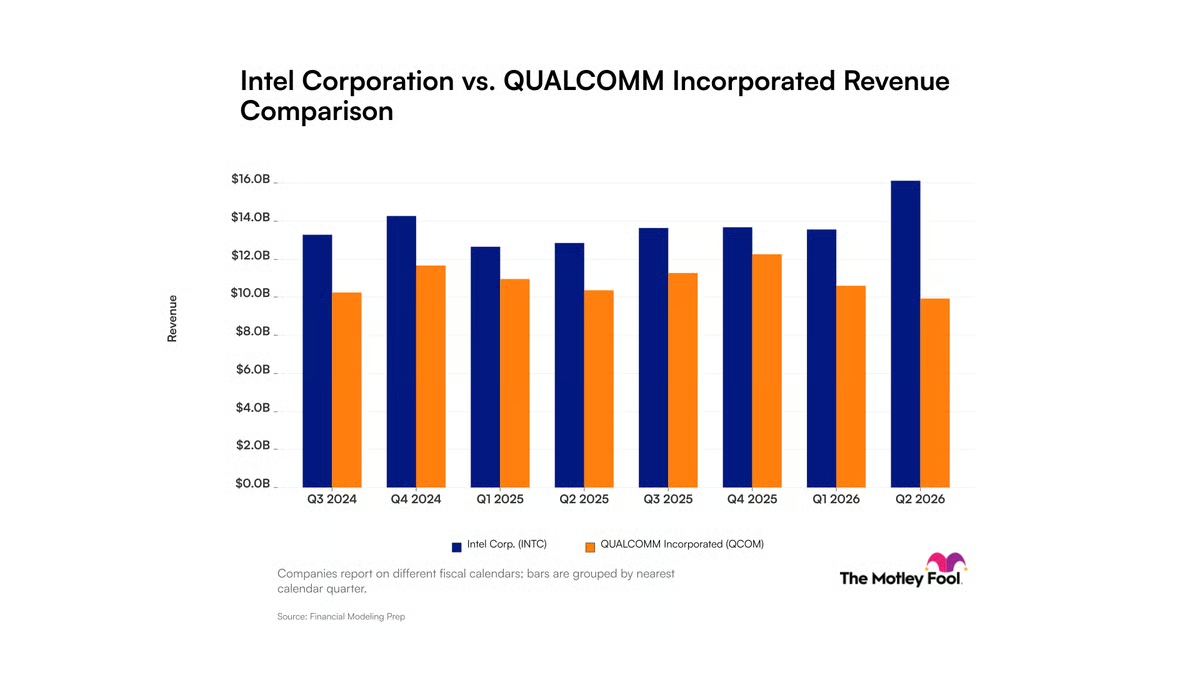
Intel’s revenue trend isn’t immune from dips, as the chart shows, but the recent quarters show a healthy rise in sales.
With both businesses, the chart shows some seasonality in revenue. Note how first-quarter sales dip from fourth-quarter sales. In each company’s most recent second quarter, Intel sees revenue jump from its prior second quarter, while Qualcomm’s dips from its prior year period. That’s a crucial divergence to note.
Intel is pressing on with its plan to revive its business. This spring it announced a partnership with Space Exploration Technologies Inc (SPCX -9.14%) and Tesla Inc (TSLA -3.08%) to build Terafab, a massive AI chip-making plant aiming to produce as many as 200 billion AI chips a year. Intel is providing its foundry expertise and its 14A process, an effort to produce 1.4-nanometer chips it announced two years ago and is still developing. Also this year, Intel agreed to help develop an AI-centric chip for the Google division of Alphabet Inc.(GOOG -3.08%), too. Last year, the company raised investments from the U.S. government and SoftBank to improve its capital position.