Income Tax Act 2025: Old refund claims and pending assessments won’t end with the new law — what changed from April 2026
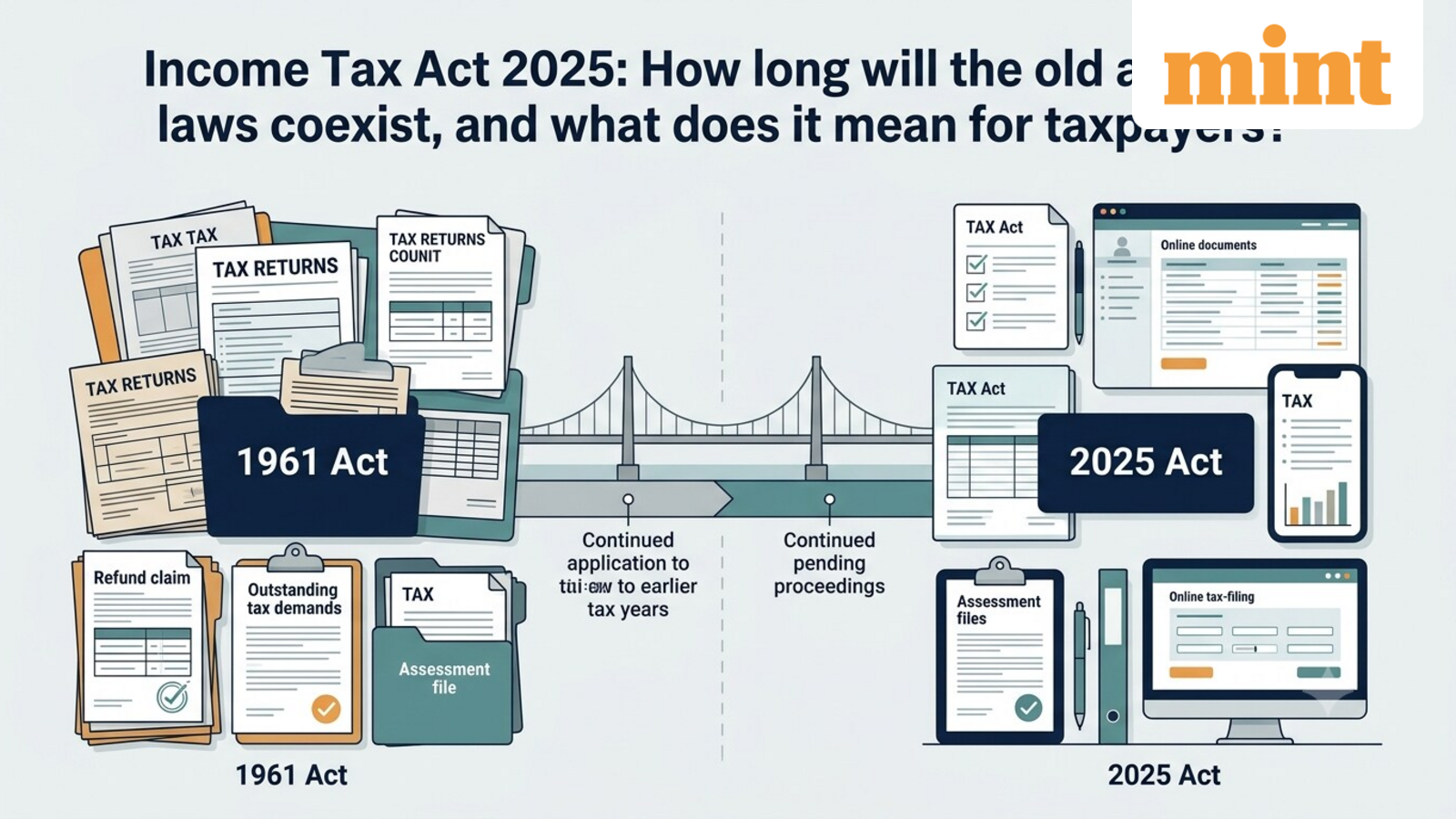
The Income Tax Act, 2025, came into effect on April 1, 2026, repealing the Income-tax Act, 1961. However, several provisions of the old law continue to apply to earlier tax years and pending matters.
This means taxpayers cannot assume that outstanding tax demands, recovery proceedings, or eligible refund claims under the old law will disappear.
Here’s what the Directorate of Income Tax’s FAQs on the interplay and transition from the Income-tax Act, 1961, to the Income Tax Act, 2025 reveal.
Do outstanding tax dues under the old Income-tax Act still have to be paid?
Yes. Tax liabilities raised under the 1961 Act remain payable even after its repeal. For instance, if a taxpayer received a tax demand notice for assessment year (AY) 2022–23 and has not paid it, the outstanding amount remains due.
The Income Tax Department can also recover old tax arrears using the recovery mechanisms available under the new Act. Existing recovery certificates and attachment orders issued under the old law remain enforceable.
For example, property attached for tax recovery under the 1961 Act does not become free from attachment merely because the new law has come into force.
Can taxpayers still claim refunds under the old law?
Yes. Rights, benefits, corrections, obligations, and liabilities arising under the 1961 Act continue to exist, subject to applicable conditions and time limits.
For example, if excess tax was deducted at source (TDS) during FY 2024–25, an eligible refund claim can still be filed after April 1, 2026.
The deductor must file the claim within two years from the end of the financial year in which the tax was deducted. The claim must be submitted in Form 26B under the Income-tax Rules, 1962, and will be processed under the Income-tax Act, 1961.
Pending refund claims relating to earlier years are also not automatically extinguished by the change in law.
How will pending assessments, appeals and notices be handled?
Proceedings pending when the new Act commenced, as well as proceedings initiated subsequently for tax years beginning before April 1, 2026, will continue under the old law.
Section 536(2)(c) of the Income Tax Act, 2025 provides for this continuity. It covers matters such as assessments, reassessments, recomputations, rectifications, penalties, revisions, and appeals.
For example, proceedings concerning AY 2024–25 will continue under the 1961 Act, even if they are initiated or completed after April 1, 2026.
Will existing tax registrations, circulars and faceless schemes remain valid?
Yes, subject to consistency with the new law. Existing PAN and TAN arrangements, faceless assessment and appellate frameworks, and eligible approvals, registrations and recognitions continue.
Similarly, circulars, notifications and instructions issued under the old Act remain valid if they do not conflict with the new provisions. Existing faceless schemes will also continue under corresponding provisions of the new law or Section 532.
Does the new Act introduce new taxes or increase the tax burden?
No. The Income Tax Act, 2025, does not impose any new tax. Its objectives include simplifying legal language, improving clarity, reducing interpretational disputes, and encouraging voluntary compliance.
The new law also replaces the term “previous year” with “tax year”. A tax year is a 12-month period within a financial year. Income earned from April 1, 2026, to March 31, 2027, will fall under Tax Year 2026–27.
How long will both laws operate simultaneously?
The 1961 Act has been repealed, but its provisions will continue to govern tax matters relating to earlier years. Section 536, the repeal and savings provision, contains 22 sub-clauses to address different transitional situations and preserve existing rights and obligations.
Practically, the Income-tax Department’s e-filing portal will support compliance under both laws. Advance tax payments for Tax Year 2026–27 will follow the new law.
What should taxpayers keep in mind?
The key takeaway is that the change in legislation does not automatically cancel past tax liabilities, recovery actions, or eligible refund claims. Taxpayers should check outstanding demands, pending proceedings, and refund eligibility under the applicable law, including relevant deadlines.
Disclaimer: This is for informational purposes only. Please consult a qualified tax expert for advice.