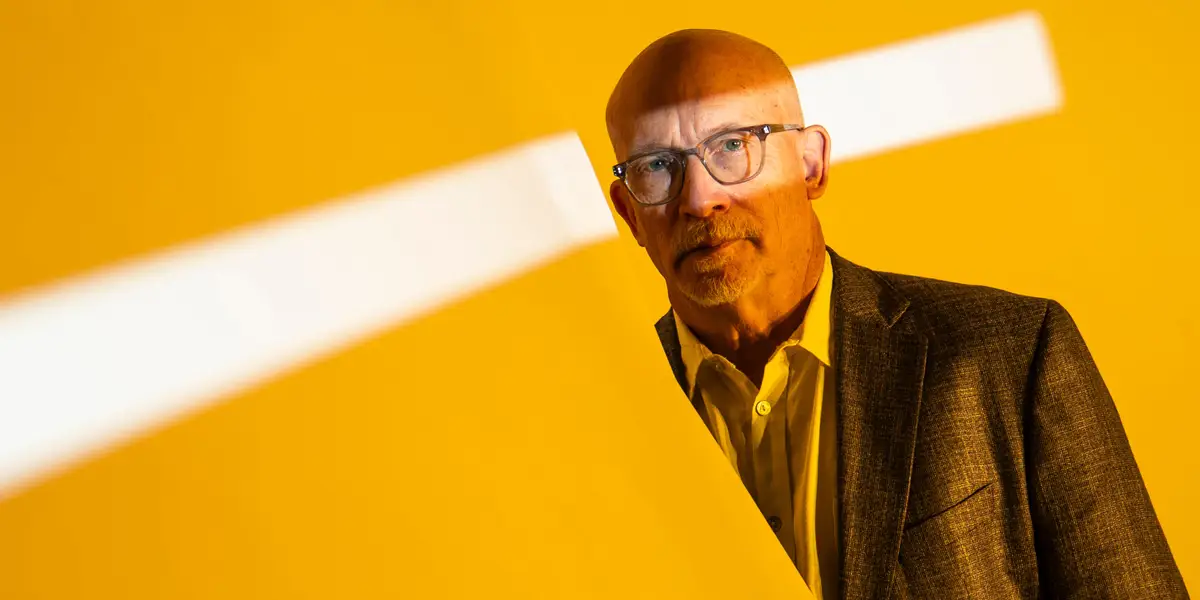
‘Musk’ Doc Director Alex Gibney Isn’t Afraid to Make Powerful Enemies
From Scientology to disgraced Theranos CEO Elizabeth Holmes, documentarian Alex Gibney has never met a subject too big or too controversial to tackle.
Then came Elon Musk.
When Gibney was approached with the idea to do a documentary on the Tesla and SpaceX CEO in 2022, his plan was straightforward: Tell the story of how Musk used his businesses to become one of the most powerful figures in the world.
But when he was ready to deliver a two-hour feature film on Musk two years later, his production company issued him a directive a filmmaker rarely hears: Make it longer.
It was 2024, and the breadth of Musk’s influence had expanded into the political sphere. With Gibney’s subject helping President Donald Trump campaign for a second term, then later spearheading the second Trump administration’s Department of Government Efficiency, Gibney’s story had expanded. His documentary would need to, too.
Finn Gomez/Getty Images
The result is “Musk,” an incisive, nearly four-hour documentary that chronicles the personal, professional, and political life of the richest man in the world. From his controversial acquisition of Twitter, which he renamed X; to his relationships with the mothers of his children; to the accidents tied to Tesla’s self-driving feature, Gibney’s film is a comprehensive look at the scope of Musk’s power and influence in the 21st century.
Gibney even found a clever workaround for featuring Musk in the doc after he declined to be interviewed. Playing on Musk’s belief that we are all living in a simulation, the director used AI to craft an avatar of Musk, who speaks in quotes amalgamated from his past interviews.
Of course, a man as powerful and outspoken as Musk has already voiced his displeasure with someone else controlling his narrative. After the movie’s world premiere at the Venice Film Festival in September, Musk threatened to sue Gibney’s production company for defamation. Musk has also bashed the movie on X, stating: “Gibney just assembled a hit list of people who either have an axe to grind or don’t even know me (but still have an axe to grind). He has ZERO integrity. Horrible human.”
Hearing from angry subjects is nothing new for Gibney, who was the subject of the Church of Scientiology’s full-page newspaper ads decrying his work over 10 years ago tied to the premiere of his documentary “Going Clear: Scientology and the Prison of Belief.”
“With Elon Musk — and he’s not unique in this, but he specializes in it — he begins tweeting horrible things about people and the next thing you know, this army of followers and bots starts to gin up the rage matrix,” Gibney told Business Insider.
Not that he’s rattled yet. With decades of documentaries speaking truth to power under his belt, Gibney has developed thick skin and some top-secret harassment survival strategies.
“Let’s just say I’ve taken some precautions,” he said.
For the latest interview in Business Insider’s Director’s Chair series, Gibney talks about creating an AI Musk, being followed by Scientologists, and his nerve-racking experience in a self-driving Tesla.
On creating an AI Musk avatar and making the movie longer
Business Insider: You thought you had finished this movie in 2024. Was it daunting to go back down the Elon Musk rabbit hole when HBO asked you to?
Alex Gibney: Yeah, it was daunting. We had to renegotiate the budget and all sorts of other stuff. But I got why HBO wanted that. And when Musk hitched his wagon to Trump, it was clear: This is big.
I started out making a film about 21st century power, which in this case involved economic power but also tech power. Now, add to that political power, and suddenly it’s a really big story.
Was AI Musk in the original movie?
The idea of it was. We had put in a placeholder for it, but we were also anticipating that maybe we might get an interview with him at some point.
It was kind of an epiphany to do it this way. It came out of past experience: What’s the workaround for somebody who won’t or can’t talk to you? In “Client 9” and “Zero Days,” we came up with workarounds that fit those stories. The key here was to find a workaround that would fit this story. That’s how we ultimately came up with the idea of the avatar.
Did it unlock anything in you regarding using AI tools in your work in the future?
I think it will depend on the project. AI has become a kind of suitcase term for everything from Siri to AGI. In this instance, this was a human effort using AI tools, which revolved mostly around sync; in other words, making the lips and the body sort of move with the voice. But there was also designing the room, what he was going to wear, the gamer chair.
The further we pushed it and the more interested we got in AI with the company we used, Makemake A.I., this idea of memes and looking at his own image, that’s where we came up with certain scenes where you see the back of his head and he’s watching himself. Those were things that we improvised on.
PATRICK PLEUL/POOL/AFP/Getty Images
On the qualities Musk and Elizabeth Holmes share and Tesla’s image
I couldn’t help but think about your Elizabeth Holmes doc, “The Inventor,” when watching “Musk.” The “fake it ’til you make it” ethos that’s baked into Silicon Valley, has that been fascinating to observe? Both Holmes and Musk are founders who are amazing salespeople hoping that what they bet on takes off.
I think there is a similarity with Elizabeth Holmes. What was rattling around in my head through this was confidence. Musk, like Holmes, was able, through force of confidence, to convince people of things that they knew not to be true. That became a superpower.
The big difference between Tesla and SpaceX and Elizabeth Holmes is that those are real products. The Tesla S is a great car. These reusable rockets are extraordinary, and we show the magnificence of that in the film.
Not to take anything away from him or those companies, but there’s also the bullshit factor. The idea of going to Mars and the promises. And you can see how they repeat themselves and get bigger and bigger. Oh, yeah, full self-driving! I’m sorry, Tesla’s self-driving option is still a level two system, and over 60 people have died.
(Editor’s note: Tesla has maintained that its Autopilot feature requires constant driver attention, and that its vehicles issue prompts warning the driver to stay alert and hold the steering wheel.)
The things you highlight about Musk’s involvement in DOGE and suggesting he influenced the election are shocking, but the things you highlight about Tesla got me the most. The battery swapping, the self-driving car feature. Were you shocked by how much smoke and mirrors there are at Tesla?
Yes. It was something that I didn’t know when I started. And as you mentioned, fake it ’til you make it. They just faked it. Mostly, it was in order to raise the stock. The economic fundamentals of the company never warranted a high stock price, but if you can convince people that the CEO is a genius and also that it’s not really a car company — it’s a tech company, so some super inventions are coming down the road — you can persuade people to gin up the stock.
(Editor’s note: Musk and Tesla did not respond to a request for comment.)
On almost hitting a child while using the self-driving feature on a Cybertruck
You rode a self-driving car yourself; you did it with a Cybertruck for the movie.
I did. There was a cut where we included a four-minute sequence of me in the Cybertruck. I went to the San Francisco Tesla showroom and wanted to drive a Cybertruck, and they showed me how to turn on the self-driving feature. I pressed “Go,” and off I went to the other side of the city. It was like a 20-minute ride there and back.
What’s interesting is for most of the trip it was kind of astoundingly good. But then there were moments when it was astoundingly bad, sometimes in ways that were played to safety. Like, I was trying to merge onto a very busy thoroughfare, and cars kept coming, and if it were me as the driver, I would nudge out there, but full self-driving couldn’t figure that out, so I sat there for 10 minutes. Other instances, it couldn’t decide what to do at critical moments and almost hit a pedestrian.
It came uncomfortably close to a child. The child kind of came from the side out of a parked car. It’s not something you would anticipate, but it was really scary.
Why didn’t you put that in the movie?
Ultimately, the legal case that we spotlight in the movie was a far more powerful deep dive. There were mortal consequences. A woman died. And the deep dive into the evidence itself was so much more powerful. If I had only done a film about Tesla, I probably would have included it.
Christopher Furlong/Getty Images
On the movie’s fate on HBO and the consequences of checking power
The greatest irony in all of this is this movie could have been out a year or so ago, but HBO asked you to make it longer. Now Paramount and Warner Bros. Discovery have merged, so HBO is now under David Ellison, who once considered bringing on Musk as an equity investor in Paramount. Are you concerned HBO will not air “Musk”?
I was concerned until recently. I’m always on the alert. But I’ve been told that they will air it and that even David Ellison very well knows about it and promises he will air it.
You have worked with HBO forever.
Yeah, I love them.
So if they are telling you it is going to happen, you believe them.
But what you learn is, shit happens. [Laughs.] Executives change. Circumstances change, and the next thing you know, it’s not what you thought. But, for now, we are making very specific plans about when it’s going to come out, which is likely in January.
Because of where the industry is going — fewer networks and distribution options, and the options available are mostly run by conglomerates often looking for political cooperation — for the kind of stories you tell, are you looking for alternative distribution avenues in the future with your company, Jigsaw?
We have a skunkworks inside Jigsaw to try to solve some of these distribution problems.
In this new environment, films that people desperately want to see are being held back from audiences. The platforms tell you people don’t want to see them, but that’s just not true. HBO is the exception, but what a lot of the platforms are doing is investing in predictable, least objectionable programming. A lot of the platforms want it to be like the cereal aisles at the grocery market: they are all the same cereal, but different variations between Rice Krispies and Froot Loops. They can predictably get people invested in that mixture of salt and sugar that keeps them coming back for more without providing anything that is nutritious.
So the avenue is theatrical, like it was a decade-plus ago. “Musk” is out in theaters through Bleecker Street, and that’s powerful because it’s a lot harder to put the genie back in the bottle when it’s already out there.
Checking power sometimes comes with blowback. You have experienced everything from Julian Assange leaking the script to “We Steal Secrets” before that movie came out to Scientologists following you around after you made “Going Clear.” Do these things wear on you, or do they fuel you?
I mean, given the fact that I haven’t stopped, it seems to be fueling me. That said, it doesn’t mean I don’t need to take precautions. But I’m still motivated by the idea of people with enormous power abusing it at our expense; that seems to be a spur for me.
When it comes to Elon Musk, he’s the richest and arguably the most powerful person in the world, so it can have these devastating consequences. Ashley St. Clair has security because the X platform has a way of directing vitriol at people. And Elon can say it’s just free speech, but he knows very well that by doing what he does and by the platform tweaking its algorithm for replies and rage addiction, he knows that his statements are going to be amplified in a really horrible way that may result in harm to an individual.
(Editor’s note: Musk, who has called himself a “free speech absolutist,” described X’s policy in 2022 as “freedom of speech, not freedom of reach,” saying the company would limit the reach of negative posts but not delete them. Musk did not respond to a request for comment about his X posts and the company’s algorithm.)
Is your experience with Musk’s followers different from what you experienced with Scientology?
Scientology is a little different, but people did come up to me in dark parking lots in a way that was discomforting. But what some ex-Scientologists told me was, “What they are doing is they aren’t going to put a rattlesnake in their mailbox; they are trying to get inside your head. So once you understand that, just don’t let them inside your head.” That turned out to be very wise advice.
Scientology was tough, and when my film on Assange came out, the vitriol on Twitter was extreme, and I wasn’t prepared for that. What I’ve come to learn is you have to know your enemy.
This interview has been condensed and edited for clarity.
“Musk” is in theaters now.