BNSF Paid Berkshire Hathaway $4.4 Billion in Dividends Last Year. Berkshire Bought It for $34.5 Billion in 2010.
Most investors know Berkshire Hathaway (BRKA +0.09%) (BRKB +0.04%) is a combination of a portfolio of publicly traded stocks and privately owned businesses like GEICO Insurance, Duracell batteries, and Shaw flooring. Is it possible, however, that investors are underestimating just how much cash the conglomerate is collecting from one of its most boring wholly owned companies? It certainly looks that way.
The business in question is the railroad BNSF, although you may know it better as Burlington Northern Santa Fe. Here’s a closer look.
All aboard the cash train!
Contrary to a common assumption, Berkshire Hathaway isn’t just a collection of companies that former CEO Warren Buffett and current CEO Greg Abel felt good about owning. Every one of its holdings serves a specific purpose. For instance, the vast majority of its privately held businesses are meant to generate reliable cash flow that backs up its insurance operation.
Berkshire also discloses surprisingly detailed information about these businesses. For instance, through the first half of 2026, BNSF has generated just over $2.9 billion in operating earnings, up nearly 10% year over year. That’s more than one-tenth of the organization’s total operating earnings — again.
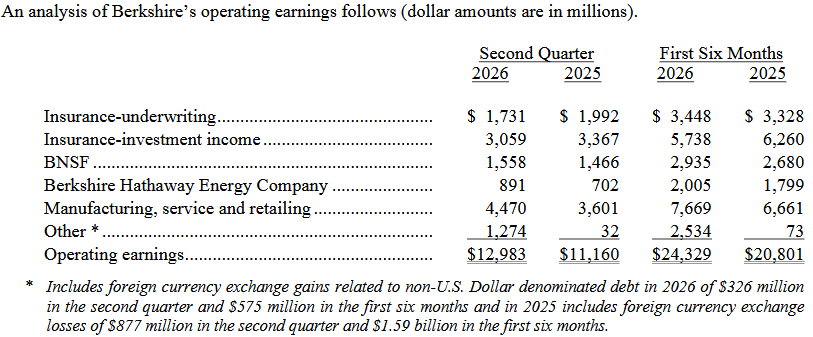
Image source: Berkshire Hathaway Q2-2026 investor report.
Although operating income is a key measure of a business’s health, in this instance it’s not necessarily the most meaningful one. Arguably more important to a conglomerate like Berkshire is how much cash an investment is reliably putting in its parent company’s pockets, whether that investment is private or a publicly traded one.
To this end, as Greg Abel noted in his 2025 letter to Berkshire Hathaway shareholders, published early this year, $4.4 billion of BNSF’s $8.1 billion in 2025 operating earnings was handed over to Berkshire in the form of a cash dividend. The railroad company is on pace to at least match these numbers again this year, extending a long-standing track record of real cash generation.
Image source: Getty Images.
The amazing part? Berkshire Hathaway paid only $34.5 billion for BNSF back in 2010. Now 16 years later, the effective dividend yield on this initial investment is a healthy 12.7%, not to mention the appreciation of the railroad’s value in the meantime. Although Berkshire itself doesn’t offer a specific figure, estimates of its market value range from $75 billion to as much as $200 billion, and Buffett has been willing to say the railroad is the conglomerate’s second-most-valuable asset, mostly due to the cash it produces.
More private, less public?
It’s just one piece of the Berkshire puzzle, of course, and a relatively small one at that; Berkshire’s current market cap stands at a stunning $1.1 trillion.
It’s an important detail, though, and an increasingly important one, particularly if the stock market itself decides to unwind its extreme valuation. Although a correction would put widespread bearish pressure on most stocks, since Berkshire Hathaway’s value largely consists of privately held companies, its ticker could be well-shielded from any such weakness.
Given this, shareholders might wish Abel would make more outright acquisitions of small cash-cow companies rather than use Berkshire’s $365.5 billion in uninvested cash to simply purchase more stocks. The private approach appears to create more long-term value.