How corporate clients’ ‘small complaints’ are hurting banks
- Key insights: Payment analysts say banks have shortcomings in service for corporate clients.
- Expert quote: “Good financial hygiene says you’re looking at your vendors every year.” —Javelin Strategy & Research’s Brian Riley.
Many corporate clients have gripes about their banks that may not amount to much. Over time, however, even minor issues can spiral and sink relationships.
Companies often look to revitalize their
Processing Content
Here are several areas where banks may be falling short:
Product shortcomings
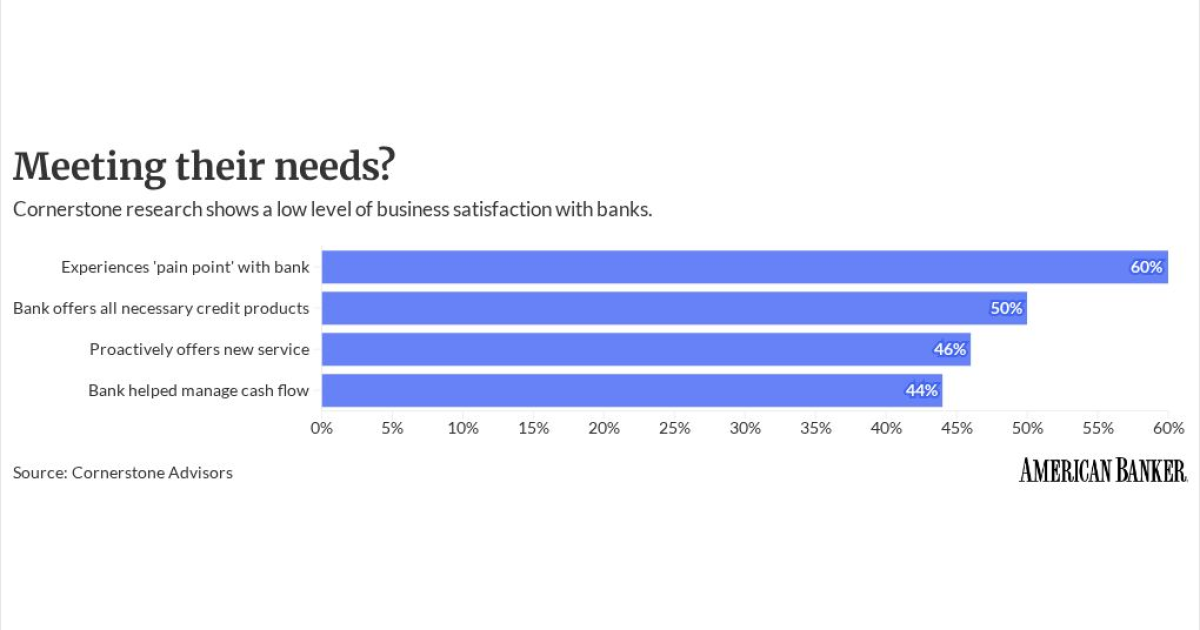
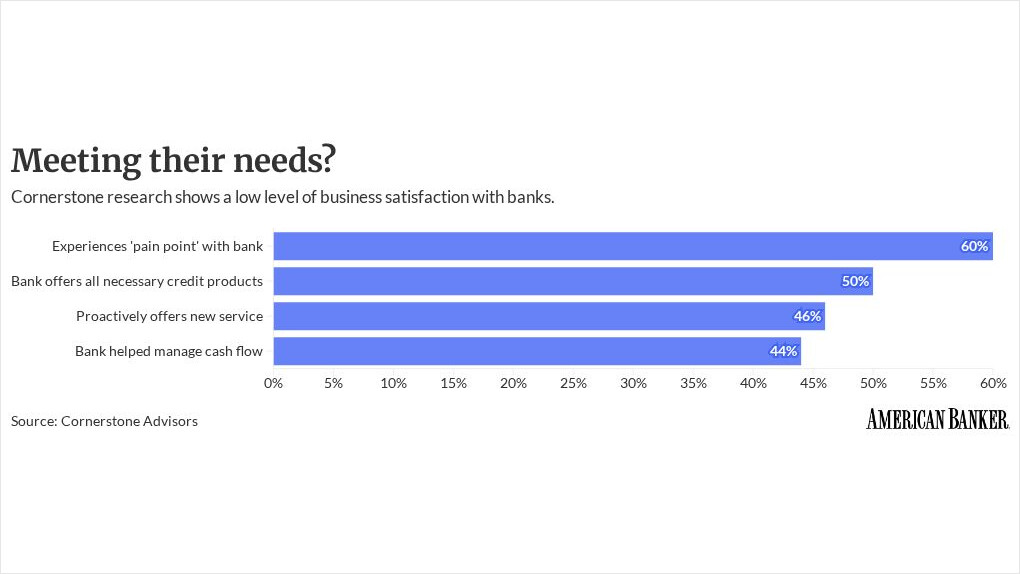
Cornerstone Advisors recently polled 1,249 small and medium-size business owners and executives at businesses with annual revenue between $100,000 and $100 million. These businesses noted that banks aren’t adequately meeting their needs. For instance, only 46% said that their bank has proactively offered new products and services as their needs evolved; 44% said their bank has proactively helped them manage their cash flow variability; and 50% said their primary bank offers all the credit products they need. Notably, more than six in 10 businesses said they’ve experienced pain points with their bank in the past two years — a noteworthy inflection point for bank management.
Managing flight risk
Businesses aren’t married to a single provider, and banks should keep that top of mind. Cornerstone Advisors found that roughly six in 10 businesses work with more than one bank. Half have a checking account with another provider, a third have a business credit card, and three in 10 have a savings or money market account. Additionally, companies use other banks for payroll and accounting integration.
“Growing an existing relationship is much lower of a hurdle than establishing a new one because you’re already a customer; they already know you,” Elizabeth Gujral, director of research and fintech advisory at Cornerstone Advisors, told American Banker. Fostering these relationships builds a moat around customers, she said. “Don’t give them a reason to leave. Give them reasons to consolidate with you.”
Underestimating competition from fintechs
Fintechs are increasingly pursuing the corporate market. While fintechs may not be able to compete in all areas, corporates may decide to siphon off more business to different partners. The upshot for banks that fail to compete effectively is that they stand to lose a large piece of business, Javelin’s Riley told American Banker. “They might not necessarily lose the account, but they could lose the channel that the fintech is going to do well in,” he said.
He points to the
Lack of integration
Businesses have many disparate systems, and they want help managing their operations. By offering embedded experiences, banks can provide that and businesses are willing to pay, Gujral told American Banker.
Smal- and medium-size businesses increasingly seek features such as embedded bill pay, invoicing and accounts receivable payments. However, many banks, especially smaller and regional institutions, aren’t investing the time and money necessary to deliver these important services.
The Cornerstone Advisors research shows that fewer than six in 10 businesses said their accounting software is integrated with their banking account, and only 46% report integration between their enterprise resource planning system and their bank.
Friction in cross-border payments
Nearly three-quarters of corporates describe cross-border payments as slow, costly and unpredictable, according to Capgemini’s 2027 World Payments
The Capgemini report found that only 21% of banks are actively scaling at least one accelerated intelligent money instrument, such as stablecoins, wholesale central bank digital currency, or tokenized deposits, and that corporates are increasingly willing to seek alternatives when their banking partners do not keep pace.
While large banks are moving in this direction, there’s opportunity for others to step up, according to Jeroen Hölscher, global head of payment services at Capgemini, and co-author of the 2027 World Payments report. There’s ample opportunity “to leverage the new instruments to make this better for their corporate clients, and that’s where they remove the friction,” he told American Banker.
Notably, 71% of corporates prefer banks over fintechs for tokenized payments at equivalent cost and quality. This underscores that banks that don’t offer stablecoins or tokenized deposits are missing out on opportunities. Moreover, corporates want transaction-settlement certainty, clarity regarding the real-time position of payments, and fraud protection. “Right now, what they are being offered is not to their expectations,” Hölscher said.
Industry-specific shortfalls
Banks are also falling short in serving certain industry verticals. For example, Cornerstone Advisors found that businesses in the restaurant and food services industry complained about banks’ inability to finance equipment or build-out on their timeline. They also cited a lack of tools for tip management or daily cash reconciliation. Additionally, they criticized banks for using a loan-underwriting approach that ignores their revenue patterns.
Businesses in the healthcare and medical services space complained that banks don’t design financing around their revenue cycle, can’t handle HIPAA-compliant payment processing, and don’t account for practice valuation and goodwill in their loan decisions.
Read more:
Banks also fell short with construction and real estate development businesses. These companies said banks’ underwriting doesn’t reflect project-based revenue. Many respondents also said their bank didn’t offer bonding or surety support or tools for tracking project-level cash flow.
Businesses have different needs, and banks that fail to differentiate will lose out, Javelin’s Riley told American Banker. “There are many different types of businesses, and the worst thing banks do is deal with them all the same.”