3 Words From Fed Chair Kevin Warsh Suggest the Worst Is Yet to Come for Wall Street
Last week, Wall Street’s artificial intelligence (AI)-driven bull market celebrated its fourth anniversary. Earlier this month, the benchmark S&P 500 (^GSPC -1.09%) and tech-powered Nasdaq Composite (^IXIC -2.15%) both catapulted to new highs, while the mature-stock-driven Dow Jones Industrial Average (^DJI -0.34%) did the same in early August.
The AI infrastructure build-out is the most game-changing trend for stocks since the advent and proliferation of the internet in the mid-to-late 1990s. Corporate earnings growth has consistently surpassed analysts’ lofty expectations.
But when things seem too good to be true on Wall Street, they usually are.

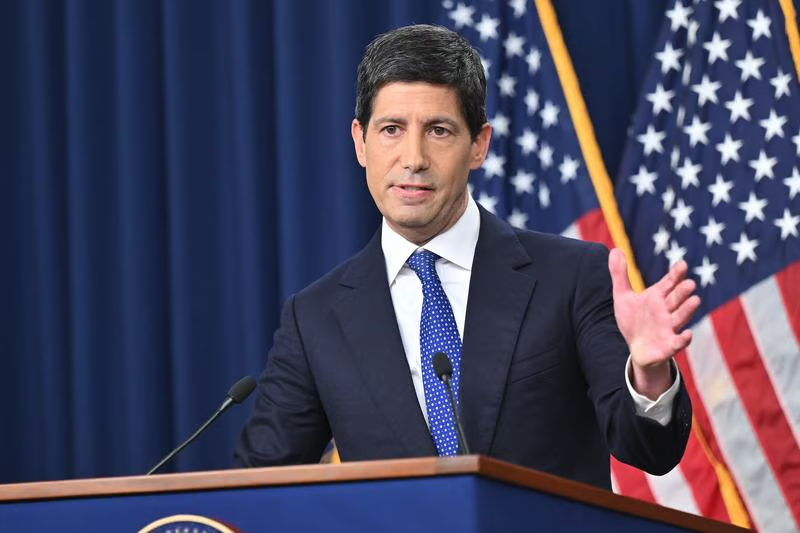
Fed Chair Kevin Warsh recently offered a huge clue about where interest rates head next. Image source: Official Federal Reserve Photo.
While the stock market has thus far succeeded in climbing the proverbial wall of worry by sweeping persistently elevated inflation under the rug, Fed Chair Kevin Warsh recently offered investors a harsh reminder.
Persistently elevated inflation can no longer be swept under the rug
Although headline inflation has pared from its three-year high of 4.2% in May, several inflation measures remain concerning. This includes the September Producer Price Index (PPI), which saw headline and core PPI rise 6.3% and 5%, respectively.
BREAKING: September PPI Inflation unexpectedly rises to 6.3%, above expectations of 5.3%.
Core PPI Inflation rose to 5.0%, above expectations of 4.4%
PPI inflation is now at its second highest level since November 2022.
The odds of rate hikes are rising sharply on the news.
— The Kobeissi Letter (@KobeissiLetter) October 15, 2026
While modest inflation is expected when the U.S. economy is growing, persistently elevated inflation has been fueled of late by a combination of Trumpflation (inflation driven by President Donald Trump’s policies) and the AI data center build-out.
The president’s tariffs and the ongoing Iran war are directly lifting consumer prices. Meanwhile, the otherworldly pricing power AI hardware companies are enjoying has increased prices for chips and memory used in a variety of tech devices.
With no quick fix to these entrenched inflationary pressures, Fed Chair Kevin Warsh and 11 other Federal Open Market Committee (FOMC) members voted unanimously (12-0) to raise interest rates by 25 basis points to 3.75%-4.00% on Sept. 16. It’s only the fourth rate-hiking cycle undertaken by the Fed this century.

Image source: Getty Images.
The Fed’s rate-hiking cycle is likely to ramp up
Unfortunately for Wall Street, the FOMC’s September rate hike may be just the beginning of an aggressive hiking cycle.
In speaking with the press after the FOMC’s September meeting, Fed Chair Warsh highlighted the strength of the job market, but was particularly critical of inflation. Said Warsh:
Price stability is foundational to economic growth, and I think we took an important step today to deliver it. And we did it in part by removing the dose of accommodation that I — that I mentioned before.
Warsh’s use of this three-word phrase, “dose of accommodation,” on three occasions in speaking with reporters is no accident. He and his FOMC colleagues don’t view monetary policy as restrictive, meaning additional “doses” can be removed from the equation to encourage a timelier return to the Fed’s long-term 2% inflation target.
Fed Chair Kevin Warsh says inflation has been “too high for too long” with little improvement through the summer.
He says the FOMC has now “removed a dose of accommodation” as price pressures remain broad.
https://t.co/6XgT9hHgBP— Shay Boloor (@StockSavvyShay) September 16, 2026
Warsh’s repeated use of these three words suggests that the central bank’s rate-hiking cycle is likely to ramp up in December and throughout 2027.
An aggressive rate-hiking cycle would be terrible news for the AI-driven bull market. The enormous amount of capital being spent on AI infrastructure is financed, in part, with debt. If borrowing costs continue to climb, we’ll likely see AI growth projections taper a bit.
Given that this is the second-priciest stock market in history, there’s simply no margin for error. Based on Warsh’s commentary, the worst appears yet to come for Wall Street.