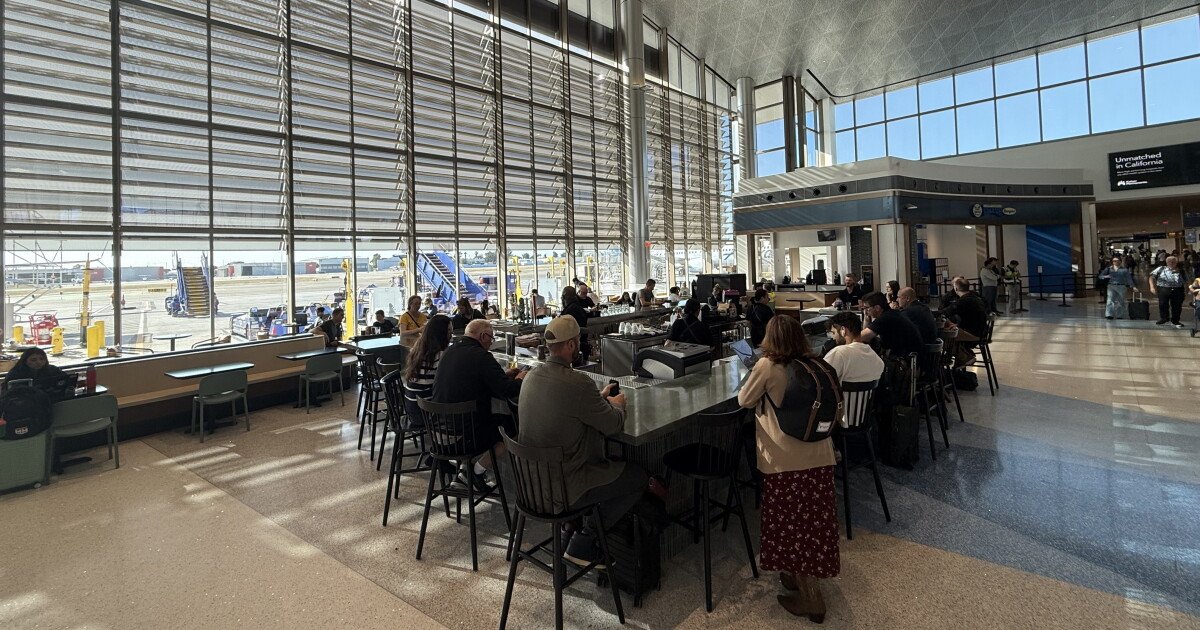
Burbank gets new airport terminal done on time and on budget

Hollywood Burbank Airport
The brand-new terminal Hollywood Burbank Airport opened Tuesday sets a high bar for other airports embarking on modernization projects.
Processing Content
The Burbank-Glendale-Pasadena Airport Authority leveraged a progressive design-build framework to finish the nearly $1.3 billion terminal replacement on schedule and on budget, offering a playbook for regional airports across the country facing record infrastructure needs.
Burbank officials celebrated the completion of the airport’s nearly $1.3 billion replacement passenger terminal at a ribbon cutting on Oct. 5, eight days before the 14-gate, 355,000-square-foot facility opened to replace the airport’s original terminal complex that opened in 1930.
The old terminal not only looked dated and worn, but also was an aviation danger, out of compliance with
Its airy, modern replacement was placed at a different part of the airport to meet those FAA standards.
“This project reflects years of planning, collaboration, and community input, and I’m especially proud that we’ve been able to modernize the airport while preserving the convenience and accessibility that travelers have come to love about Burbank,” said Tamala Takahashi, Burbank’s mayor.
The airport will serve as the front door to southern California for millions of travelers, “and we couldn’t be more excited to welcome them,” she said.
Smaller and more manageable
Major modernization projects at regional airports don’t have as many moving parts as capital improvement programs at larger airports like the Los Angeles International Airport, said Kevin Archer, a S&P Global Ratings director.
Still, what Burbank airport officials accomplished sets an example for other regional airports embarking on major infrastructure changes, Archer said.
The project went from groundbreaking to open-for-business in just over two and a half years.
The construction timeline and financial management of the Burbank project stand out relative to standard industry outcomes, Archer said.
“Regional airport projects often face delays driven by supply chain interruptions, labor shortages, or [issues related to] complex municipal oversight,” Archer said.
Performing large-scale capital improvements within strict schedule and budget constraints remains a significant challenge across the aviation industry, making successful delivery a key indicator of governance and project control, Archer said.
Pointing to the project’s predictable rollout, Archer noted, “The fact the project is coming in on time just validates everything in the rating analysis.”
S&P rates the Burbank-Glendale-Pasadena Airport Authority’s revenue bonds A. It has ratings of A2 from Moody’s Ratings and A-minus from Fitch Ratings. All assign stable outlooks.
For municipal bond analysts who track airport credits, operational reliability and execution capability are central components when weighting debt obligations against future revenue capacity, Archer said.
The consistent adherence to scheduled dates reinforces the confidence S&P has in the airport authority’s execution framework, Archer said.
Procurement model
A central contributor to maintaining Burbank’s schedule discipline was the procurement model.
Rather than relying on traditional multi-contract delivery methods that can introduce friction between design and construction phases, the authority adopted a progressive design-build framework.
That meant that the airport and design-builder agreed on a maximum price before substantial work was done, Archer said.
This structural setup created clear contractual parameters about cost caps and delivery dates from the outset, he said.
By setting financial limits before major construction activities began, the authority mitigated common exposure points that lead to cost overruns, he said.
When the contract was approved in 2023, it covered the entire cost of the project. The contract dictated that the design-builder had “to achieve substantial completion by Oct. 13 or incur substantial damages,” Archer said.
Because it was structured that way from the outset, it kept the project on track and from deviating too much.
Financing a capital plan exceeding $1 billion required substantial debt issuance, transforming the airport authority’s balance sheet structure.
“Over recent years,
Because the higher debt burden is already factored into current ratings, completion of the terminal is unlikely to prompt immediate rating upgrades in the near term, he said.
Between the 2026 and 2023 bonds sold for the project, the airport’s outstanding debt jumped from $75 million to $1 billion.
Further upgrade in S&P’s rating would “require unexpected and sustained shifts in regional passenger demand,” Archer said.
Burbank’s competitors
Burbank’s peers include other Los Angeles region airports, such as Long Beach and
In Southern California, Burbank also competes with Orange County’s John Wayne Airport and Los Angeles International Airport.

Hollywood Burbank Airport
All three of Burbank airport’s regional peers are small or medium hubs with Southwest as the dominant carrier and subject to competition among one another, Fitch said.
Ontario has significantly fewer borrowing needs supporting lower leverage, said Fitch, which recently upgraded Ontario’s rating.
Long Beach has a smaller, constrained enplanement base, with the number of passenger flights
The Ontario International Airport authority plans to issue $174 million of airport revenue bonds next week.
The bonds will support the airport’s capital plan, according to an investor presentation, with a focus on reconstructing runways and taxiways, and modernizing the two existing terminals.
BofA Securities is senior manager on the deal. PFM and CSG Advisors are co-municipal advisors. Hawkins is bond counsel.
In the long run, Ontario officials envision
Fitch upgraded the Ontario airport credit to A-plus from A-minus ahead of the deal. S&P affirmed its A rating.
Outlooks are stable.
Record airport volumes
Based on issuance figures, regional airports and larger metropolitan airports are
Airports pushed out a lot of debt last year, and it’s looking like they are on track to have a second year of heady issuance.
In 2025, airports issued $19.9 billion in debt in 74 issues from January through September, and they have sold $16.7 billion in bonds in 74 issues through Sept. 30, 2026, according to LSEG data. They sold $25.9 billion in bonds in 95 issues during the 12 months of 2025, the data showed.
All told, the transportation sector sold $75.1 billion in bonds in 458 issues in 2025, the fifth largest sector for debt sales last year, according to LSEG data. It trailed education, general purpose, utilities and healthcare categories.
The entire muni industry sold $571.8 billion in bonds in 9,383 issues in 2025, according to the data.
In general, muni volume is expected to hit a record volume for 2026, according to the September 2026 municipal market update produced by Peter Block, managing director and head of municipal strategy at Ramirez & Co.
“At roughly $430 billion through early September and plus-9% year-over-year, issuance is tracking our $600 billion record supply number,” Block wrote in a Sept. 8 report. “We expect significant positive net supply in September and October with modest issuance in November and December.”
The completion of Burbank’s terminal overhaul occurs alongside similar infrastructure updates across smaller and regional facilities throughout the region.
Passenger preferences have increasingly favored smaller regional hubs due to ease of access, shorter lines, and proximity to major population centers, Archer said.
“It’s interesting to see, as you have seen in California, there have been a lot of smaller airports, who have convenient locations who are undertaking projects,” Archer said. “Burbank was first. But
Despite the momentum surrounding regional options, larger hubs maintain fundamental advantages regarding flight density and international connectivity, he said.
Los Angeles International Airport continues to serve as the dominant gateway for Southern California air travel, serving well over twice as many passengers as the region’s four other airports combined.
“There are just certain things LAX can do that Burbank and John Wayne (in Orange County) can’t do,” Archer said.
At the same time, regional airports take advantage of geographic convenience to retain local passenger bases.
“To some degree whether you are living in Hollywood Burbank or Orange County, folks prefer to fly out of their local airport,” Archer said. “Burbank and Ontario market themselves as more convenient. You can drive up and park and walk to your gate. The people who live in this upper basin scenario of Los Angeles prefer to fly out of Burbank, but there are certain offerings LAX has that the others can’t offer.”