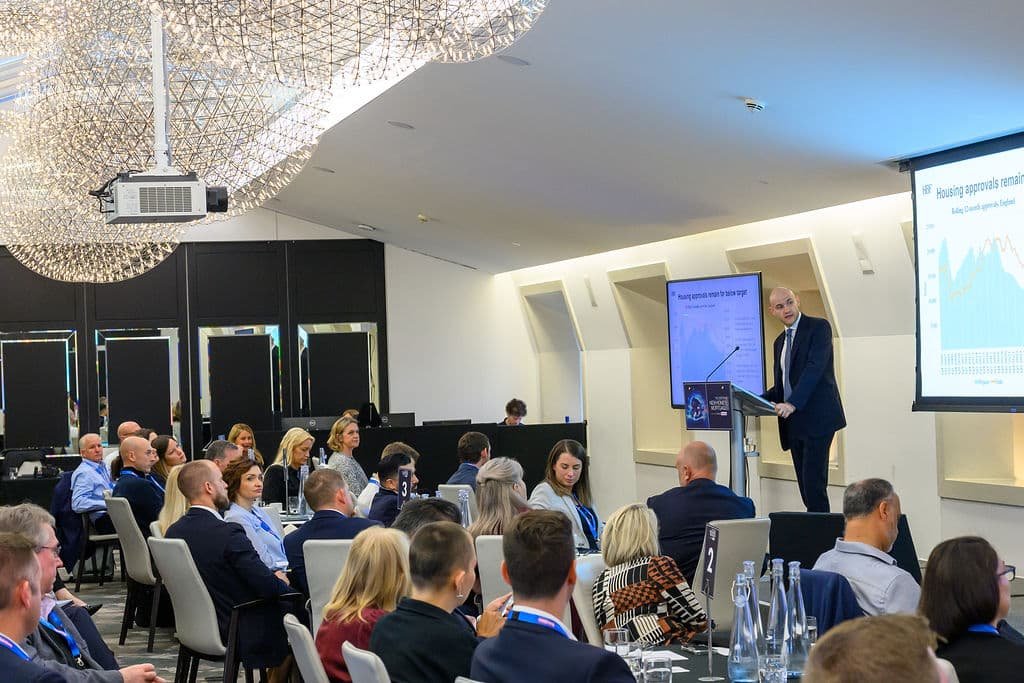
British New Homes Mortgage Senate: The economics of housebuilding have changed since Help to Buy
An improvement in the viability of housebuilding is needed to ensure the sector meets the government’s targets, as the current landscape is different to when the last first-time buyer scheme was introduced.
Speaking at the Mortgage Solutions’ British New Homes Mortgage Senate, David O’Leary, executive director at the Home Builders Federation (HBF), said the “ever-changing” policy landscape had made the past few years a “challenging time” for housebuilders.
He said the housebuilding sector had been more optimistic at the start of the year and felt there were potentially “green shoots coming” with regard to the market, but that external factors, including the war in Iran, had quelled any improvements.
He said some members of the HBF were exceptions to this, depending on their product offer and locality. However, he said that output was “nowhere near” the 300,000 homes per year needed to fulfil the government’s overall target of one-and-a-half million new homes and was “getting further away [from the target] with each passing month”.
“One of the issues that we’ve frequently highlighted to this government is that as a result of the huge increases in policy costs and taxes levied on development and the suppressed level of demand the 1.5 million homes target has become unachievable. Indeed, supply levels have fallen such that on current trajectories there will likely be fewer completions achieved in this Parliament than the last,” he added.
He added that those political consequences were one thing, but the economic impact was “massive”.

Your First Home: confidence to build
Sponsored by Halifax Intermediaries
The realities of developing new homes
He said the increase in supply expected by government and the Office of Budget Responsibility (OBR) due to changes to planning policies was “not coming through”.
O’Leary added: “The planning reforms were forecast by the OBR to boost housing delivery by 170,000, generating 0.2% in GDP growth, reduce borrowing by £3.5bn and we’ve not seen any sign that that’s happening.”
He said there were questions as to what the Prime Minister’s focus on council housebuilding meant for the affordable housing landscape and it was unclear whether local authorities were expected to deliver this, as they “don’t have the capacity… so there might be a role for housing associations or the private sector to support this”.
O’Leary did say the government reopening the conversation around developing on grey belt and the more recent efforts to improve planning approval timescales were positive, and once the economics of housing delivery improved, the sector would potentially be able to deliver homes more quickly as a result.
Reinvigorating first-time buyer support
O’Leary said addressing the myths around Help to Buy had been one of the federation’s priorities when engaging with the government about the support needed for first-time buyers.
He said the government’s own evaluations showing the value the scheme brought helped “detoxify” the debate, along with research showing it had not been inflationary and was “very high value for money”.
O’Leary said these insights likely contributed to the government’s consideration of a successor to Help to Buy, particularly the data showing that 15% of all new homes delivered between 2013 and 2023 could be attributed to the scheme.
“That equates to 280,000 homes that wouldn’t have existed without Help to Buy, just over 1% of the entire housing stock,” he added.
He said the announcement of Your First Home was “very positive” as this was the first time there had been no government assistance for first-time buyers since the 1960s.
A different economic landscape compared to the last buying scheme
Prior to the announcement of Your First Home, the HBF’s proposal for a successor scheme included developer contributions, meaning firms would be “paying for their customers to have access to this government equity loan, which would reduce the immediate cost to government”.
He said the HBF was now part of discussions to work through the details of this and other potential add-ons of the new scheme.
O’Leary said the 2.5% deposit from buyers did catch the HBF “slightly unawares” because it had not been part of any proposals put forward by the federation or any individual builder.
It is suspected the government equity loan will amount to 20%, but the size of the developer contribution is yet to be confirmed.
Regarding the developer contribution, O’Leary said: “We are trying to make a case for some kind of gradual increase in that developer contribution, such that small housebuilders who have been right at the brunt of the challenges with regards to viability and affordability can access the scheme.”
He said the answer to how many homes would be delivered through the Your First Home scheme was “dependent on the parameters government sets with regards to price and income caps, developer contributions and the length and depth of the scheme”.
“Comparing today with 2013 when Help to Buy arrived, the economics of building homes is different,” O’Leary said.
He said the last decade had brought “additional cost on top of additional cost”, with taxes, levies, policy and regulatory costs.
“If you take 2020 as a baseline, the additional cost of building a home today is around £76,000… about half of that is build cost inflation and has been driven by certain world events that are out of our control, but things that decision-makers can control, such as tax rises and new levies, have added a further £37,000 per home”, said O’Leary.
Most costs for housebuilders
He said the new Building Safety Levy, which from this month adds on average around £3,000 to the cost of building a home and higher rates in London and the South East, would be a further challenge to developers.
While the Conversative Party has pledged to lower the cost of building a home, O’Leary said it is always politically easier to introduce such policies than remove them.
“I think that’s where we’ve got to with the Building Safety Levy. We’ve shown again and again that it’s not needed, on the basis of the money already collected from developers in the Building Safety Fund, but it’s £340m of additional tax that the government plans to collect that has already been scored and accounted for,” he added.
Read more coverage from this year’s British New Homes Mortgage Senate: