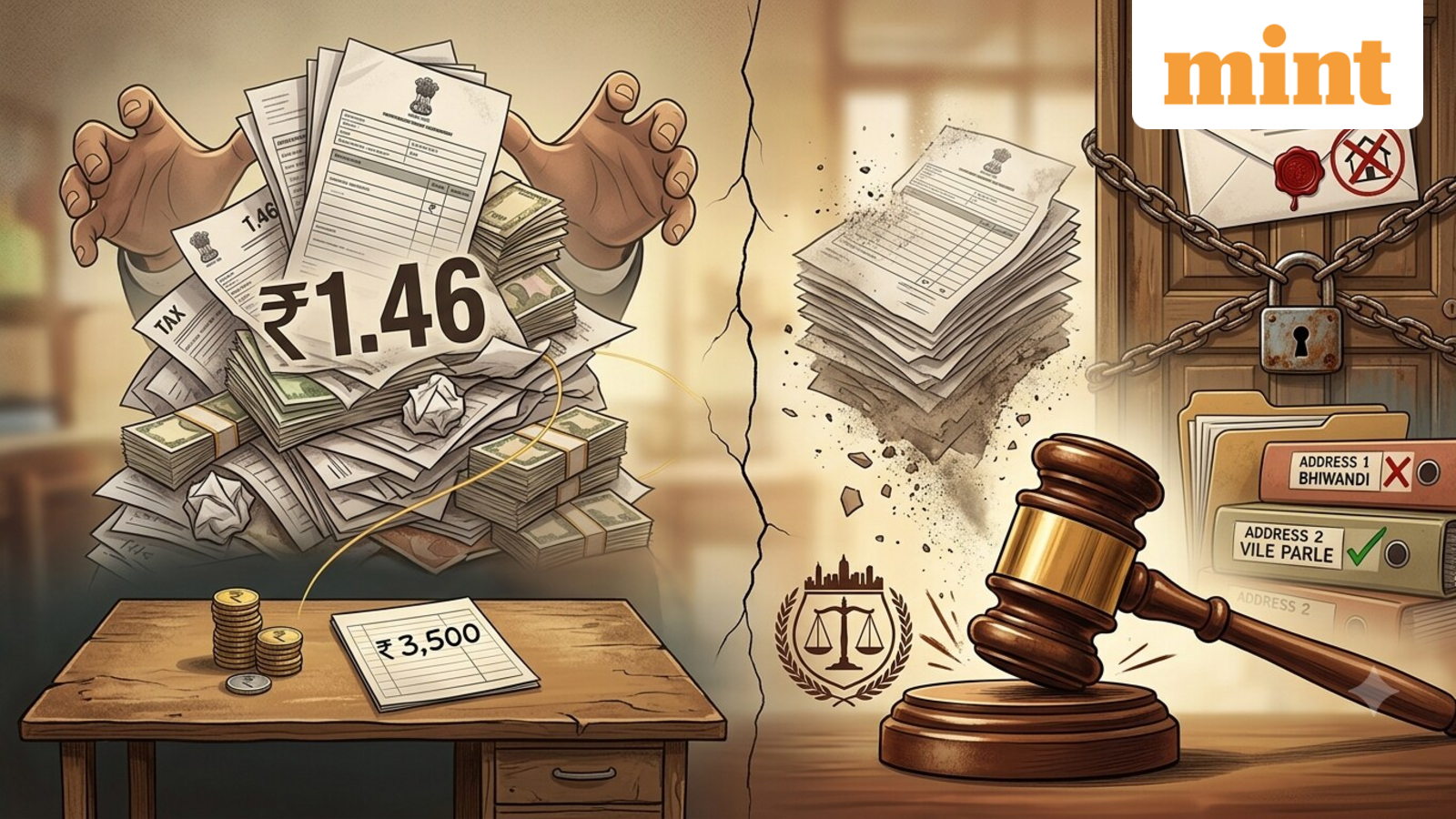
Man earning ₹3,500 a month faced ₹1.46 crore tax demand; how ITAT Mumbai came to his rescue
A Mumbai man who said he earned ₹3,500 a month as an office worker was assessed to a tax liability based on transactions worth nearly ₹1.46 crore that he denied making. The Income Tax Appellate Tribunal (ITAT), Mumbai, has now quashed the reassessment after finding that the Income Tax Department failed to establish valid service of the notice required to reopen his assessment.
In Ravi Dilip Waghela v. Income Tax Officer, ITA No. 1799/Mum/2025, for assessment year 2012-13, the tribunal ruled on 21 September 2026 that the reassessment could not legally proceed without valid service of the notice under Section 148 of the Income-tax Act, 1961. It consequently set aside the assessment of ₹1.46 crore, without deciding whether the disputed transactions were genuine.
How did the ₹1.46 crore tax assessment arise?
According to the tribunal order, the Income Tax Department received information from the investigation wing in March 2018 about a business identified as a provider of accommodation entries. Examination of its bank account revealed debit entries of ₹1.27 crore and credit entries of ₹18.85 lakh associated with Kingsy Pharma, which the department’s information identified as a proprietary concern belonging to Waghela.
The assessing officer treated ₹1.27 crore as unexplained expenditure under Section 69C and ₹18.85 lakh as unexplained credit under Section 68 of the Income-tax Act. With the returned income taken at ₹10,000, the assessment under Sections 144 and 147 was completed at ₹1,46,57,500.
Waghela disputed the connection. He told the tribunal that he had worked as an office boy for his former employer, Veeru Mehta, for approximately 18 months from September 2009, earning ₹3,500 a month. He said he had provided signatures and know-your-customer (KYC) documents for employment-related purposes, but his employer had allegedly used them without his knowledge to obtain another permanent account number (PAN) and establish Kingsy Pharma.
The tribunal did not conclusively determine whether this alleged misuse had occurred. Instead, it examined whether the department had validly served the notice initiating reassessment.
Why did the ITAT quash the reassessment?
The department issued a notice under Section 148 on 27 March 2019. The notice sent to an address in Bandra, Mumbai, remained unserved. The department subsequently attempted to serve it by affixing it to the door of a locked room at Sonam Apartment in Bhiwandi. However, the tribunal found no adequate evidence establishing that Waghela lived or carried on business at that premises. The department’s own records indicated that he did not reside there.
The tribunal also noted that the department later obtained Waghela’s Vile Parle address and email address through information from TransUnion CIBIL. A final show-cause notice was delivered there in November 2019, and he responded by disputing the PAN and denying knowledge of the transactions.
The bench held that issuing a notice within the limitation period and validly serving it are distinct requirements. Simply affixing a notice to a locked property, without establishing its connection to the taxpayer, was insufficient to establish valid service.
It also considered Section 292BB, which addresses certain objections to the service of notices when a taxpayer participates in proceedings. The tribunal held that the provision did not cure the defect in this case because Waghela had objected to non-service before the assessment was completed.
The tribunal consequently quashed the reassessment under Sections 144 and 147. The additions of ₹1,27,62,500 and ₹18,85,000 could not survive because they arose from an invalid reassessment. It left the questions concerning the disputed PAN, bank account and transactions undecided.
What should taxpayers do if they dispute an income-tax notice?
The ruling highlights the importance of checking whether a reassessment notice was issued and served in accordance with the applicable legal requirements. A taxpayer who disputes a notice should preserve the notice, envelopes, delivery records, correspondence and any responses sent to the department.
Taxpayers who believe that their PAN or identity documents have been misused should also gather relevant employment, banking and identity records and raise their objections promptly through the appropriate channels.
However, the ruling does not mean that a disputed transaction or tax demand is automatically invalid whenever a taxpayer denies knowledge of it. In Waghela’s case, the tribunal’s decision rested on the failure to establish valid service of the jurisdictional notice, not on a finding that the alleged transactions were fraudulent or tax-free.