Govt issues notification on PM CARES scholarship, spells out rules for children without Aadhaar
The government has notified Aadhaar authentication requirements for beneficiaries of the special scholarship scheme under PM CARES for Children, while specifying alternative procedures for children who do not have an Aadhaar number or are unable to authenticate their identity.
The Ministry of Social Justice and Empowerment issued the notification on 14 October 2026, published in the Extraordinary Gazette of India under S.O. 5628(E). The rules, issued under Section 7 of the Aadhaar Act, 2016, cover identity verification for children receiving scholarship assistance to continue their education from Class 1 to Class 12 under the scheme.
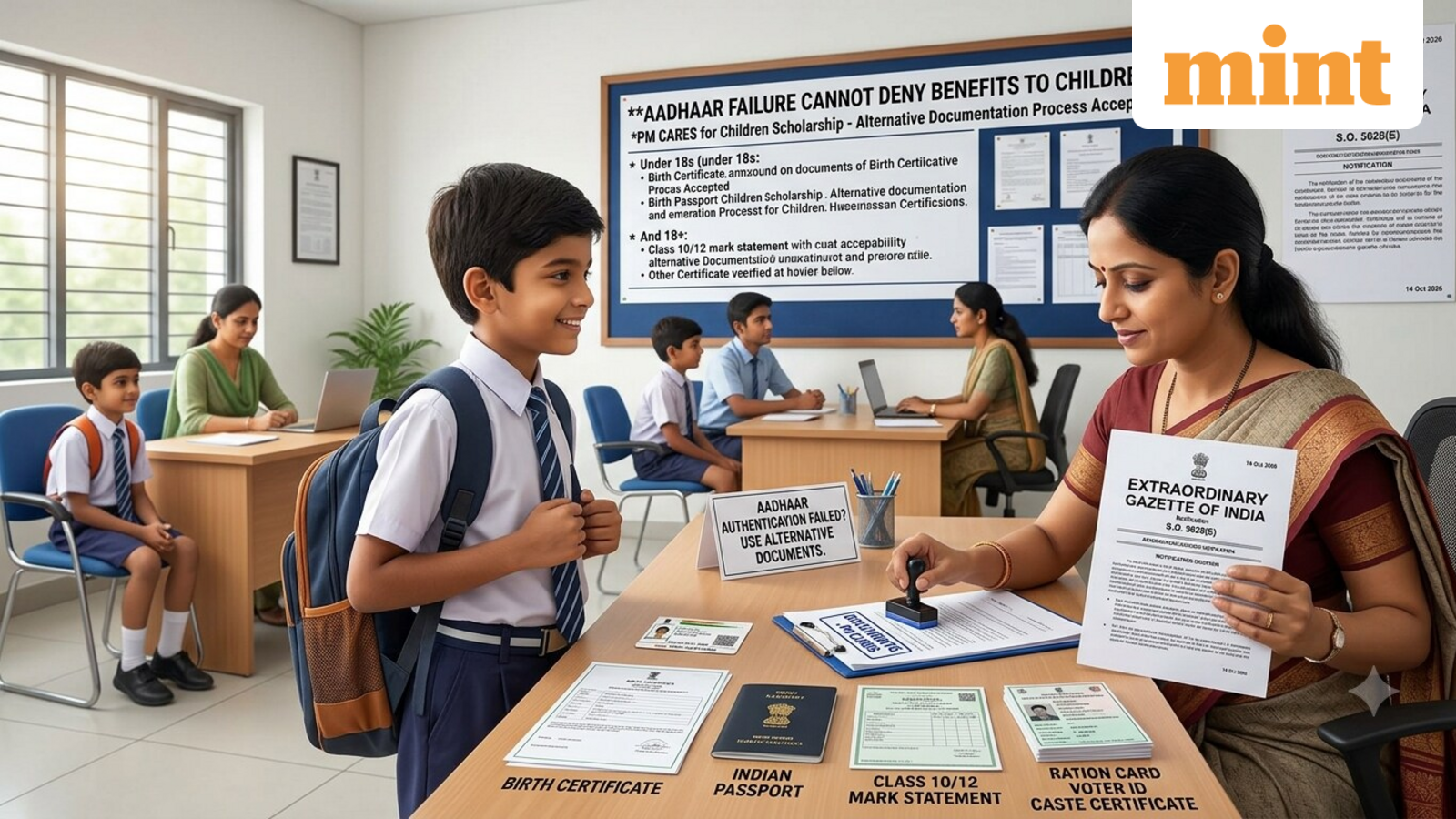
Importantly, the notification states that a child cannot be denied benefits under the scheme solely because Aadhaar authentication fails or the child has not been assigned an Aadhaar number. It also lays down the documents and verification procedures that can be used in such cases.
Aadhaar not available? These documents can be used
The notification provides separate document requirements for beneficiaries below 18 years of age and those aged 18 years or above who have not been assigned an Aadhaar number.
For a child below 18, the required documents include an acknowledgement from the Aadhaar enrolment centre containing the enrolment ID and proof of age. Accepted age-proof documents include a birth certificate, Indian passport or a Class 10 or Class 12 certificate or marks statement issued by a recognised school education board.
The notification also recognises specific documents for children in registered child-care institutions and certain documents applicable to foreign nationals.
In addition, beneficiaries must submit a document bearing their photograph to establish their relationship with their parent or legal guardian. Accepted documents include a ration card, Indian passport, specified caste or domicile certificates, and certain government-issued medical or insurance identity cards. Adoption orders or other documents establishing legal guardianship are also recognised in the circumstances specified in the notification.
For beneficiaries aged 18 or above who do not have Aadhaar, the notification lists documents such as an Election Commission-issued voter identity card, ration card, Indian passport, driving licence, disability certificate or Unique Disability ID, along with other specified identity documents. An enrolment acknowledgement containing the enrolment ID is also required.
These provisions allow beneficiaries without Aadhaar to establish their identity through the prescribed alternative documentation process.
What happens if Aadhaar authentication fails?
The notification also addresses situations in which Aadhaar authentication fails because of issues such as poor-quality biometric information.
If one biometric authentication method does not work, another biometric method or one-time password (OTP)-based authentication must be offered wherever feasible and permissible.
If biometric and OTP-based authentication are not possible, the benefit may be provided after the genuineness of the Aadhaar number is established through offline verification. The notification specifies Aadhaar Secure Quick Response (QR) codes and Aadhaar Paperless Offline e-KYC documents as possible means of verification.
This provision is relevant for beneficiaries who possess Aadhaar but encounter difficulties completing the authentication process. It establishes alternative verification mechanisms rather than making a failed authentication attempt the sole basis for withholding benefits.
How will the government verify alternative documents?
The Department of Social Justice and Empowerment will designate an officer to check the documents submitted by beneficiaries who have not been assigned an Aadhaar number.
The officer must verify the enrolment request by entering the enrolment ID on the myAadhaar portal to establish that the ID is valid and that the enrolment request has not been rejected. The officer will also verify the other documents and may seek assistance from the government entities or authorities responsible for preparing or maintaining the relevant records.
The ministry is required to take steps to publicise the Aadhaar requirements through the media so that beneficiaries are aware of the process.
For children, the notification goes further by requiring the department to maintain records when benefits are provided through the alternative identity-verification procedure. These records will be reviewed and audited periodically.
The department must also follow the specified exception-handling mechanism to ensure that genuine beneficiaries aged 18 or above are not deprived of their benefits.