
Dividend Stocks vs. Bonds: Which Makes Sense Right Now?
This article originally appeared in NerdWallet’s investing newsletter, the Nerdy Investor. You can subscribe for free here.
I came of age during the Great Recession, when the Federal Reserve slashed interest rates to zero and kept them there for almost a decade. (The Fed cautiously started to raise rates a tiny bit in the late 2010s, only to slash them back to zero during the pandemic
[1]
.)
So for most of my adult life, Treasury bonds paid basically nothing in yield. If you were looking to earn passive income as an investor, dividend stocks were pretty much the only game in town. If you’re under the age of ~40, this is probably true for you, too.
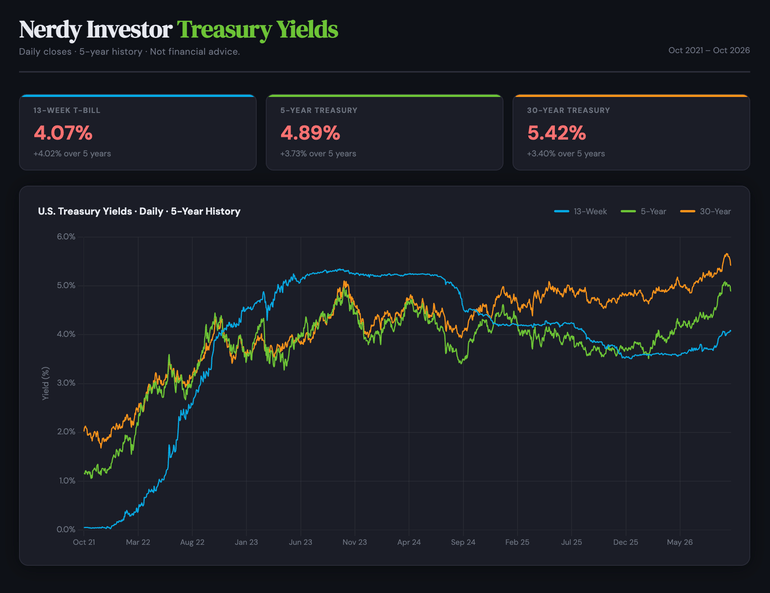
As I write this, the 3-month T-bill yield is around 4.07% and the 5-year note is getting close to 5%. You can see the yields for other Treasurys and savings rates in the table below:
|
Maturity |
Yield |
|---|---|
|
Savings (National Avg) |
0.37% |
|
2-Year |
4.82% |
|
10-Year |
5.19% |
|
30-Year |
5.52% |
|
Source: U.S. Treasury, Treasury yields accurate as of 10/14/26; FDIC, national savings rate as of 9/1/26. |
|
That’s a lot higher than we’re used to seeing bond yields. It’s also a lot higher than quite a few dividend yields. In fact, it’s higher than the vast majority of yields in the Dividend Aristocrats index (a group of S&P 500 companies that have raised their dividend payouts annually for at least 25 years).
So if you’re looking for a dividend yield that’s higher than current bond yields, you’re probably looking at a risky dividend that could be cut. This raises an interesting question: Is dividend investing worth it in this age of high bond yields?
There isn’t a simple answer. Both dividend stocks and bonds have some unique advantages over each other. We’re breaking it down below.
Dividend stocks still have some advantages
Potentially higher yields. Treasury bonds now pay higher yields than the vast majority of the Dividend Aristocrats, but not all of them.
|
The highest-yielding Dividend Aristocrat is Amcor Plc (AMCR), with a dividend yield of 5.92%. |
||||
|---|---|---|---|---|
|
Ticker |
Company |
Dividend Yield |
||
|
AMCR |
Amcor Plc |
5.92% |
||
|
CLX |
Clorox Co |
5.92% |
||
|
O |
Realty Income Corp |
5.86% |
||
|
HRL |
Hormel Foods Corp |
5.74% |
||
|
TROW |
T. Rowe Price Group Inc |
5.05% |
||
|
KMB |
Kimberly-Clark Corp |
4.89% |
||
|
PEP |
PepsiCo Inc |
4.50% |
||
|
Source: Finviz. Data is current as of Oct. 16, 2026, and is intended for informational purposes only. |
||||
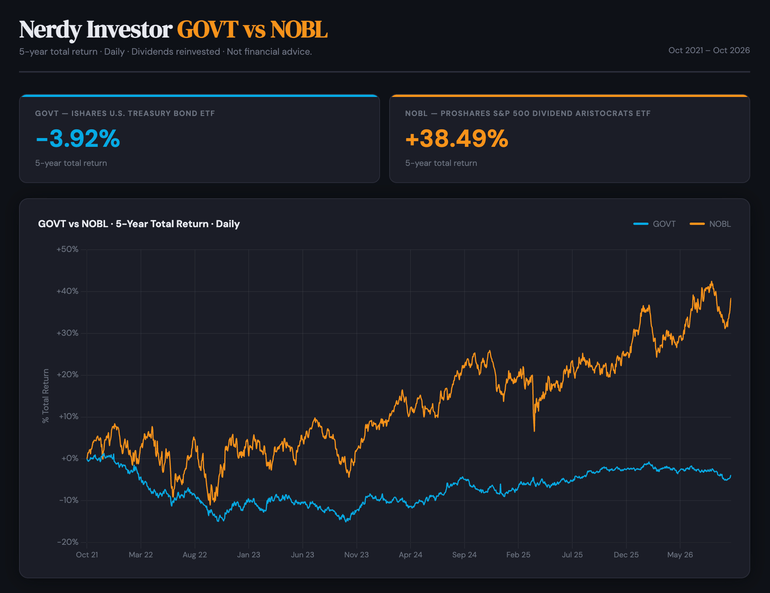
If you look at a chart of the ProShares S&P 500 Dividend Aristocrats ETF (NOBL) compared to the iShares U.S. Treasury Bond ETF (GOVT), this becomes clear:
More frequent payments (sometimes). Treasury bonds and notes pay interest semiannually, while short-term bills are sold at a discount to their face value, meaning that you realize their yield when you cash them in at maturity for the face value
[4]
. That means that if you’re investing in individual Treasury securities, you’re going to wait at least three months (the shortest commonly marketed Treasury duration) between payments.
Many large-cap dividend stocks also pay out dividends quarterly, semiannually or annually, but there are some monthly dividend stocks. (We have a page that tracks the highest-yielding monthly dividend stocks.)
One caveat here: If you’re more of an ETF investor, you should note that there are ETFs that pay out monthly dividends that contain both dividend stocks and bonds. In fact, our page on the highest-yielding monthly dividend ETFs shows a mix of both.
But Treasurys also have some advantages
Virtually no default risk. Treasurys are widely regarded as the benchmark for a risk-free investment worldwide. The risk of a default isn’t exactly zero (that’s technically not true of any investment), but Treasurys are backed by the full faith and credit of the United States government, which oversees the largest national economy in the world.
A U.S. Treasury default is extremely unlikely, and it’s sort of a “giant asteroid” scenario — if it were to happen, it would precipitate an unprecedented global financial and political crisis, and “darn, I should have bought dividend stocks instead” would probably be the least of your worries.
State & local tax exemption. Income from Treasurys is taxable at the federal level, but not at the state and local levels
[5]
, while dividend income is taxable at all three levels. That means that if you live in a high-tax jurisdiction, like I do (New York City greatest city in da world baybee), the after-tax yields of Treasurys compare even more favorably to those of dividend stocks.
Predictability. If you buy Treasurys and hold them to maturity, you are guaranteed by the U.S. government to earn the yield at the time of purchase. That dependability can make planning a lot easier, especially if you’re using short-term or mid-term Treasurys as more of a savings vehicle than an investment.
By contrast, dividend stocks are much less predictable. Stocks are more volatile than Treasurys. That gives them the potential for greater capital gains, as shown above, but it also gives them the potential for greater losses when the market gets turbulent.
Neither the author nor editor owned positions in the aforementioned investments at the time of publication.
The graphics in this newsletter were created by our editorial team with the assistance of AI. They use non-AI-generated market data, and have been reviewed by our team for accuracy and quality.