Amid pessimistic economic and policy sentiments, advisors see the potential in their firms
- Key insight: Advisors are less optimistic in October than they were in the summer about the state of the economy.
- Supporting data: In a survey of 213 advisors, outlooks and confidence fell more than they rose.
- Forward look: Despite the worries, advisors reported confidence in their practices.
Processing Content
The optimism of the summer has faded as financial advisors’ outlooks on the economy have dipped once again.
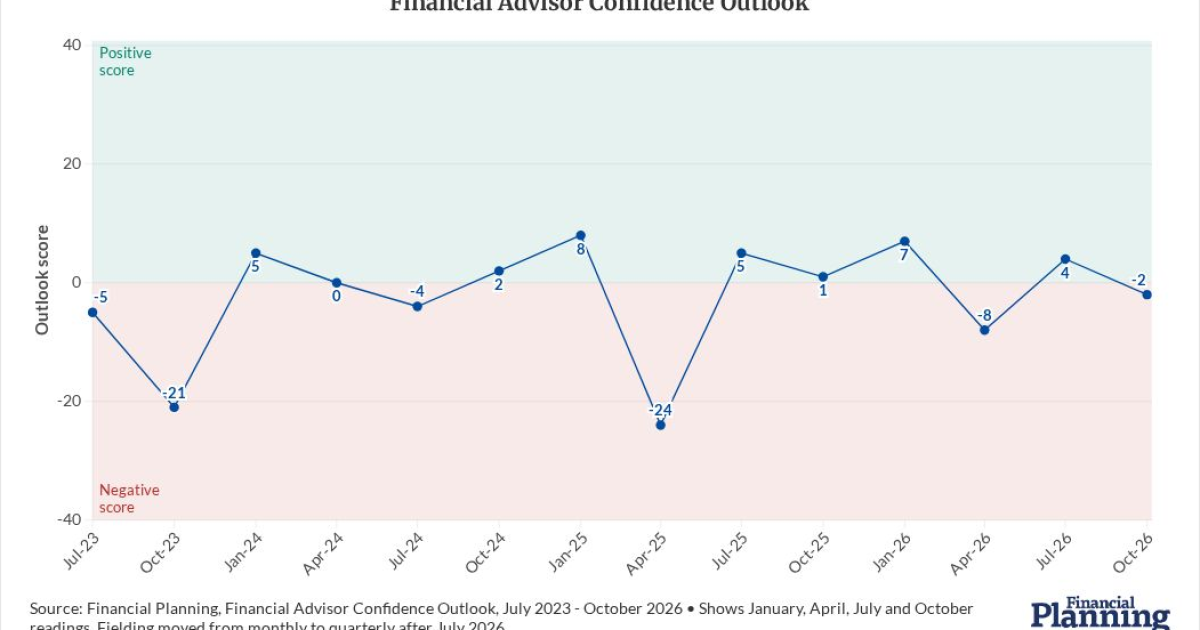
After upbeat findings in July, financial advisors’ overall outlooks have dropped to their lowest overall level since April in Financial Planning’s latest Financial Advisor Confidence Outlook (FACO) survey.
Outlooks on the global economic system and overall economy, which drove optimism in July, have cooled. Outlooks on government policies and client risk tolerance also fell while confidence in practice performance rose. Advisor confidence fell in October to a score of minus-2 on a scale from minus-100 (most pessimistic) to 100 (most optimistic). That score — compiled from surveys of 213 advisors in October — fell from plus-4 in July.
Optimism back then was fueled by the economy as the global economic system score rose 17 points to minus-34 from minus-51 in June. Advisors had their eyes on potential geopolitical improvements as concerns related to Iran and the Strait of Hormuz looked to be fading. These newest results come as FACO’s schedule has shifted from a monthly to a quarterly report.
Economic worry remained
Similar to July, the economy was the primary driver of advisors’ outlooks in October, but in this instance, outlooks fell substantially. The global economic system score fell 16 points from minus-34 to minus-50, erasing most of the ground it had gained in July, landing the score near October 2025’s level of minus-51.Advisors also expect volatility to remain. Fifty-four percent expect the global economic system to experience more volatility over the coming three months, up from 43% in July while 43% expect it to stay the same and 4% expect less volatility, down from 9% in July.
The overall economy also declined by 11 points over the past three months, falling from plus-38 in July to plus-27 in October.
In the survey, 14% of advisors expect the economy to contract, up from 10% in July, while 41% expect it will grow, down from 48%. Overall, more advisors (45%) expect it to remain constant, up from 42% in July.
Sentiment on policy waned
Advisors expressed uncertainty in October around policy issues, which included new legislation and monetary policy with independent RIAs the most pessimistic, scoring minus-22 compared with minus-1 for everyone else in the survey.
The government policy score fell by 12 points from plus-5 to minus-7, representing its first negative score since June 2024 and its lowest since May 2024.Monetary policy was the biggest reason for the decline. Twenty-one percent of advisors expect a positive impact from it on clients’ financial well-being over the coming three months, and 33% expect a negative impact.
When asked about attitudes around client risk tolerance, 58% expect it to stay the same over the coming three months, compared with 67% in July, while 26% expect a decrease, compared with 19% in July. Expectations that it would increase rose 2 percentage points to 16% from 14%.
The bright spot?
Despite the uncertainty over some aspects of the survey, advisors remained upbeat when it came to their own practices.
Practice performance scored plus-35, rising 9 points and representing the highest score since May, when it was 39. Some 38% of advisors expect their firm will outperform its goals over the next three months, 60% anticipate meeting them and 3% said they expect to underperform.
Among advisors, those using commission payment structures had more confidence in their practice with a score of plus-54 compared with advisors who don’t use commission at plus-21.