Planned 10% SIP step-up: Should you proceed if your mutual fund is delivering negative returns? Expert weighs in
If your mutual fund investment is in the red, increasing your systematic investment plan (SIP) may seem counterintuitive. However, negative returns alone may not be a sufficient reason to postpone a planned SIP step-up.
A SIP step-up means increasing your regular SIP investment amount at a set interval. For example, if you invest ₹10,000 every month and increase it by 10% annually, your monthly SIP would rise to ₹11,000 in the second year.
Here’s what investors should consider before deciding whether to proceed with a planned SIP step-up or defer it.
Should you continue with step-up SIP when your fund is delivering negative returns?
Aditya Agarwal, Co-Founder of Wealthy.in, said, “If the investor can afford it, the step-up should go ahead as planned. A correction does not change the reason it was planned in the first place. It only changes the price at which the extra money gets invested.”
He added that the reason behind the step-up also matters. If it is tied to a salary increase, delaying it may mean the additional income gets absorbed into higher spending. If it is meant to keep pace with inflation or address a shortfall in the target corpus, postponing the increase simply widens the gap between the target and the plan.
The only good reason to hold back is affordability. If the planned increase would strain monthly cash flow or eat into the emergency fund, it is fine to step up by a smaller amount now, pause it, or top up later, Agarwal added.
How can step-up SIP benefit from rupee-cost averaging?
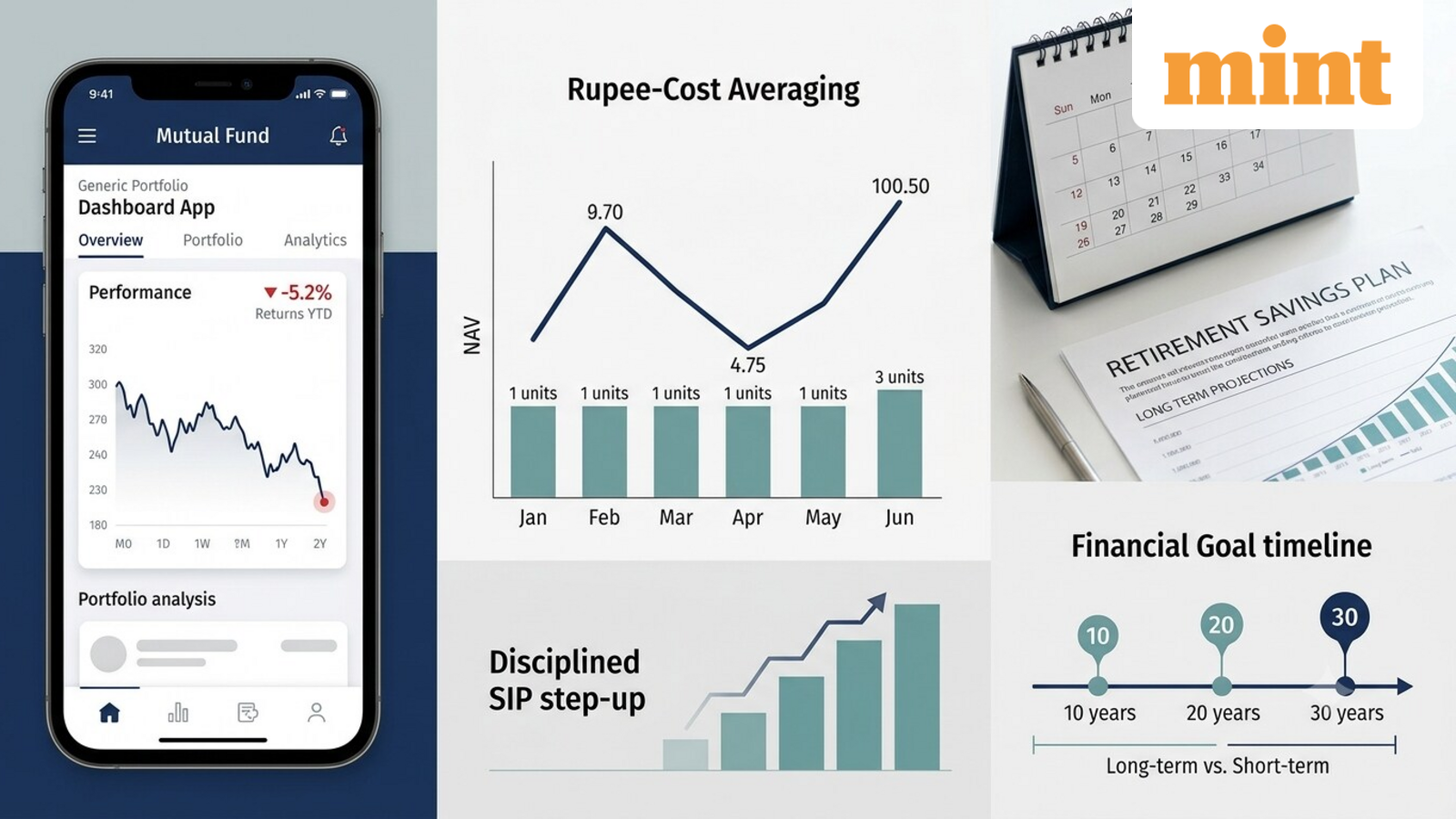
Rupee-cost averaging is a feature of investing a fixed amount at regular intervals. When a fund’s net asset value (NAV) falls, the same investment amount buys more units. When the NAV rises, it buys fewer units.
Suppose an investor increases their monthly SIP from ₹10,000 to ₹12,000 when the fund’s NAV falls from ₹50 to ₹40.
At an NAV of ₹40, the investor purchases 300 units with a ₹12,000 contribution, compared with 200 units with a ₹10,000 contribution at an NAV of ₹50. The additional ₹2,000 and the lower NAV together result in a higher number of units purchased.
Agarwal explained that investors should not use rupee-cost averaging as a reason to invest more than they can afford. The additional SIP contribution should come from monthly income or surplus savings, rather than by dipping into the existing investment portfolio or emergency reserves.
If a fund has consistently underperformed its benchmark index and category peers over the long term, say, 3 to 5 years or more, investors should review its performance and underlying reasons before increasing their SIP through a step-up.
A sustained period of underperformance warrants closer scrutiny rather than automatically investing more to average out the cost.
“Before stepping up, investors should calculate how much of their monthly income remains available after essential expenses, loan repayments and other financial commitments,” he noted.
How do investment horizon and goals determine whether you step up your SIP?
The time remaining until a financial goal is an important consideration when deciding how to approach a step-up SIP during a fund’s downturn, Agarwal said.
For a retirement goal 15–20 years away, a correction can be a reasonable time to continue stepping up equity investments. There is enough time for markets to work through a downturn, and the higher SIP gets, the more units it can buyat lower prices.
For a goal 3 to 5 years away, the incremental amount should usually go towards debt or conservative hybrid funds, in line with the goal’s allocation already shifting away from equity as it nears. Even if equity funds have delivered positive returns recently, that does not change the amount of time available before the money is needed, he explained.
“The mistake to avoid with shorter-term goals is using a market fall as a reason to load up on equity in the hope of catching up. If the market takes longer to recover than the goal allows, the investor could end up short exactly when the money is needed,” Agarwal added.
Disclaimer: This story is for educational purposes only. The views and recommendations made above are those of individual analysts or broking companies, and not of Mint. We advise investors to check with certified experts before making any investment decisions.
About the Author
Sheetal Goel is a Content Producer at Livemint, where she covers corporate developments, personal finance, business trends, markets, and SEBI-related updates. She focuses on simplifying complex financial concepts and presenting them in a clear, reader-friendly manner, thereby helping audiences better understand investment trends, personal finance, and market developments. Her writing focuses on making finance more accessible to everyday readers while maintaining clarity, accuracy, and relevance.
She holds a degree in Economics (Hons.) along with an MBA in Finance, which has helped her develop a strong foundation in financial analysis, market understanding, and business reporting. Before joining journalism, she worked with finance and broking firms, where she closely followed market developments, investment strategies, and evolving industry trends. This practical exposure strengthened her understanding of financial markets. She has also written content across multiple formats and platforms, including YouTube, LinkedIn, and Instagram.
Over time, she has developed expertise in covering market-linked stories, investor-focused topics, and regulatory updates in a simplified yet informative style. She also enjoys reading and listening to Hindi poetry, reflecting her appreciation for literature and creative expression beyond the world of markets and numbers.