A Smile Is America’s Favorite Way to Greet a Neighbor
- Smiling is the most common way U.S. homeowners greet strangers and familiar faces in their neighborhood, followed closely by saying hello: 45% of homeowners smile when they see strangers, and 40% go with a verbal greeting.
- For people homeowners recognize but don’t know, 51% smile, and 49% say hello.
- Nearly half of baby boomer homeowners greet strangers in their neighborhood by saying hi, making them more likely than younger people to go with a verbal greeting. Smiling is the most common greeting among Gen Xers, millennials and Gen Zers who own their home.
Nearly half (45%) of U.S. homeowners smile at strangers when they see them in their neighborhood, making it the most common greeting among the six we asked about in a recent Redfin survey.
It’s followed closely by saying hello, with two in five (40%) respondents choosing that option. Making eye contact rounds out the top three, with 30% of homeowners making that selection.
The results are similar for greeting a familiar face. Just over half (51%) of homeowners greet people they recognize but don’t know with a smile, just under half (49%) opt for saying hello, and 42% wave.
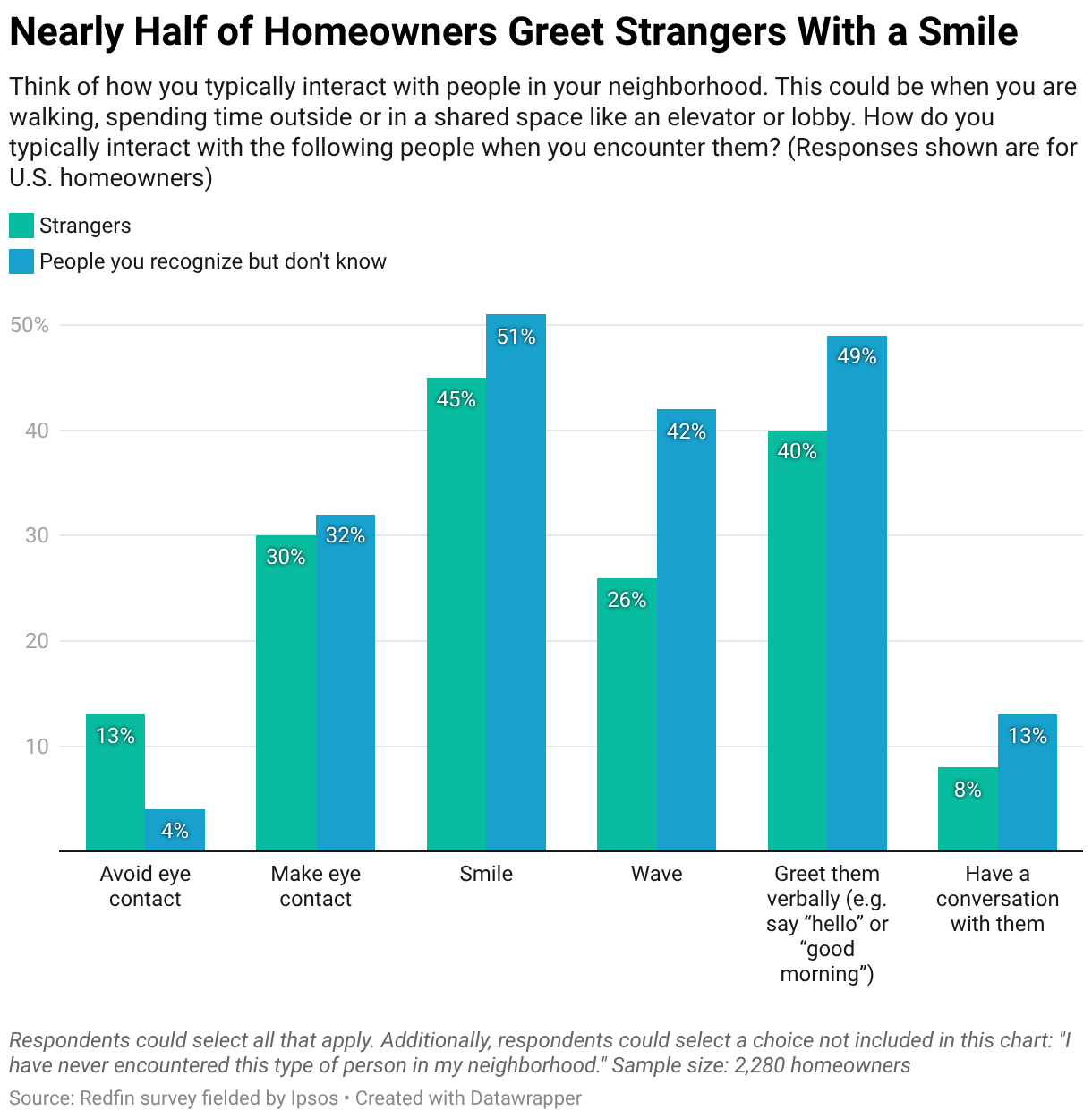
This is according to a Redfin survey conducted by Ipsos in May 2026, fielded to 4,000 U.S. residents, including 2,280 homeowners. The results for these respondents have a credibility interval of +/- 1.9 percentage points for all U.S. residents, and +/-2.5 percentage points for homeowners. This report focuses on homeowners’ responses to the following question: “Think of how you typically interact with people in your neighborhood. This could be when you are walking, spending time outside or in a shared space like an elevator or lobby. How do you typically interact with the following people when you encounter them?” It asked about strangers, people you recognize but don’t know, acquaintances, and friends. Respondents could select all that apply from a list of six options, which are listed in the chart above, or they could select “I have never encountered this type of person in my neighborhood.”
“Most people aren’t stopping to have a conversation with every neighbor they pass, but a smile, wave or quick hello can go a long way toward making everyday interactions feel friendly,” said Daryl Fairweather, Redfin’s chief economist. “Homeowners may feel inclined to make those small connections because they often expect to stick around their neighborhood for a long time. Establishing a friendly relationship with your neighbors can make you feel good in the moment–and it’s an investment that could pay off years into the future, when you may need to borrow a snowblower or a pickup truck. It’s a reminder that even the smallest gestures can help people feel more connected to the place they call home.”
A recent Redfin analysis found that Salt Lake City is America’s most neighborly city, followed by Portland, OR and Kansas City, MO. That report ranked places by their “neighborliness” based on factors including volunteerism, helping neighbors and community involvement.
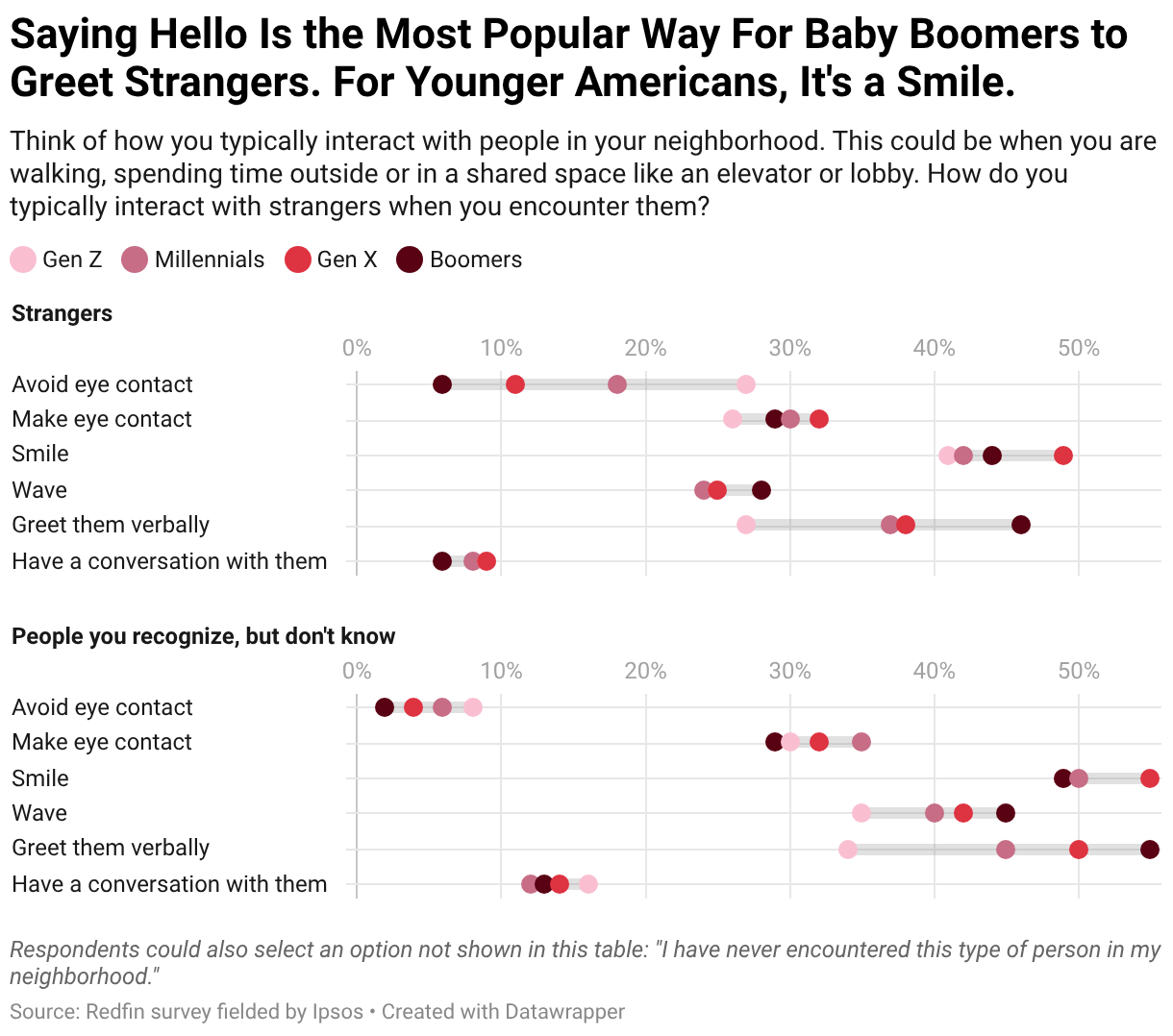
Baby Boomers Are Most Likely to Say Hello, Gen Xers Most Likely to Greet Strangers With a Smile
Baby boomers are more likely than younger Americans to say hello to strangers; 46% of homeowners in that generation greet people they don’t know verbally, compared with 38% of Gen X homeowners, 37% of millennial homeowners and 27% of Gen Z homeowners.
Gen Xers are most likely to greet strangers with a smile. Roughly half (49%) of Gen Xers who own their home smile at strangers in their neighborhood, compared to 44% for baby boomers who own their home, and 42% of millennials and 41% of Gen Zers who own their home. .
But that doesn’t mean younger Americans are unfriendly. A smile is the most common way for millennial and Gen Z homeowners to greet strangers.