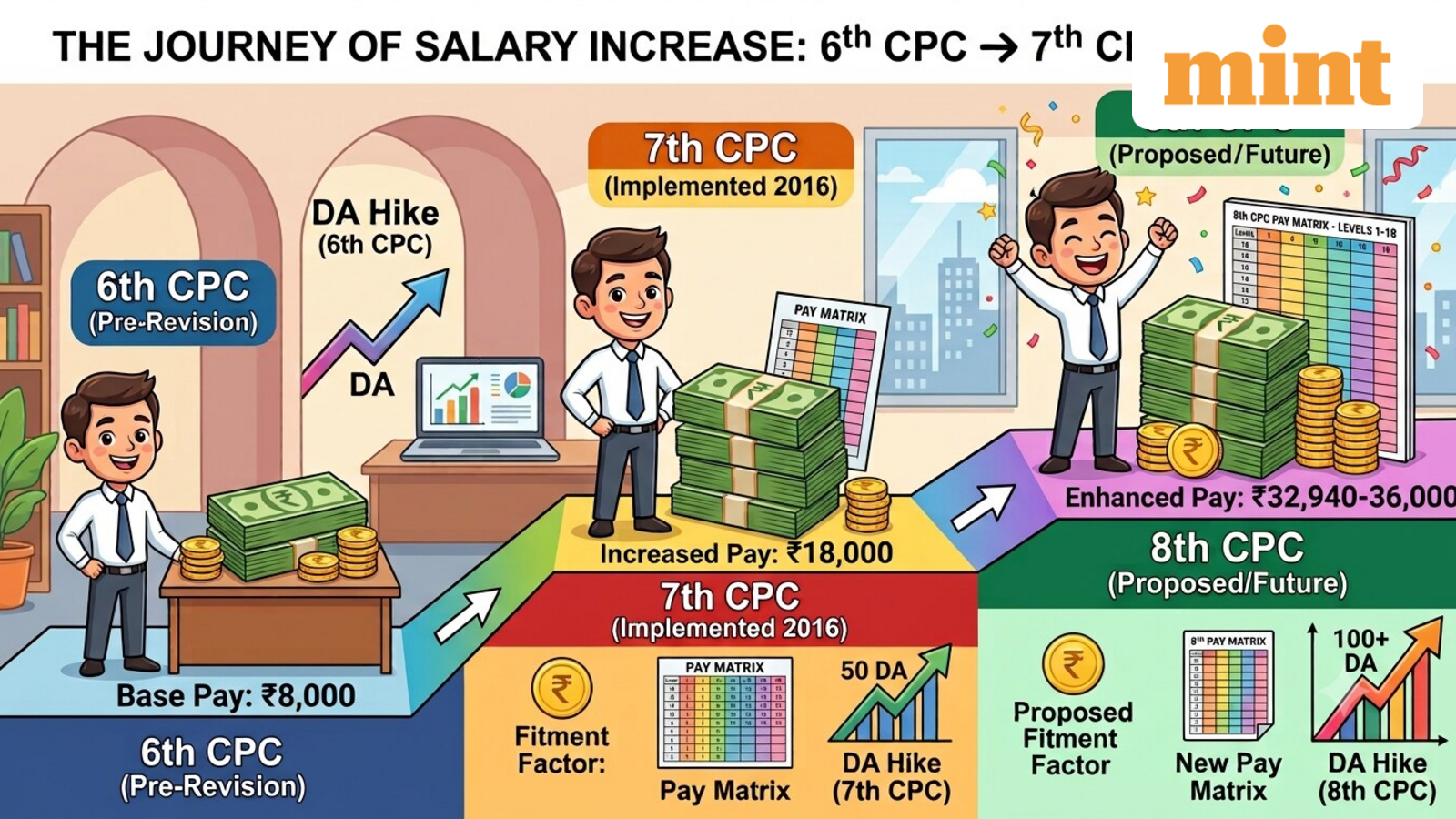
DA, pay scale, salary, pension, increments — Here’s what can be expect from 8th CPC recommendations; full list
The 8th central pay commission (CPC) is in its consultation stage and has scheduled meetings in Mumbai later this month, in order to hold discussions with employee unions, representatives, groups, pensioner associations, federations, and other stakeholders, before releasing its official recommendations.
Overall, the recommendations are set to benefit over 1 crore individuals, including about 50 lakh central government employees and close to 65 lakh pensioners, including personnel and retirees with the defence and railway ministries.
Established by the central government every 10 years to revise the allowances, pay and pensions of its employees, the pay commission or CPC, is responsible for decisions on contributions, retirement benefits and government spending. All central government employees and retired former servicemen are impacted by the revisions.
Former Supreme Court Justice Ranjana Prakash Desai is Chair of the 8th CPC, and the panel includes Member-Secretary — Pankaj Jain, a former IAS officer, and Member of the Commission — Professor Pulak Ghosh, a tenured Professor of Finance and Member of the Economic Advisory Council to the Prime Minister.
8th CPC: Terms of Reference, explained
The Terms of Reference (ToR) of the 8th Pay Commission outline what central government employees and pensioners can expect from its final recommendations. Approved by the Union Cabinet last year, the ToR defines the commission’s scope of work and specifies the areas on which it must make recommendations.
The ToR as specified, is as follows:
The 8th CPC will be a temporary body comprising a Chairperson, one part-time Member and a Member-Secretary. It has been asked to submit its recommendations within 18 months of its constitution, although it may submit interim reports if required.
While framing its recommendations, the commission has been asked to consider the economic conditions in the country and the need for fiscal prudence; the need to ensure that adequate resources are available for developmental expenditure and welfare measures; the unfunded cost of non-contributory pension schemes; the likely impact of the recommendations on the finances of the State Governments, which usually adopt the recommendations with some modifications, and the prevailing emolument structure, benefits and working conditions available to employees of Central Public Sector Undertakings and the private sector.
- To review the existing allowances and conditions of their admissibility and recommend rationalisation keeping in view the multiplicity of allowances.
- For pensioners, to review the Death-cum-Retirement Gratuity of employees borne on the National Pension System (NPS) (including Unified Pension Scheme) and make recommendations; and the Death-cum-Retirement Gratuity and pensions of employees not borne on the NPS (including UPS) and make recommendations.
When can we expect announcement?
As per the timeline, the commission is likely to announce its recommendations within 18 months of the constitution (on 3 November 2025). This means February or April 2027 is the earliest we can get any official announcements on its decisions. But the absolute deadline to submit the report is May 2027.
Further, based on past trends, once the pay commission’s recommendations are made, the rollout takes another two to three years to complete. This means that hikes announced in 2027 may only be fully implemented by 2029 or 2030.