Chase, Wells third-quarter residential mortgage results
Processing Content
- Key Insight: How a 56 basis point margin drop at Chase affects nonbank mortgage originators.
- Expert Quote: “it remains unclear if banks are continuing to take share” — Bose George, KBW
- Supporting Data: A 69% quarterly decline in JPMorgan Chase’s production revenue to $46 million.
Overview bullets generated by AI with editorial review.
The third-quarter mortgage results from JPMorgan Chase and Wells Fargo highlights the importance for the publicly traded nonbanks to have a more balanced operation between originations and servicing, BTIG said.
“The third quarter showed weaker retail origination volumes, consistent with our expectations for our nonbank coverage,” said the report from Managing Director Douglas Harter.
His counterpart at Keefe, Bruyette & Woods, Bose George pointed to the 56 basis point decline in gain-on-sale margin at Chase.
“We think this was worse than expected; however, pipeline hedge losses or other one-time items could have impacted GOS margins,” George said. “We also note Chase saw an uptick in correspondent versus retail which has a lower GOS margin. We model fairly flat to down modestly gain-on-sale margins by channel for nonbank mortgage originators.”
The drop-off compares with BTIG’s expectations of a 5 basis point increase in gain on sale for the nonbanks Harter covers.
“We would note that bank GOS margins have historically been much more volatile on a quarterly basis than our nonbank coverage, which limits the near-term comparability between the two,” Harter said.
George added it is difficult to read across to nonbanks from just one data input, which could have been affected by hedging or other one-time items. Wells Fargo does not report gain on sale.
JPMorgan Chase reported combined production revenue and net mortgage servicing revenue of $258 million in the third quarter, compared with
Production revenue of $46 million was down 69% versus the prior period but net servicing revenue was 19% higher to $212 million.
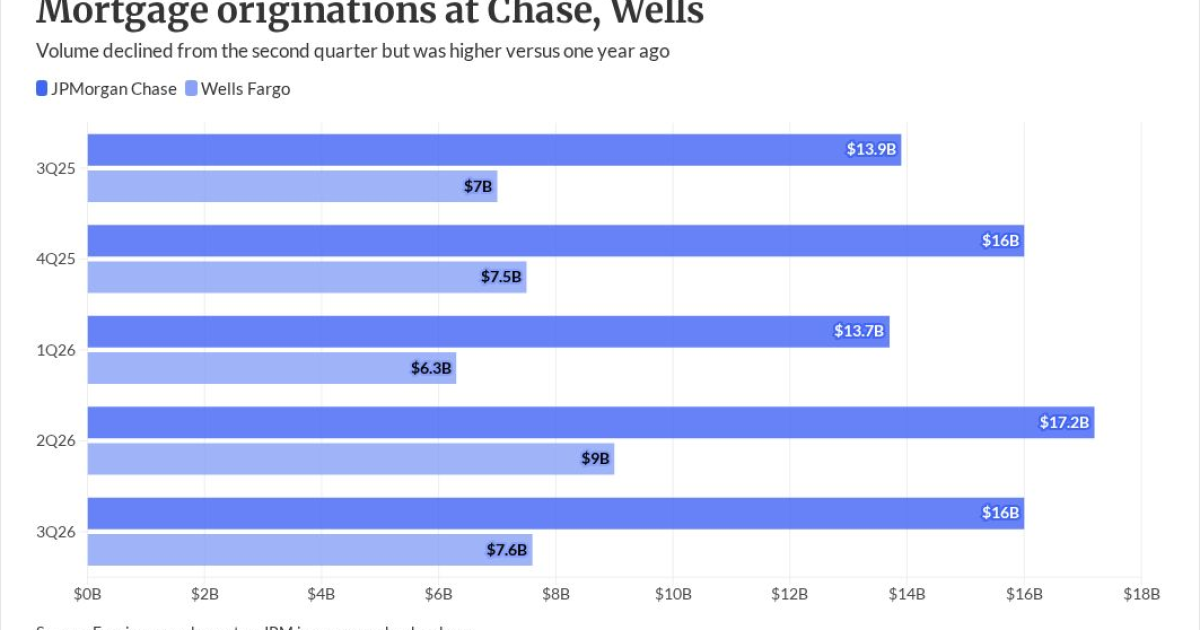
Total volume was $16 billion, of which $8.7 billion was retail and $7.3 billion correspondent. In the second quarter, Chase produced $17.2 billion, with $10.6 billion coming from retail. This was still a 15% year-over-year improvement from $13.9 billion.
Wells Fargo, which only operates in retail, produced $7.6 billion, versus $9 billion in the second quarter and $7 billion
It serviced $343.9 billion at quarter-end, continuing
The retail volume decline between both companies was in line with Harter’s expectations of a 15% quarter-to-quarter decline; industry forecasts expected an 8% reduction.
“Net/net, we’d characterize the quarter as in-line for volume, although it remains unclear if this reflects industry volume or if banks are continuing to take share from nonbanks,” George said.
KBW is expecting “a fairly neutral reaction” in independent mortgage banker stock prices, “although the multiples remain depressed given the sell-off year-to-date.”
On the servicing side, Chase’s carrying values were up 9 basis points in the third quarter. As of Sept. 30, Chase serviced $651.9 billion.
“This is directionally in line with our expectations given the 75 basis point increase in the 10-year Treasury yield in the quarter,” Harter said. “For our coverage, we are forecasting a more modest low single-digit increase in MSR values for the third quarter.”
Rithm remains Harter’s “top pick, based on its balanced business model and attractive valuation.”
KBW also expects an increase in MSR values, but did not give further information.