Heed Warren Buffett’s Advice: The Time to Be Fearful When Others Are Greedy Has Officially Arrived
For more than half a century, Berkshire Hathaway‘s (BRKA +0.97%)(BRKB +0.89%) Warren Buffett had a knack for running circles around Wall Street’s benchmark stock index, the S&P 500 (^GSPC +0.59%). Prior to his Dec. 31, 2025, retirement, the Oracle of Omaha outperformed the S&P 500 by more than 6,000,000%!
Even though Buffett never recommended individual stocks, his nuggets of investing wisdom have always been highly sought after by investors. In fact, lengthy books have been written about these unwritten investing rules that led to his glaring outperformance.
But there’s only one unwritten rule that Warren Buffett refused to break in his time as Berkshire Hathaway’s CEO: his quest for value. If a stock didn’t offer an attractive value proposition, he wanted no part of it, regardless of its competitive moat, capital-return program, or the quality of its management team.

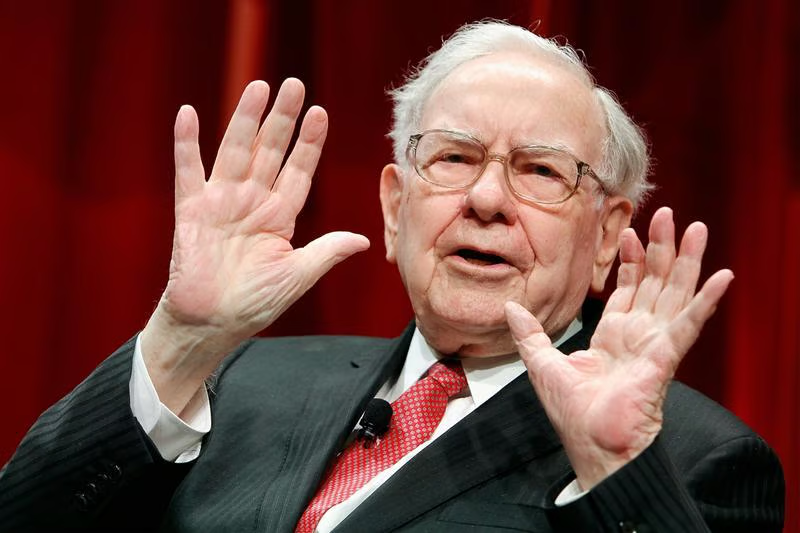
The Oracle of Omaha was a net seller of stocks for 13 quarters leading up to his retirement. Image source: Getty Images.
In Buffett’s 1986 letter to shareholders, he coined what’s arguably his most popular bit of investing wisdom in proclaiming:
Our goal is more modest: we simply want to be fearful when others are greedy and to be greedy when others are fearful.
Put simply, the Oracle of Omaha suggests buying stocks when others are panicking, and being wary when equity valuations are soaring. This bit of advice is highly relevant 40 years later, with the time to be fearful when others are greedy officially arriving.
Warren Buffett’s favorite valuation tool just made dubious history
In the lead-up to Buffett’s Dec. 31 retirement as CEO, he was a net seller of stocks for 13 consecutive quarters, totaling approximately $187 billion. While he alluded to tax-based selling as part of the reason for this net selling activity, historically pricey stock valuations almost certainly played a role.
Given that there’s no one-size-fits-all strategy for valuing individual companies on Wall Street, “value” is a tricky subject. But Berkshire’s now-former boss had a very clear valuation tool he preferred: the market-cap-to-GDP ratio (now known as the “Buffett indicator”).
Stock Market reaches most expensive valuation in history after the Warren Buffett Indicator hits 239%, surpassing the Dot Com Bubble, the Global Financial Crisis, and the 2022 Bear Market 🤯 👀 https://t.co/K5LBAN6S2Q
— Barchart (@Barchart) August 15, 2026
In a 2001 interview with Fortune magazine, Buffett referred to this ratio as “probably the best single measure of where valuations stand at any given moment.”
When backtested to December 1970, the Buffett indicator has averaged 89%. In other words, the cumulative value of public companies has averaged 89% of U.S. gross domestic product (GDP), spanning nearly 56 years. In mid-August, the Buffett indicator approached 240% and exceeded 238% as recently as last week.
The Buffett indicator suggests that finding value in today’s stock market is increasingly difficult.
Although Warren Buffett has always been a long-term investor and rarely, if ever, tried to time short-term moves in the benchmark S&P 500, he wasn’t afraid to sit on his hands and wait for stock valuations to come back into his wheelhouse when greed became apparent on Wall Street. His persistent selling in the lead-up to his retirement is what built up a veritable cash war chest for his successor, Greg Abel.
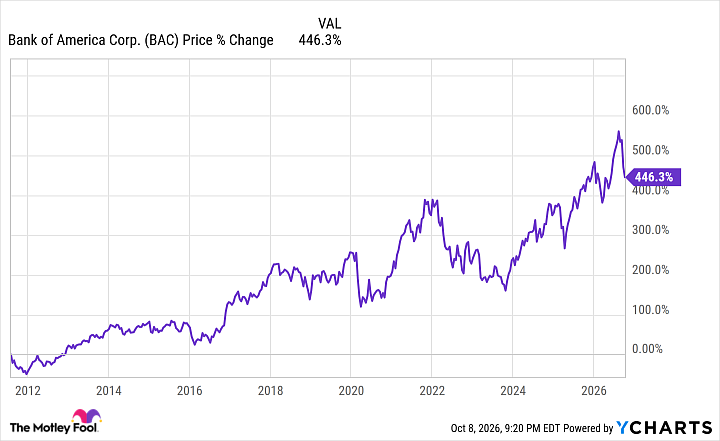
This patience has also worked out swimmingly for Berkshire’s shareholders in the past. Waiting for valuations to make sense allowed Buffett to nab a $5 billion stake in Bank of America (BAC +1.32%) in 2011 at a greater-than-60% discount to its book value. By mid-2017, Berkshire was recognizing a windfall profit from its BofA position.
While stocks remain attractive over the long run, investors would be wise to heed Buffett’s advice in the interim: be fearful when others are greedy.