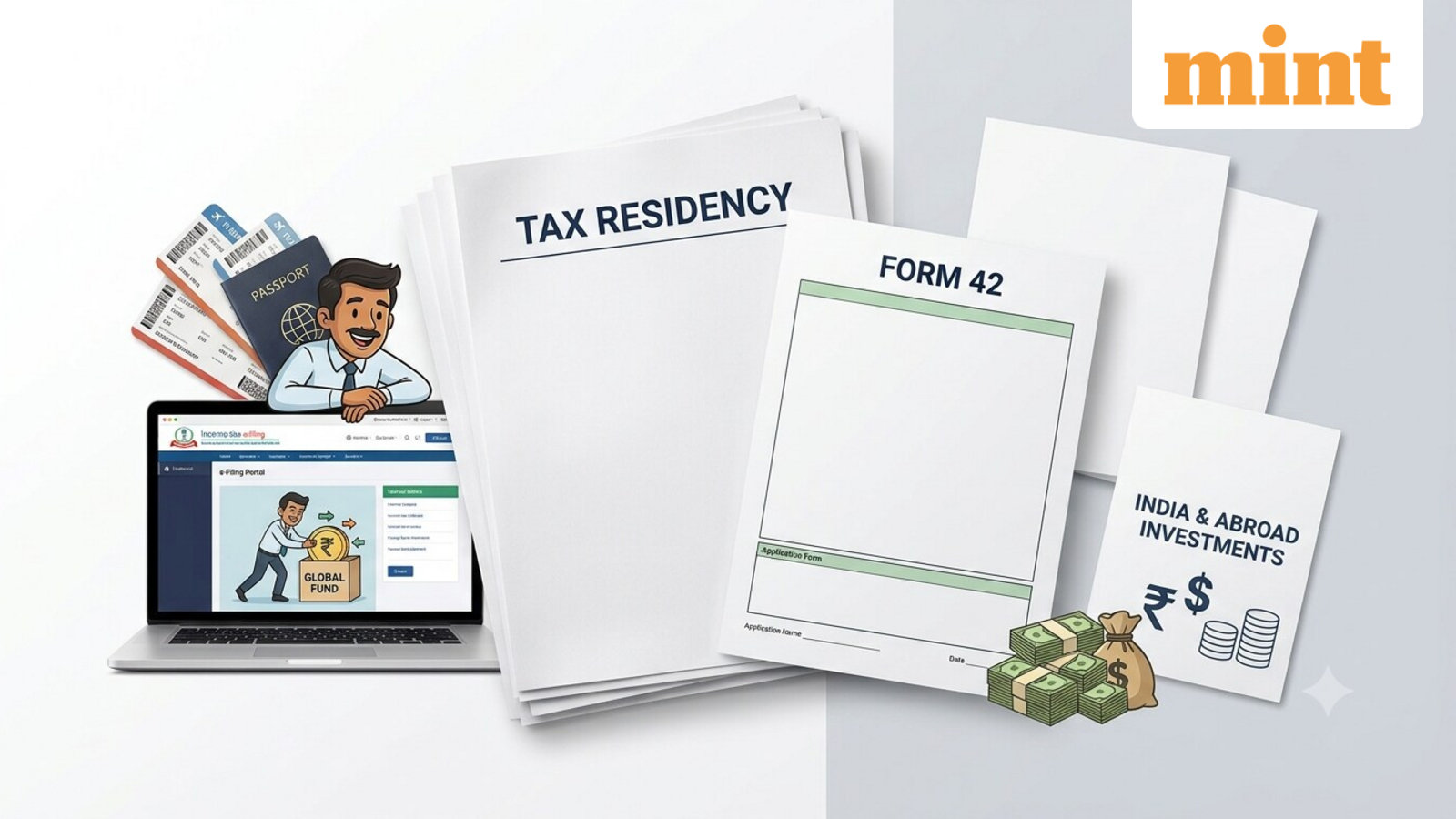
Want relief from double taxation on foreign income under DTAA? Know how to apply for residency certificate using Form 42
Indian residents earning income from overseas may need a Tax Residency Certificate (TRC) to claim tax benefits under a Double Taxation Avoidance Agreement (DTAA).
Under the Income-tax Act, 2025, applicants can apply for the certificate online through the e-filing portal using Form No. 42. Here is what taxpayers need to know about tax residency, DTAA benefits, and the application process.
What is a Tax Residency Certificate (TRC)?
A Tax Residency Certificate establishes a taxpayer’s residential status for tax purposes in India. It can serve as supporting documentation when an Indian resident seeks benefits available under a tax treaty between India and another country.
TRC allows taxpayers to fulfill requirements for tax claims in other countries under the Double Taxation Avoidance Agreements (DTAAs).
What is a Double Taxation Avoidance Agreement?
A DTAA is a tax treaty between two countries that sets out how specified categories of income will be taxed.
Suppose an Indian resident earns interest from a bank deposit in another country. The foreign country may deduct tax on the interest earned, while India may also tax the income because the individual is an Indian tax resident. This can result in double taxation. The taxpayer can claim relief under the applicable DTAA.
India has entered into DTAAs with several countries, and taxpayers may qualify for an exemption, a lower tax rate, or relief from double taxation.
| Albania | Israel | Qatar | Armenia | Italy | Romania |
| Australia | Japan | Russian Federation | Austria | Jordan | Saudi Arabia |
| Bangladesh | Kazakhstan | Serbia | Belarus | Kenya | Singapore |
| Belgium | Korea | Slovak Republic | Bhutan | Kuwait | Slovenia |
| Botswana | Kyrgyzstan | South Africa | Brazil | Latvia | Spain |
| Bulgaria | Libya | Sri Lanka | Canada | Lithuania | Sudan |
| China | Luxembourg | Sweden | Colombia | Macedonia | Switzerland |
| Croatia | Malaysia | Syria | Cyprus | Malta | Tajikistan |
| Czech Republic | Mauritius | Tanzania | Denmark | Mexico | Thailand |
| Egypt | Mongolia | Trinidad and Tobago | Estonia | Montenegro | Turkey |
| Ethiopia | Morocco | Turkmenistan | Fiji | Mozambique | Uganda |
| Finland | Myanmar | Ukraine | France | Namibia | United Arab Emirates |
| Georgia | Nepal | United Kingdom | Germany | Netherlands | United States |
| Greece | New Zealand | Uruguay | Hong Kong | Norway | Uzbekistan |
| Hungary | Oman | Vietnam | Iceland | Philippines | Zambia |
| Indonesia | Poland | Ireland | Portugal |
*Source: PwC, List of countries with which India has DTAAs, As of 12 May 2026
What is Form 42 and who can apply?
Under Sections 159(1) and 159(2) of the Income-tax Act, 2025, an Indian resident seeking a certificate of residence must submit Form 42 to the Assessing Officer.
Registered users with a valid PAN on the income-tax e-filing portal can apply. Applicants must provide the required personal details and documents, such as Aadhaar, TAN, or passport, along with supporting documents for the information furnished in the form.
There is no prescribed filing deadline. Taxpayers can submit the application when they require the certificate.
How can taxpayers file Form 42 online?
- Visit the Income Tax Department’s e-filing portal and sign in using your PAN as the user ID and your password.
- Select e-File, then Income Tax Forms, followed by File Income Tax Forms.
- Open the section for forms under the Income-tax Act, 2025, and select Form No. 42.
- Choose the applicable Tax Year.
- Enter the applicant’s particulars in Part A. Some information may be prefilled from the portal profile. Check the details, including the address, and save the section.
- Provide the information required for the TRC in Part B. Field 8 is applicable to individuals, while Field 9 applies to applicants other than individuals. Field 10 requires the applicant’s address for the year for which the certificate is sought. Save the section.
- Open the attachments section and submit the applicable supporting documents. Attachments A1 and A2 are for individuals, while A3 applies to applicants other than individuals. Additional documents can be submitted under A5.
- Ensure all four sections—Part A, Part B, Attachments, and Verification—are marked complete. Preview the application and correct any errors before proceeding.
- Select “Proceed to E-Verify”. Verify the application using the OTP, electronic verification code (EVC), or DSC.
- After successful submission, download the acknowledgement receipt and retain the Transaction ID and Acknowledgement Receipt Number for reference.
The application is processed by the Income Tax Department. If approved, the Tax Residency Certificate is issued in Form No. 43.
Disclaimer: This is for informational purposes only. Please visit the official website for the latest updates and consult a tax expert.