8th Pay Commission: Pensioners’ association seeks 3.833 fitment factor and 6% annual increments
The 8th Pay Commission has completed its key meetings in Bengaluru on 8 October. In these meetings, the 3-member panel headed by Justice Ranjana Prakash Desai held discussions with prominent organisations and unions such as the Coordination Committee of Central Government Pensioners Associations, Karnataka; the Karnataka Posts and Telecommunications Pensioners’ Association; the Karnataka Income Tax Pensioners’ Association and the Karnataka Central Government Pensioners Association, among others.
This article focuses on the proposals and recommendations of the Karnataka Posts and Telecommunications Pensioners’ Association presented to the 8th Pay Commission panel in its memorandum submitted earlier for the consideration of the 8th Pay Commission panel.
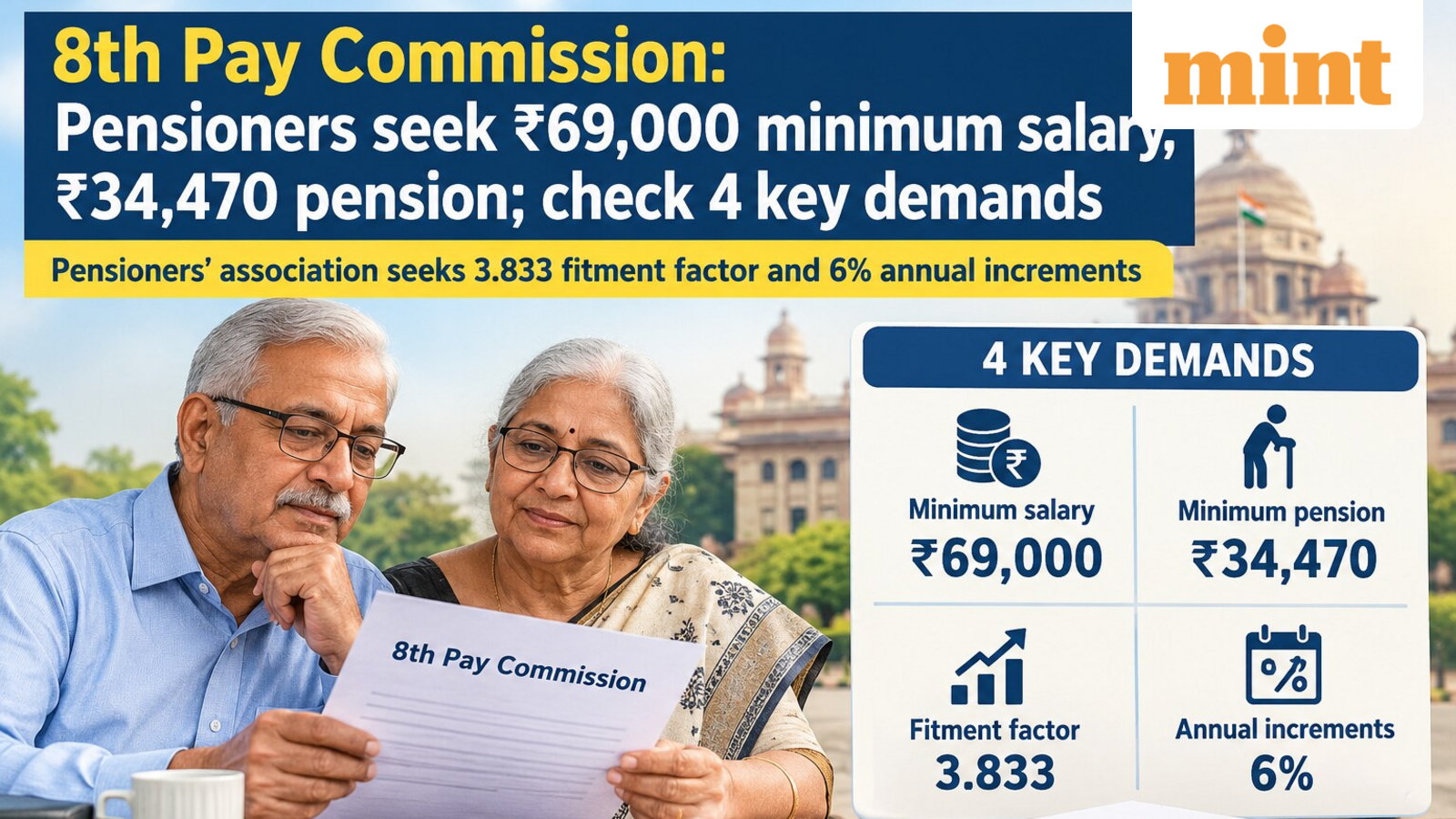
The reputed union has proposed several key changes, including a substantial increase in the minimum basic pay and pension under the 8th Central Pay Commission, recommending a fitment factor of 3.833. The proposals they submitted also seek meaningful changes to annual increments, minimum wage calculations, and family-unit norms.
It is also important to keep in mind that the recommendations are demands made by the association and have not been approved by the central government. Currently, the 3-member panel continues with its consultative process, with another key set of meetings beginning in Mumbai from 22 October 2026 lined up. Let us now check the proposals put forward by the union in detail.
8th Pay Commission: What are the proposed salary and pension revisions?
The association has argued that existing pay and pension levels need to be revised to account for rising inflation, day-to-day expenses and living costs. Its principal demands include the following:
|
Pay and pension component |
Existing level |
Proposed level |
|---|---|---|
| Minimum basic pay | ₹18,000 | ₹69,000 |
| Minimum basic pension | ₹9,000 | ₹34,470 |
| Annual increment rate | 3% | 6% |
| Fitment factor | To be finalised | 3.833 |
Note: These are some of the union’s proposed changes, not the approved 8th Pay Commission benefits. They are illustrative in nature; for complete details, refer to the official memorandum.
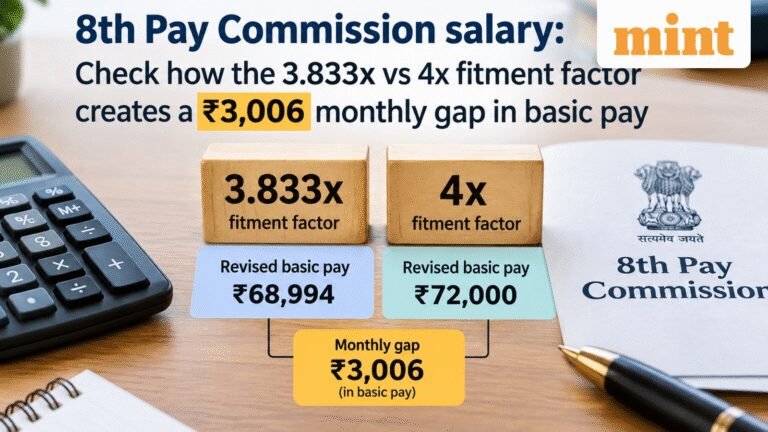
Now, when the proposed fitment factor of 3.833 is applied to the existing minimum basic pay of ₹18,000, then it would result in about ₹68,994 or approximately ₹69,000. This is the core demand of the union, i.e., to meaningfully improve the basic pay of serving employees to provide them with a base to combat inflation.
Furthermore, multiplying the existing minimum pension of ₹9,000 by the same multiplier, i.e., 3.833, gives ₹34,497. The association’s proposed pension figure of ₹34,497 is currently its stated demand, rather than the exact result of that multiplication.
Aykroyd formula revision and higher annual increments
The association has also requested an update to the ‘Aykroyd formula’ that is utilised to assess minimum wage requirements. It wants calculations to clearly reflect the changing household expenses and the growing role of digital services in day-to-day living.
Light has been shed on aspects such as internet services, online communication, and other digital services, which are now an inherent part of day-to-day living and should therefore be adequately addressed by the 8th Pay Commission panel as part of household expenses.
It has also been highlighted that raising the annual increment rate from 3% to 6% can improve employee motivation and performance.
Family-unit calculation is also under review
One more vital demand is to replace the existing 3-unit family calculation with a broader and more comprehensive framework accounting for:
- Employee.
- Spouses.
- Children.
- Dependent parents.
The proposal aims to make minimum wage calculations more reflective of and aligned with the household’s requirements. The major units in this are 5 instead of the usual 3. These 5 core units are divided as follows: (employee 1 unit, spouse 1 unit (no gender discrimination), 2 children, 0.8 units each of the parents.
In summary, it is essential to keep in mind that, as of today, these are just broader demands highlighted by the prominent union. These demands will be analysed by the 8th Pay Commission panel and subsequently considered as the commission proceeds to present its final report to the central government. Their approval, hence, is subject to the final report of the 8th Pay Commission panel along with further clearance by the central government.
When will the 8th Pay Commission submit its final report?
The 8th Pay Commission was constituted on 3 November 2025. As per the ToR (terms of reference), the three-member panel is expected to table its final report by May-June 2027, i.e., 18 months after its constitution.
Hence, central government employees and pensioners will have to wait a few more months for the commission’s examination of stakeholder submissions and the government’s final decision, as more than 11 months of the allocated time have already elapsed, with about 7 months remaining.
Disclaimer: The proposals and figures discussed are illustrative and based on the association’s memorandum. They are subject to the 8th Pay Commission’s recommendations and the Central Government’s approval. For complete details, refer to the association’s official memorandum. This article is for general information only.