Pa. credit union to offer Google Gemini-based bot to members
- What’s at stake: Consumers have started turning to large language models like ChatGPT, Claude and Gemini for financial help.
- Forward look: Experts say banks and credit unions will need to offer their own large language model-based financial advisors in order to compete.
PSECU, a credit union in Harrisburg, Pennsylvania, was an early adopter of digital banking — in 1995 it started mailing floppy disks to members so they could conduct transactions from home.
Soon, it will be one of the first to offer members a way to manage their finances with Google Gemini.
Processing Content
The credit union, which has $10 billion in assets and a half-million members, is working with Candescent, which has woven Google Gemini into its mobile- and digital-banking software.
When members log into their banking app or website, the home screen will show them a summary of their finances and early warnings about issues they should address — for instance, if they have a bill coming up, and they don’t have quite enough money in their accounts to cover it. It will also offer suggestions, including how to pay down debt faster or increase savings, based on their goals.
If a customer has spent $400 less than they normally do in a given month, they’ll be asked questions like, Do you want to put this extra cash into your money-market account? Do you want to pay off a loan?
“That action is fulfilled immediately without having to click, click, click, click, click,” Gareth Gaston, chief product officer at Candescent, told American Banker.
The software also offers a conversational experience, he said. “The conviction there is that you should be able to do anything in a conversational talk or text. You should be able to say, ‘I want to pay my bill’ and have that conversational experience, rather than use a prescriptive menu-driven thing, which is yesterday’s chatbot.”
The bot is transparent to the end user and to the institution and fully auditable, according to Gaston.
“For what it’s worth, I don’t expect that our clients are just going to turn all of this on on day one and go nuts,” he said. “This is going to be a journey both for us and our clients.”
The credit-union member still has to take the action, Erin Hennessy, chief member experience officer at PSECU, told American Banker. “But because we have the information, we want to give it to them in a way that’s easy to understand. So it’s not necessarily financial advice, but it’s financial guidance.” Customers can opt out of the summaries and personalized insights if they don’t want the credit union analyzing their accounts this way.
“I think this is an early sign of the next inflection point in banking,” said Theodora Lau, founder of consultancy Unconventional Ventures. “First, we had internet banking. Then came mobile banking. And now, this. The first two shifts changed where banking happened — computer browser and mobile phone. This one changes how banking happens. Instead of navigating the bank’s menus, which can be complicated, members can just ask for what they need in their own words.”
Lau said this reminds her of when Amazon introduced Alexa, and dozens of banks came out with Alexa Skills that consumers could use to ask questions like, Hey, Alexa, how much money did I spend at Starbucks last month?
“And then conversational banking stalled,” Lau told American Banker. “Two things have changed since then: The technology has matured, and the users have also matured. Millions of people now type and talk to AI assistants every day, for work or for personal use. So the habit and expectations are already there. Banking is simply catching up.”
Giving credit union members a leg up
Hennessy says her only goal for the new tool is to help the credit union’s members.
“I think that’s the difference between a credit union and a bank,” said Hennessy, who previously worked for Rocket Mortgage and several banks. One of the reasons she left for-profit financial services firms for a nonprofit, she said, “is we actually do hope and dream that because we can equip our members with data and insights, they can be better informed, they can make better decisions, and they can be better off financially.”
PSECU’s members are Pennsylvania state employees, such as teachers, administrators and transportation workers.
“Those are the people that I would love to have a leg up,” Hennessy said. “I’d love for them to have information. I’d love for it to be easy for them to make really tough financial decisions.”
The new technology may or may not lead to member growth and product adoption. “If we have the right products for you, it will. If we don’t, it won’t,” Hennessy said. “I am not here to report quarterly to shareholders. My shareholders are my members.”
Industries other than financial services are setting customers’ expectations, Hennessy pointed out.
“We’re at a point right now where it’s not just the big banks, like JPMorganChase and Bank of America, that are setting expectations,” Hennessy said.
Gaston, who formerly was chief digital product officer at U.S. Bank, said consumers’ expectations are significantly higher because of AI’s prevalence.
Banking apps are a “sea of sameness out there,” Gaston said. “The experience should be beautiful and elegant. People should open their banking or credit union app and say, ‘Wow, that’s a really well-designed app.'”
Aware of the risks
Hennessy acknowledged that Gemini is not always accurate, and there are risks to putting such a model in front of customers.
“While we will never have 100% accuracy, a human can’t have 100% accuracy” either, she pointed out. “We do have enough governance and feedback mechanisms in place that I do feel confident.”
As she saw it, the credit union could let fear get in the way, or it could move forward and be a pioneer.
“As we know, the pioneers didn’t have paved roads, and so we do know that we’re going to have to pave our road a little bit,” Hennessy said.
Read more:
PSECU will roll Gemini out to employees, friends and family first.
“We will learn from them,” Hennessy said. “That will happen for a period of time, and our goal there, as with anything you’re testing, is to break it, find the problems, find the errors. So that is our hope for that phase one to be extended and to be deep and to really find a lot of things.” It will gradually roll out to more people.
The credit union does not plan to use agentic AI in Gemini yet — for instance, to let customers automatically move money from one account to another, higher-yield account.
“This is a system and a technology that can grow with us,” Hennessy said. “So that is not our roadmap today. If that makes sense down the road, we can always add it to the roadmap. Right now we want to launch with confidence, with security and listening to our members.”
She hasn’t yet established a time frame for the rollout.
“What we don’t want to do is rush into something,” Hennessy said. “What we want to do is get it out there, get it live within a controlled environment among people who will give us real-time feedback, so we can learn.”
Financial institutions will need to work with frontier models to stay competitive, Lau said.
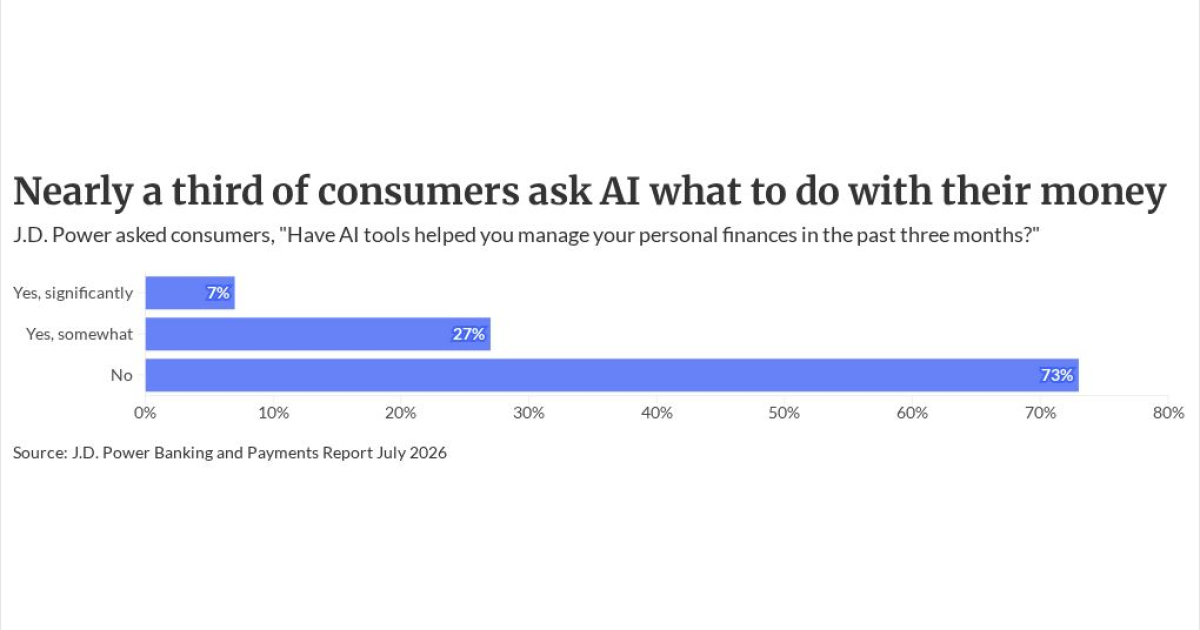
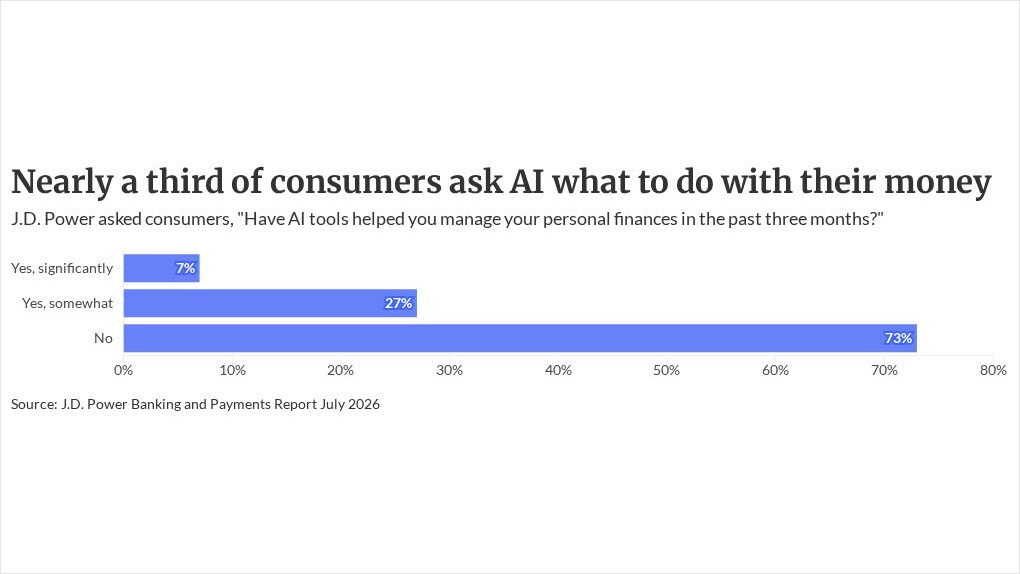
“According to J.D. Power, consumers are increasingly using AI to ask for financial advice,” she said. “And they are now just about as likely to credit AI as their bank for helping them make smarter financial decisions. Having this conversation within the walls of the institution, with the data and governance that come with it, is far better than having the agent run from the big tech provider’s side.”