Business leaders cope with AI risks
- Key insight: Find out how a vast majority of C-suite leaders rate their organizational agility.
- What’s at stake: Businesses attempting to scale artificial intelligence without equipping their existing workforces.
- Expert quote: “it’s difficult to do that without a partner.” — Scott Laliberte, Protiviti
Executives are dealing with more business risks as the impact of artificial intelligence cascades across the global economy and brings new challenges and opportunities, according to a new survey.
Processing Content
The
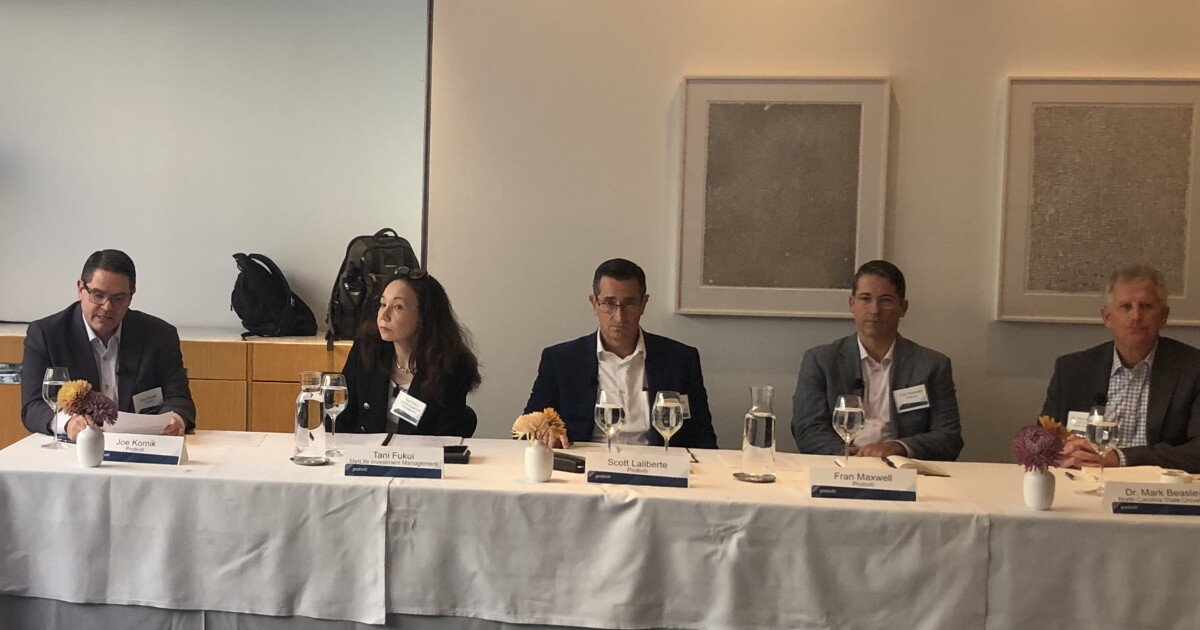
“Competing in 2027 will depend less on managing any rules and more on whether an organization can transform while simultaneously protecting the business from all the emerging threats that we’re seeing in the marketplace, and then responding fast enough to the speed of change,” said Joe Kornik, global lead of editorial programs at Protiviti, who moderated a discussion on the findings.
While organizations want to transform and grow, most of the executives polled appear to lack strong confidence that their companies can transform, protect enterprise value and respond quickly to emerging opportunities and risks at the same time. However, while the executives expressed greater confidence in their organizations’ ability to protect enterprise value (48%) and transform the business (45%), fewer were highly confident in their ability to respond with agility to emerging opportunities and risks (38%). The survey found that 78% of organizations lack strong confidence across all three of these capabilities.
Accounting Today asked about the risks from tariffs and taxes. “Generically, when you have a divided government, which is the base expectation, under no one political party having both friends of Congress and the presidency, then you wind up with much more of a struggle to raise materially taxes and/or not make major spending changes just because of the budget process, so we would not expect major changes going forward, until the next presidential election,” said Tani Fukui, an economist and senior director at MetLife Investment Management.
There were differences among executives in different industries when it came to trade and taxes. “To hit the trade side, because there’s been so much volatility there that a 5% to 10% increase did not make the top five as far as trade and tariff specific risk, except for manufacturing and distribution, that was a top five concern because it’s hitting them most directly, but the other industries less,” said Mark Beasley, professor of enterprise risk management and director of NC State’s ERM Initiative and co-author of the report. “It wasn’t a top five. There’s been so much noise in this space and they’re going to let it settle out a little bit, but the manufacturing and distribution that did matter.”
AI has moved from adoption to absorption, with with 44% of the executives polled ranking workforce enablement as their top priority for maximizing AI’s value, ahead of integration (42%) and governance (40%).
Nearly two-thirds (65%) see significant opportunities to expand ecosystem partnerships to enhance how they go to market, up from 62% last year. Some 30% of the executives cited advanced data analytics a top investment priority, up from 20%, the fastest riser in the study.
The top priorities cited for maximizing AI value included equipping the workforce to realize AI’s value (44%); integrating AI with technology, process and people (42%); and improving governance and accountability for AI (38%).
Tracking assets such as AI agents can be a problem for companies. “You see the emphasis on transformation and speed, but it’s difficult to do that without a partner,” said Scott Laliberte, global leader of the emerging technology group at Protiviti. “If you take an example, a lot of the transformational activities are driven by a business coming up with a great idea to do X. It’s typically transformational in nature. It may involve some AI models or data that the organization doesn’t have. How do you do that quickly? You’re going to spend all the time retraining your workforce and reviewing your tech stack, or you’re going to go find a partner leader. That’s what we’re seeing: all these new partners coming up with specializing in a particular area, and even existing partners are building new capabilities into their tools and tech stack.”
However, he noted this will probably fuel third-party risk management as well as supply chain risks in future surveys.
Organizations will need to adjust their workforce and talent to cope with AI risks.
“There’s so much in the media and other sources around what AI is going to do to take jobs away,” said Fran Maxwell, global CHRO team and people and change leader at Protiviti. “The best place to start is just communicating openly and honestly about what the strategy is and what the intent is to support people.”
Introductory bullet points created by AI with editorial review.