Advisors are building portfolios for the wrong clients
- Key insight: Advisors often default to plans and models that favor male clients over females. It is as much a tech problem as it is a financial one.
- What’s at stake: Female clients who don’t feel their advisor relates to them or meets them where they are could be inclined to leave, taking the money they inherited from male clients with them.
- Expert quote: “Women are going to outlive their husbands and then $4.5 trillion is going to flow to the widows. And for the most part, women have not been part of the conversations that their spouse had with their advisor.”
It is no secret that algorithms and technological models tend to leave women behind, and wealth management is no different. But with the Great Wealth Transfer beginning to sprout, the industry can’t ignore women, who are set to inherit a majority of the wealth in motion.
Processing Content
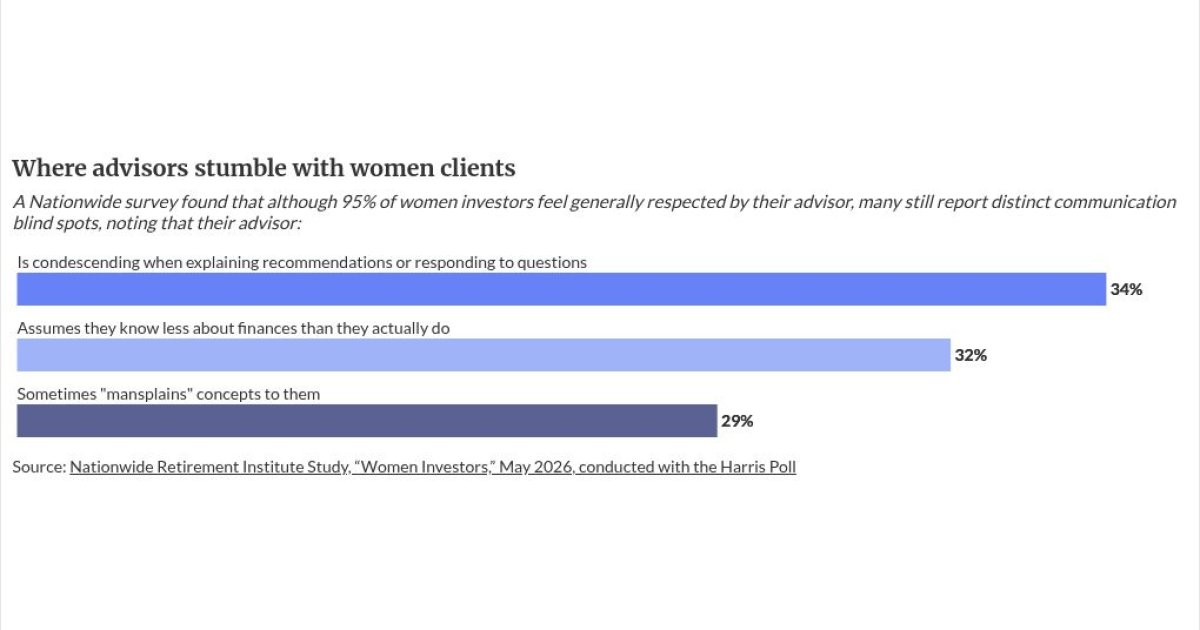
Past research points to women feeling left out of the conversation, ‘splained to by their male advisors or simply preferring to remain on the sidelines. While some change in perception about women and wealth has slowly begun to take shape, women remain a largely untapped segment for advisors looking to build their client rosters.
Shubhi Rao is an alumna of Google and several other household tech names who lives and breathes data. In 2022, she founded Uplevyl, a first-of-its-kind software platform that strives to put women first.
As millionaire and even billionaire clients increase in number, major players have begun to ration their human capital to their upper-tier clients, according to Rao. Financial thresholds create a barrier to entry that average investors can’t reach, and time is of the essence.
“Between now and the next five to six years, this industry is going to shrink by another 110,000 advisors, while demand is going up,” she said.
Rao shared her insights into how the industry can and should consider women clients now — before it’s too late to capture widowed women and inheritors as part of the Great Wealth Transfer.
This interview has been lightly edited for length and clarity.
Financial Planning: Tell us a little about what inspired you to start Uplevyl.
Shubhi Rao: I didn’t realize that the quality and type of data really was so crucial if you wanted to build models that work for everyone. That is the quest I was on: where are the data sets that would truly be helpful to women? There are other data sets that when you pull them together, women disproportionately use them compared to men. Somebody has to pull all that together to support women professionally, personally and financially, and that is where I thought I really had to go solve this problem.
So, I always said I didn’t choose to be an entrepreneur. That’s the byproduct. I just had to go solve this gender data set and build a platform that would be useful to women. And if useful to women, it will be useful to men as well.
FP: What do advisors miss when women aren’t part of the equation or conversation?
SR: First of all, women have wealth. That wealth is more of a recent phenomenon, but it will accelerate. Women are going to outlive their husbands, and then $4.5 trillion is going to flow to the widows. And for the most part, women have not been part of the conversations that their spouse had with their advisor.
FP: What else should advisors bear in mind about women clients around widowhood?
SR: She has different perspectives, lenses and risk appetite, so she’s going to express it very differently. She may [not be excited about benchmarks or crypto]. What she’s probably more looking for is “do I have enough money? I know that women may live longer, but I need more money for healthcare. Will I have [what] I may need toward the back end of my life?”
When she becomes a widow, she’s got hundreds of hours of work ahead of her, everything from getting the death certificates to estate planning to tax, to accounting and figuring out Social Security. With multiple properties, typically it’s the financial advisor who more than likely ends up having to help her, but has not necessarily had that same relationship, and it’s very administratively intense to help her, taking hundreds of hours and thousands of dollars before you hit a new steady state, whatever that might be.
FP: Why are advisors disconnected from women clients?
SR: It all comes down to dollars and cents because the advisor managing one household with $500,000 and then managing another with $3 million has to spend the same amount of time. Of course you’re going to spend more time with the household that has $3 million.
If we look at historical data where the man has been the dominant investor, our underlying models are going to reflect most of that behavior and attributes. So they may assume that the man is going to retire at 60 or 65 or the man is going to live up until this point. Oftentimes what the model actually could miss is that for many women, their peak earnings might be around 40 to 45. They may have taken a caregiving break, so as a result, their portfolio might be smaller. They live longer, but they need more healthcare and more funding toward the back end of their lives. We shouldn’t [assume] when everybody turns 65, this should be their portfolio allocation.
FP: What does the different time horizon imply for a woman’s portfolio?
SR: Maybe the woman should stay in equities longer because she needs that income for a much longer period of time. Her time horizon is much longer, and it’s also skewed more toward that back end. It’s like a heavy drawdown period for her. That probably isn’t reflected in the majority of the data because that is not the behavior exhibited in the dominant data set.
FP: How can advisors better serve women clients to close some of that gap?
SR: Advisors have to shift and think about spending more time with her, helping her to address the life events. She has a very different investment thesis, so how do we work with her and make sure that the underlying model systems accept or really understand her and other women at scale?
Advisors may also need a very different fee structure. What if your client needs more time around everything? Maybe they lost a spouse or sold a business and need more help. What if they really want to sit down and think it through? That takes hours. Advisors are going to have to start to think about how to charge people for this that seems fair to both sides.
FP: Life events hit us all. Why are they so complicated to work through?
SR: Whether that life event is divorce or retirement or loss of job or a sale of the company or loss of spouse, the complexity primarily comes because of the jurisdictional complexity we have built into this country. When you think about how divorce works in California, it is very different from Texas. How community property works in California versus Florida is very different. This is why the advisor becomes the switchboard, because they have to bring in all these different experts, but then those experts also have to research what’s happening. Our laws don’t stay static. They’re continually changing.
It’s hard to fix how we provide highly curated jurisdictional information to the advisor that is not definitive. We’ve spent all this time writing all these beautiful laws to help and protect us, but it’s not accessible to the common person. The advisor also has to then deal with all this. Over the years we’ve just piled on and piled on and created more and more and then we revise things and we add things and it’s not a static set of laws.