RBI repo rate at 5.50%: Another 50 bps hike likely by March 2027 — which debt mutual funds suit 3–18 month horizons?
The Reserve Bank of India’s 25-basis-point (bps) repo rate hike has raised questions among debt fund investors about how further rate moves could affect bond yields and fund returns.
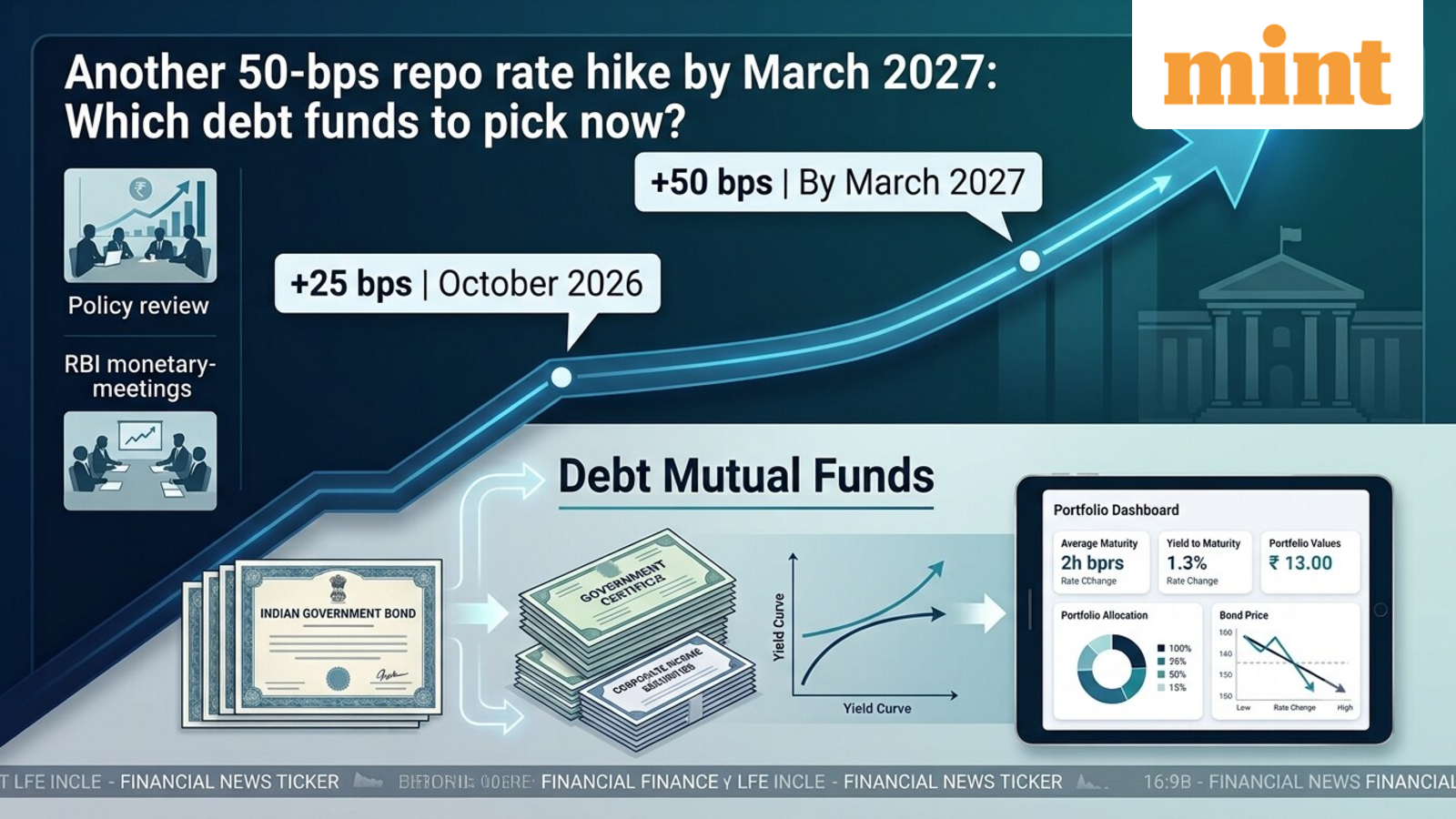
On October 7, the RBI’s Monetary Policy Committee (MPC) raised the policy repo rate by 25 bps to 5.50% from 5.25%. A higher repo rate typically pushes bond yields up and existing bond prices down, which can affect debt fund NAVs and returns.
As per the Kotak Mutual Fund October 2026 report, it now expects another 50 bps of rate hikes by March 2027, taking the repo rate to 6%, citing the RBI’s shift from neutral to a calibrated tightening stance and its higher FY27 CPI inflation projection of 5.2% from 5%.
Here’s what debt-fund investors should consider across 3-, 12- and 18-month investment horizons now.
How have bond markets reacted to the RBI rate hike?
According to a Kotak MF report, the 10-year G-Sec yield initially hardened by 5–6 bps to around 7.25% before easing back to about 7.20%. Meanwhile, the 30-year G-Sec yield softened to around 7.69% on October 7.
Market pricing currently appears more aggressive than the likely policy path implied by the RBI, leaving room for expectations to moderate over time. The fund house expects the yield curve to flatten further during the remainder of the tightening cycle, with shorter and intermediate maturities likely to adjust more than the long end.
Long-duration G-Secs remain attractive for medium- to long-term investors at yields near 7.70%. However, yields could test 7.90–8% in the coming months, making staggered allocation more suitable for investors with longer horizons.
Which debt funds suit an investment horizon of at least 3 months?
For investors with a minimum three-month horizon, ultra-short-duration, money-market and low-duration funds can be considered, according to Kotak MF.
Abhishek Bisen, Head–Fixed Income, Kotak Mahindra AMC, said the shorter-end yield curve remains relatively steep, allowing investors to earn attractive yields even over a brief holding period. These categories also have limited interest-rate sensitivity, which can help contain mark-to-market volatility and provide greater capital stability.
Which debt funds suit a 12-month investment horizon?
For investors with at least a one-year horizon, corporate bond, short-duration and banking & PSU funds may be considered, according to the report.
Bisen said corporate bond spreads remain attractive, while portfolio yields to maturity are approaching 8% on a gross basis. Over a one-year horizon, accrual income becomes a more important driver of returns, while the impact of interim interest-rate volatility tends to reduce.
This combination of attractive carry and moderate duration risk could offer a favourable risk-reward profile for investors willing to stay invested for 12 months, he added.
Which debt funds suit an over 18-month longer horizon?
For investors with an over 18-month horizon, Kotak MF recommends considering gilt, dynamic bond, long-duration, income-plus arbitrage FoFs and target-maturity funds.
Bisen said this segment requires a longer-term perspective and an understanding that bond markets often anticipate and price policy actions well in advance. The recent rise in 10-year G-Sec yields, while 30-year yields softened, suggests that much of the tightening cycle may already be priced in.
As yields move closer to 8%, fresh investments offer more attractive accrual potential. Investors with longer horizons could benefit from both accrual income and potential capital gains if yields stabilise or decline over time, he noted.
| Investment horizon | Debt fund categories |
| At least 3 months | Ultra-short-term, money market, low-duration |
| At least 12 months | Corporate bond, short-duration, banking & PSU |
| More than 18 months | Gilt, dynamic bond, long-duration, income-plus arbitrage FoFs, target-maturity |
*Source: Kotak Mutual Fund October 2026 report
What should debt fund investors do if the RBI does not hike rates as expected?
“If the RBI raises rates differently than expected or keeps the policy rate unchanged, investors should first assess the magnitude of the rate hike and the timing of any further tightening,” Bisen said.
Market expectations already factor in roughly 100 bps of tightening, while the probability of a significantly larger-than-expected rate-hike cycle appears low. Any additional hikes are also likely to be several months away, allowing yields to adjust gradually.
For debt-fund investors, the current elevated-yield environment continues to offer attractive accrual opportunities across high-quality debt categories, provided investments are aligned with their investment horizon and risk tolerance, he explained.
Disclaimer: This story is for educational purposes only. The views and recommendations made above are those of individual analysts or broking companies, and not of Mint. We advise investors to check with certified experts before making any investment decisions.
About the Author
Sheetal Goel is a Content Producer at Livemint, where she covers corporate developments, personal finance, business trends, markets, and SEBI-related updates. She focuses on simplifying complex financial concepts and presenting them in a clear, reader-friendly manner, thereby helping audiences better understand investment trends, personal finance, and market developments. Her writing focuses on making finance more accessible to everyday readers while maintaining clarity, accuracy, and relevance.
She holds a degree in Economics (Hons.) along with an MBA in Finance, which has helped her develop a strong foundation in financial analysis, market understanding, and business reporting. Before joining journalism, she worked with finance and broking firms, where she closely followed market developments, investment strategies, and evolving industry trends. This practical exposure strengthened her understanding of financial markets. She has also written content across multiple formats and platforms, including YouTube, LinkedIn, and Instagram.
Over time, she has developed expertise in covering market-linked stories, investor-focused topics, and regulatory updates in a simplified yet informative style. She also enjoys reading and listening to Hindi poetry, reflecting her appreciation for literature and creative expression beyond the world of markets and numbers.