RBI rate hike: Debt funds, equities, FDs or gold, which asset classes may benefit as the rate cycle turns? Expert view
The Reserve Bank of India (RBI) has raised the repo rate by 25 basis points, signalling a shift in its monetary policy approach as the central bank balances stronger economic growth with emerging inflationary pressures. The move is important for investors because higher interest rates can affect bond yields, deposit rates, borrowing costs and equity valuations differently.
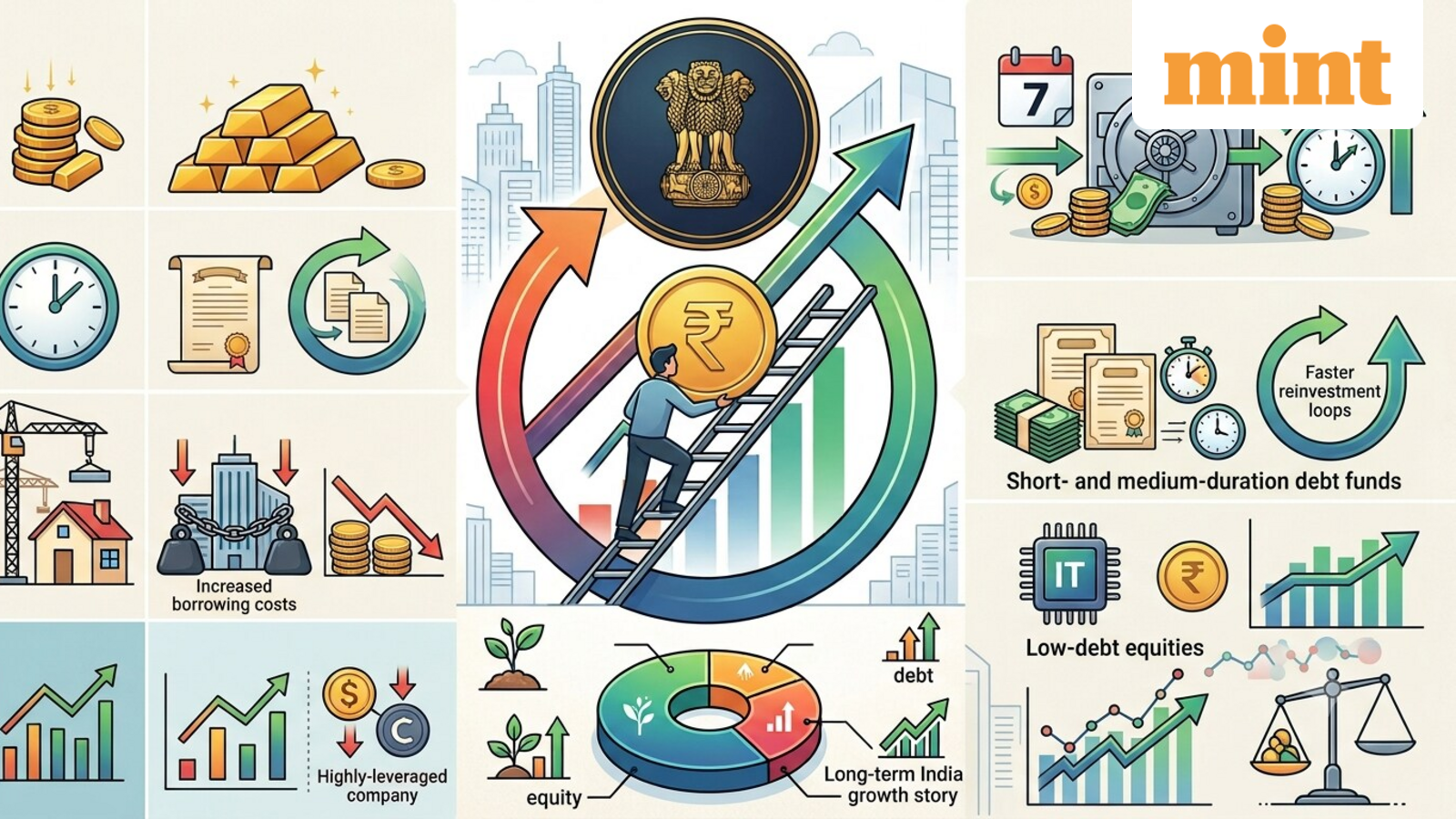
For retail investors, the key question now is where to position fresh money as the rate cycle changes. Short- and medium-duration debt funds could be relatively better placed, while long-duration bonds may face near-term volatility. Equities could see a mixed impact, with highly leveraged sectors more exposed to higher borrowing costs. Fixed deposits, meanwhile, could become more attractive as banks gradually reprice deposit rates.
Short-duration debt funds may weather higher rates better
Manish Srivastava, Executive Director at Anand Rathi Wealth Limited, said the impact of the rate hike is likely to be mixed across asset classes. Within fixed income, short- and medium-duration debt funds are relatively better placed because their lower duration limits the impact of rising yields and allows them to reinvest at higher yields as rates reset.
Long-duration debt funds, on the other hand, could face near-term mark-to-market pressure if bond yields move higher following the rate hike.
“Short & medium duration funds appear better placed from a risk-adjusted perspective as their lower duration reduces the MTM impact if bond yields rise further,” said Srivastava.
That does not mean investors should completely avoid long-duration funds. If inflationary pressures moderate and the RBI eventually moves towards rate cuts, longer-duration bonds could benefit because of their higher duration.
The appropriate strategy, therefore, depends on the investor’s time horizon. Investors with a short-term horizon can consider money-market, liquid and short-duration strategies. Those with longer investment horizons can selectively consider longer-duration categories such as target-maturity funds, he said.
Rate-sensitive sectors could feel the pressure
The impact of the RBI’s move on equities is unlikely to be uniform. Higher borrowing costs can affect businesses that depend heavily on debt financing while also influencing demand for big-ticket purchases.
Srivastava said real estate, housing finance, NBFCs and infrastructure could face pressure as financing costs rise. Discretionary consumption could also moderate as borrowing becomes more expensive.
NBFCs could see some margin pressure, although the impact would depend on their liability profile, pricing power and asset quality.
On the other hand, IT and other low-debt, dollar-earning businesses are relatively less sensitive to domestic interest rates.
For investors, however, Srivastava cautioned against making investment decisions purely on the basis of the rate cycle. For long-term investors, he said, the India growth story remains intact, supported by strong fundamentals and projected Nifty 50 corporate earnings growth of around 12-14% in FY27.
The key variable from here is whether the latest move remains a one-off normalisation or marks the beginning of a broader tightening cycle.
FD investors could benefit as deposit rates reprice
The rate hike could be positive for investors whose fixed deposits are maturing or those looking to make fresh deposits. Banks could gradually reprice deposit rates higher, giving savers an opportunity to lock into better rates.
However, investors should compare post-tax returns, particularly those in higher tax brackets.
Srivastava said investors in higher tax brackets could also evaluate alternatives such as arbitrage funds, which may offer relatively higher post-tax returns along with liquidity and debt-like stability, depending on the investor’s circumstances.
For existing FD holders, there may be little reason to break a deposit solely because the RBI has raised rates. Investors can instead consider staggering fresh investments as deposits mature, allowing them to benefit if rates move higher.
Gold may lose appeal as the rate cycle turns
Gold presents a different picture. Since it does not generate interest income, higher interest rates increase the opportunity cost of holding the asset.
Srivastava said investors should be cautious about increasing their gold allocation, particularly because the precious metal has become relatively volatile in recent years. Gold also tends to face pressure during a rate-hike cycle as higher interest rates increase the opportunity cost of holding a non-yielding asset.
Instead, he suggested maintaining a diversified portfolio. For long-term investors, he suggested an allocation framework of around80:20 across equity and debt to maintain stability and liquidity across market cycles.
The broader message for investors after the RBI’s 25 bps hike is that the rate cycle should not prompt abrupt portfolio changes. Debt investors need to pay closer attention to duration, equity investors should assess the sensitivity of their holdings to borrowing costs, and FD investors may get opportunities as deposit rates adjust.
The next phase will depend largely on how inflation evolves and whether the RBI’s latest move remains a one-off adjustment or marks the start of a more sustained tightening cycle.