GAO report finds early signs of impact from trigger leads ban
When the “trigger leads” law went into effect on March 5, it marked a watershed moment for consumer advocacy groups that had spent years fighting to restrict credit bureaus from selling consumers’ data without their permission.
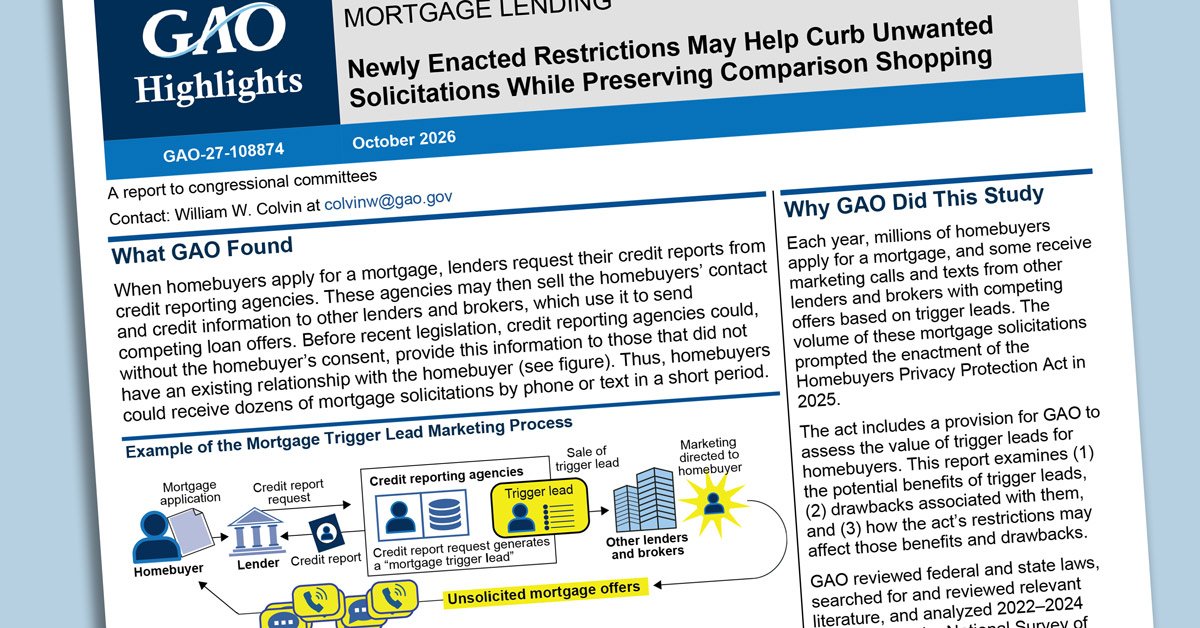
A new report by the U.S. Government Accountability Office (GAO), delivered Tuesday to U.S. Senate and House of Representatives committees, examines how the restrictions may be helping curb unwanted mortgage solicitations while preserving consumers’ ability to comparison shop.
Under the trigger leads law, credit bureaus can no longer provide a homebuyer’s contact and credit information to lenders and brokers that do not have an existing relationship with the consumer. The GAO’s survey said that under the old system, no more than 3.5% of homebuyers obtained loans through competing offers based on trigger leads.
Advertisement

‘Homebuyers will be better off’
Will Colvin, acting director of the financial markets and community investment group at the GAO and the report’s primary author, talked with Holly Hobbs from the office’s “Watchdog Report” podcast about the findings.
Noting that the law had been in effect for just over six months, Colvin said it was a premature to render a final judgment about its effectiveness.
“But we do think that homebuyers will be better off because of it. They’ll certainly begin receiving fewer mortgage solicitations because fewer lenders and brokers can buy these trigger leads now,” he said.
“We also think that homebuyers might be more receptive to these offers because they’ll be coming from lenders that the homebuyer already knows and likely trust,” Colvin added. “So, in many ways, this is a good news story because Congress saw a problem and has taken action to address it.”
Aside from simply being an annoyance, Colvin said, the GAO found that offers generated through mortgage trigger leads carried other risks. Some homebuyers reported receiving texts that were misleading, including messages advertising very low interest rates that were quickly raised when the consumer followed up.
Others reported receiving deceptive texts.
“They might come from someone who claims to work with their current lender, but only later would they find out that these texts were coming from a completely different company,” Colvin said. “Also, this wide sale of homebuyers’ personal information certainly raises privacy concerns because all this is being done without the homebuyers’ actual consent.”
Mortgage groups pleased with results
Congress approved the legislation in August 2025 without opposition, following a years-long effort by industry groups like the National Association of Mortgage Brokers (NAMB), the Broker Action Coalition (BAC) and the Mortgage Bankers Association (MBA).
BAC President Brendan McKay told Scotsman Guide his group is “thrilled to see the independent GAO study confirmed what supporters of the trigger lead legislation believed all along.”
He said that consumers’ information was being sold without their permission, while providing very little meaningful benefit.
“What trigger leads did provide was a flood of unwanted solicitations, confusion and, in some cases, deceptive marketing,” McKay said. “The legislation has been a resounding success, and BAC is working to deliver similar results on other challenges facing the mortgage industry.”
Michael Farrell, NAMB’s new president, told Scotsman Guide that a mortgage application should not set off a flood of calls and texts from companies the borrower never chose.
“That volume does not create competition. It creates noise, and borrowers tune it out. The GAO’s report confirms this,” Farrell said. “Real comparison shopping happens when a borrower asks for it. Independent mortgage brokers do it every day by placing a single application with many lenders and showing borrowers the options side by side. Consent-based shopping works. Unsolicited volume does not.”
After the GAO’s report was released, the MBA told Scotsman Guide it was “pleased to hear feedback from its members that the law is working as intended, and we are not hearing of instances of consumers becoming victims of trigger leads abuses.”