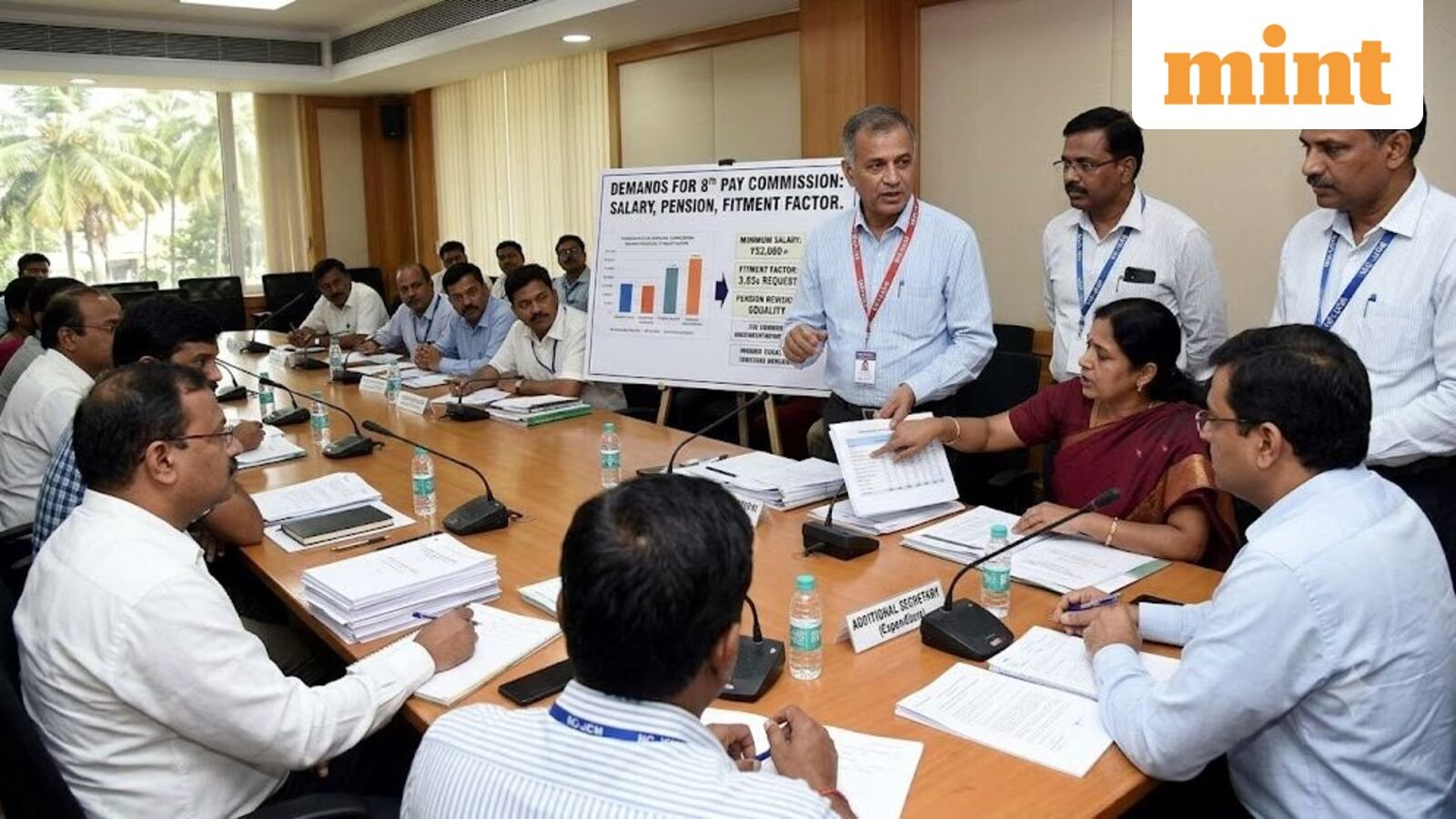
8th Pay Commission: Salary, pension, fitment factor — What employee unions want ahead of Bengaluru meeting
The 8th Pay Commission is set to hold its next official meeting with eligible unions, associations and other stakeholders in Bengaluru starting Wednesday, 7 October, as the process of discussion and consultation continues.
The panel of the 8th Pay Commission has not yet decided on a specific agenda for the meeting beginning tomorrow. The memoranda submitted by various unions and organizations over the past few months underscore that pay, fitment factor, allowances, pension reforms and career progression remain key areas of concern.
Among the prominent organizations that have submitted demands in recent months are the Indian Railways Technical Supervisors’ Association (IRTSA) and the Railway Senior Citizens Welfare Society (RSCWS). Their memorandums were submitted earlier in the year, highlighting concerns of railway employees and pensioners. They touched on areas such as the fitment factor, pension reforms and allowances.
Similar concerns are expected at the upcoming meetings in Mumbai, as the fundamental demands and aspirations of the employee unions are expected to centre on the same issues.
Let us see the key changes requested by IRTSA and RSCWS.
IRTSA seeks changes in pay and career structure
IRTSA has urged changes to the existing pay and career structure for technical supervisors. They have raised issues concerning increments, promotions, the Modified Assured Career Progression Scheme (MACPS) and allowances linked to difficult and challenging work conditions.
The association has proposed a minimum pay of ₹52,600 and distinct fitment factors across pay levels. It has also sought changes to boost the career progression of Junior Engineers (JEs) and Senior Section Engineers (SSEs), as well as improved pay for demanding duties.
RSCWS focuses on pension security
RSCWS has focused on retirement security and the overall structure of payments and allowances. They have argued in their memorandum that a greater share of remuneration should be included in basic pay, as some allowances may not be included in pension calculations. Apart from the above, periodic revision of allowances and greater protection against inflation are requested to protect the purchasing power of serving employees and pensioners.
The RSCWS has highlighted continuing post-retirement expenses, including housing, transport and healthcare, and called for better financial security for pensioners.
Demands of IRTSA and RSCWS
|
Key issue |
IRTSA demands |
RSCWS demands |
|---|---|---|
| Minimum/basic pay | Minimum pay of ₹52,600 | Greater weightage to basic pay to strengthen retirement benefits |
| Fitment factor | 2.92 for Levels 1–5; 3.50 for Levels 6–8; 3.80 for Levels 9–12; 4.09 for Levels 13–16; 4.38 for Levels 17–18 | Focus on strengthening the basic pay component |
| Annual increment | 5% annual increment | Not specifically highlighted |
| Allowances | Review of night-duty, overtime, risk and hardship allowances | Periodic revision of HRA and TA; better balance between basic pay and allowances |
| Career progression | Better promotions; changes to MACPS; revised career structure for JEs and SSEs | Not specifically highlighted |
| Difficult duties | Better compensation for night duty, overtime, risk and hardship | Review and enhancement of hardship and specialised-duty allowances |
| Pension/retirement | Pay and career structure supporting employees during service | Meaningful basic pay enhancement for better retirement security |
| Inflation | Not specifically highlighted | Link important allowance revisions to inflation or suitable indices |
Note: These demands are illustrative in nature. For complete details, refer to the memorandums of the respective unions.
What to watch from Bengaluru meeting
The discussions in the upcoming meetings are expected to focus on the same core areas: fitment factor, salary revision, and pension reforms, among others.
However, for serving central government employees and pensioners, it is important to note that individual union demands should not be treated as final recommendations of the 8th Pay Commission panel. The Commission will consider representations from a broad range of stakeholders before finalizing its recommendations to the Centre.
The Commission’s report is tentatively expected to be tabled around May-June 2027, i.e., 18 months after the constitution of the 8th Pay Commission on 3 November 2025.