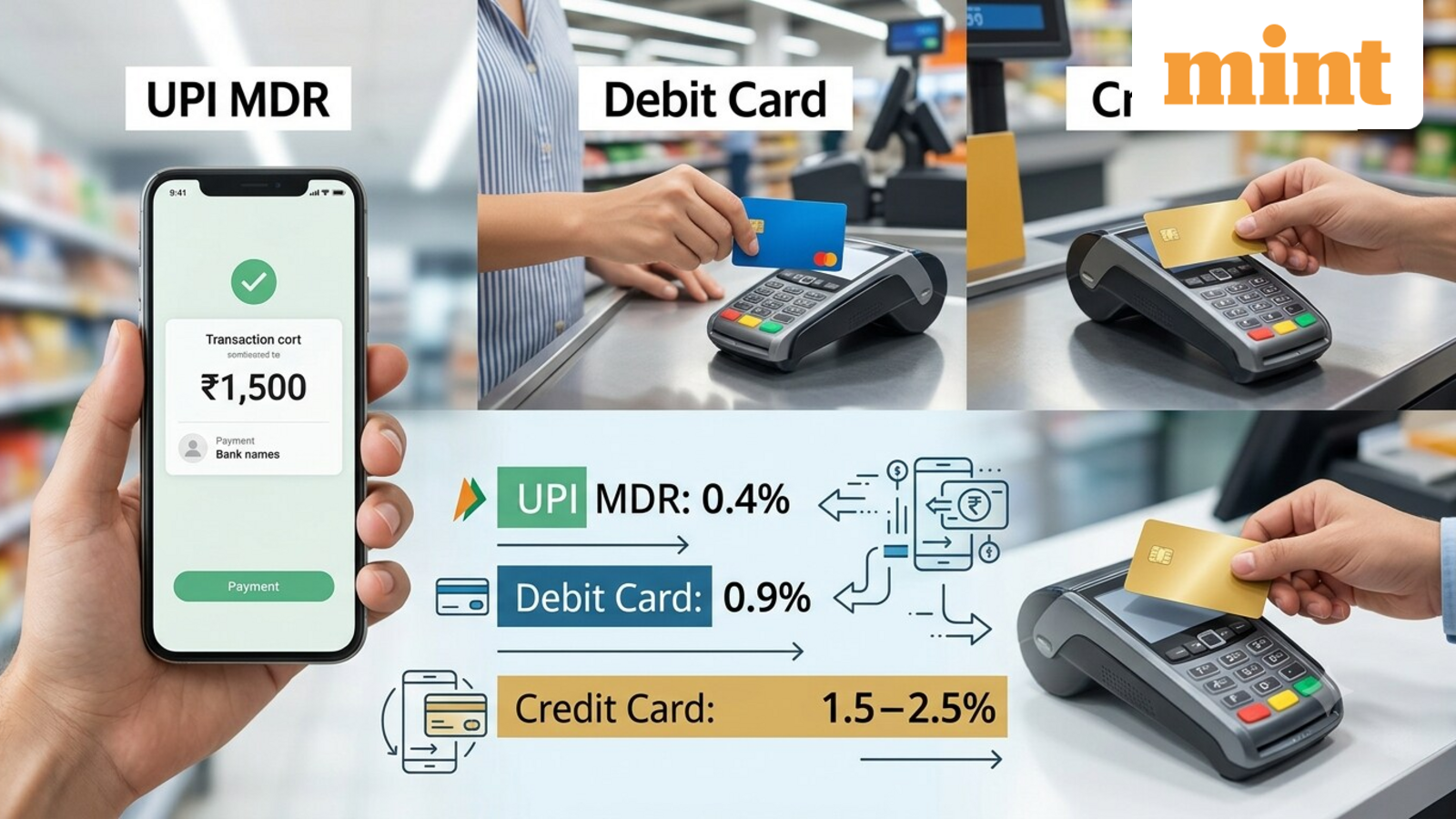
UPI MDR charges: How does it compare to traditional Debit, Credit Card per transaction? Cost difference explained
With the UPI merchant discount rate (MDR) set to apply from 15 October 2026, merchants will pay a 0.4% charge on eligible person-to-merchant (P2M) UPI transactions above ₹2,000. The charge will apply to the merchant and not to the customer making the payment.
But how does this UPI MDR compare with the charges merchants typically pay when customers use debit or credit cards? Here is what you need to know.
How does UPI MDR differ from debit and credit card charges?
According to NPCI FAQs released on 15 September, “UPI MDR is structured to be much lower than all traditional card-based transaction fees. Standard credit card MDRs typically range from 1.5% to 2.5% per transaction, while debit card MDRs are capped up to 0.90%.”
Credit card MDRs can vary depending on factors such as the card network, merchant category, and agreements between banks and merchants. The actual rate charged to a merchant may therefore differ across transactions.
By setting the baseline UPI MDR at 0.4% on transactions above ₹2,000 and capping it at ₹300 for high-value purchases, UPI remains the most affordable digital payment acceptance tool for commercial enterprises, NPCI noted.
What would the MDR be on a ₹10,000 payment?
Consider a customer making a ₹10,000 payment to a merchant. At a 0.4% UPI MDR, the merchant would pay ₹40 as the transaction charge.
If the same ₹10,000 payment is made through a debit card at an MDR of 0.90%, the merchant charge would be ₹90.
At a credit card MDR of 1.5%, the charge would be ₹150. If the credit card MDR is 2.5%, the charge would rise to ₹250.
Is MDR on UPI higher than debit and credit cards?
At a 0.4% MDR, the UPI charge increases with the transaction value until it reaches the ₹300 cap. This cap is reached when the transaction amount is ₹75,000, since 0.4% of ₹75,000 is ₹300.
For any UPI payment above ₹75,000, the merchant will still pay a maximum MDR of ₹300.
For comparison, on a ₹75,000 payment, a 0.90% debit card MDR would cost the merchant ₹675. A credit card MDR of 1.5% would amount to ₹1,125, while a 2.5% MDR would cost ₹1,875.
Therefore, even at higher transaction values, the capped UPI MDR results in a lower merchant charge than the debit and credit card MDRs.
Disclaimer: This is for informational purposes only. Please visit the official website for the latest updates.