What Is Hyperliquid (HYPE)? Plus: 4 Hyperliquid ETFs
If you’ve dabbled in crypto investing, you’ve probably heard of BTC, ETH, SOL and XRP. Hyperliquid (HYPE) is a little more obscure — and its ticker symbol might feel very on-the-nose to its critics and skeptics.
But here’s where things get weird: Hyperliquid’s core product isn’t the HYPE token. It’s an online trading platform which isn’t currently legal in the U.S. (although that may change soon).
Below, we’re doing our best to shed some light on this complicated and shadowy cryptocurrency project, and the recent dramatic price increase of its core token.
What exactly is Hyperliquid?
As mentioned earlier, Hyperliquid is actually an online trading platform. There’s a crypto token called HYPE that is attached to that platform, but the trading platform is Hyperliquid’s core product.
Many of these things are very new, very risky and exist in regulatory gray areas, which makes the overall legality of the platform questionable in many countries. To that end, the Hyperliquid website blocks U.S. users from trading, in an effort to avoid getting slapped with a big fine by U.S. regulators.
HYPE is the Hyperliquid platform’s native cryptocurrency, and it is legal and available in the U.S., even though its underlying platform is not.
It’s a pretty weird and confusing situation, and to make matters even more complicated, its legal status is in flux right now.
What’s the deal with Hyperliquid’s legal status in the US? How does President Trump factor in?
“The biggest unanswered question may be what ‘Hyperliquid in the U.S.’ actually means. It doesn’t necessarily mean that an American retail investor will open the existing Hyperliquid interface and immediately receive access to every product currently available internationally,” Jung said in an email interview.
There are already spot and leveraged Hyperliquid ETFs
Despite the Hyperliquid platform’s evolving legal status, the SEC has already approved three spot ETFs that track the HYPE token. They’re listed below in order from lowest to highest fee.
|
Fund name & symbol |
Fee |
|---|---|
|
Grayscale Hyperliquid Staking ETF (HYPG) |
0.29% |
|
21Shares Hyperliquid Staking ETF (THYP) |
0.30% |
|
Bitwise Hyperliquid ETF (BHYP) |
0.34% |
|
Source: SEC EDGAR database and fund websites. Data is current as of September 28, 2026, and is intended for informational purposes only. |
|
There’s also one leveraged ETF that tracks HYPE, the 21Shares 2x Long HYPE ETF (TXXH), which uses various Hyperliquid derivatives (like futures) to target twice the daily returns of HYPE.
Why is HYPE up so much this year?
According to Jung, one thing that has propelled HYPE’s strong returns this year is the popularity of its underlying platform. “Hyperliquid has grown into one of the largest venues for on-chain derivatives trading and has generated substantial trading fees,” he said.
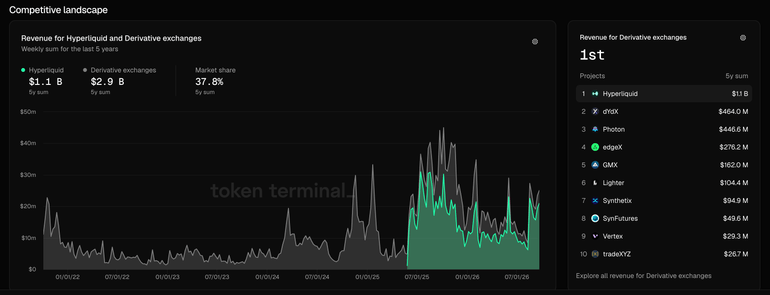
Source: Token Terminal. Data is current as of Sept. 30, 2026, and is intended for informational purposes only.
What are the risks of trading HYPE or HYPE ETFs?
Jung said that Hyperliquid’s legalization in the U.S. is not a sure thing, and that “delays, restrictive conditions or an unfavorable change in regulatory treatment could reverse some of the optimism currently being priced into HYPE.”
He also noted that the Hyperliquid buyback mechanism has played a large role in the token’s price increases this year, and that buyback mechanism is dependent on the underlying trading platform continuing to be popular and pull in a lot of revenue. “If trading volumes or market share decline materially, fewer fees would mean less capital flowing into HYPE purchases. That would challenge one of the strongest parts of the current valuation thesis,” he said.
And trading could very well decline if people or governments catch on to the fact that, frankly, the Hyperliquid platform is a sketchy internet casino. All of the things that you can “invest” in on the platform are purely speculative assets with almost no real-world economic value.
Here’s the bleak thing: We live in a time when sports gambling apps like Kalshi are running ads during NFL games. There’s certainly demand for online gambling, and regulators currently don’t seem to care much about the potential harms of that demand.