What AI’s biggest CEOs really want from Washington

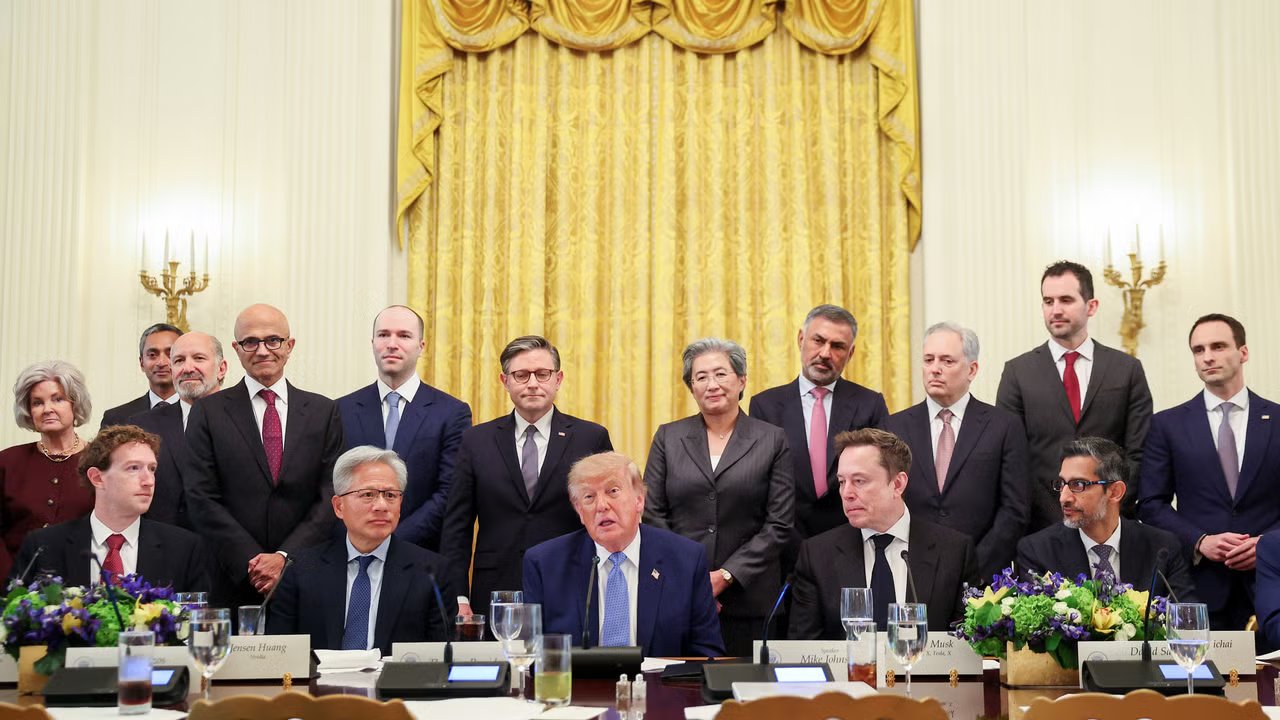
On Tuesday, President Donald Trump brought many of the most powerful people in AI to the White House, including Nvidia CEO Jensen Huang, Meta CEO Mark Zuckerberg, Google CEO Sundar Pichai, and Anthropic CEO Dario Amodei.
At a high level, most want some version of the same thing: more data center capacity, faster permitting, more federal spending on AI, and a light (or nonexistent) regulatory touch. Their priorities overlap, sometimes considerably, but the companies’ different businesses give them different stakes in the details. Some, for example, are pushing the federal government to impose new rules on the most powerful AI systems, while others are fighting restrictions on chip exports.
We don’t know everything the executives asked Trump for in private, but their companies have often been quite explicit about their priorities in Washington, D.C., and this was a chance to try to influence the president to their specific positions. Here’s what each had at stake.
Anthropic wants the government to regulate frontier AI
For much of the past year, Anthropic brass has argued that the most advanced AI makers need more government oversight—which would likely mean imposing new requirements on Anthropic itself.
The company’s proposed “regulatory ladder” would make the rules tougher as AI systems become more capable, eventually bringing in external testing and incident reporting. Anthropic says its Advanced AI Framework can function as a road map for policymakers, including giving governments authority to block or stymie high-risk deployments.
Dario Amodei also came into Tuesday’s meeting after months of fighting with the Trump administration over the Pentagon’s use of Claude. In March, after Anthropic refused to drop restrictions on mass domestic surveillance and fully autonomous weapons, the Pentagon designated the company a supply-chain risk. Anthropic challenged the move, but a federal appeals court upheld the designation in September. Still, relations appear to be thawing, as Trump hosted Amodei for a private dinner a few days before the larger White House gathering.
Nvidia wants Washington to not do anything that stops AI’s demand for more chips
As a leading chipmaker, Nvidia benefits as the AI industry builds more models and data centers. It’s no surprise, then, that its CEO says governments should regulate real harms instead of trying to predict every possible risk.
At a G20 event in September, Jensen Huang said policymakers should focus on “practical and actual harm” rather than “theoretical and hypothetical harm.” The Wall Street Journal reported that Huang confronted Amodei at the White House meeting over his public warnings about AI risk.
Nvidia also has billions riding on U.S. controls on exports of advanced AI chips to China. The government has repeatedly restricted which Nvidia processors can be sold there without a license. In 2025, those restrictions left Nvidia with $4.5 billion in charges related to H20 chips it could no longer freely sell in China. More recent rules have allowed the company to resume some sales, but Nvidia says it has been able to ship only a fraction of the H200 chips approved for export. The company warns that losing access to China gives local competitors more room to grow.
Meta wants to protect open AI
Meta, a pioneer in open-source AI (in which model weights are released so developers can run and build on them), has a strong stake in whether the federal government draws a regulatory distinction between closed frontier models and open ones. After all, restrictions on how advanced models can be released or distributed could cut directly against the strategy Meta has spent years pursuing.
In an August essay, Mark Zuckerberg claimed that restrictions on access to leading open-source models could concentrate AI in fewer hands. And, he argued, the U.S. needs to lead in open-source AI because those models are likely to become more popular globally, and thus represent an opportunity to extend soft power.
The Meta CEO also warned against rules that narrow what data American developers can use for training or restrict model “distillation,” the practice of training one AI system on the outputs of another. He says those limits could leave American models at a disadvantage to Chinese competitors.
Google wants one federal rulebook
In the list of recommendations Google published last year for the Trump administration’s AI Action Plan, the tech giant called for preserving access to data for model training, expanding energy supplies, streamlining federal AI procurement, and avoiding export controls that shut American companies out of foreign markets. It has also pushed the federal government to preempt what it calls a “chaotic patchwork” of state rules governing frontier AI.
CEO Sundar Pichai has made a similar case, arguing at the 2025 AI Action Summit that governments should “address risks, without stymying innovation,” and avoid fragmented regulatory regimes.
Google has more exposure to federal AI policy than most of its rivals because it sits across nearly every part of the market: It builds frontier models, sells cloud computing, operates massive data centers, sells AI tools to businesses and governments, and runs the world’s dominant search engine.
OpenAI wants federal safety rules, but aimed at the biggest labs
Like Anthropic, OpenAI wants federal rules for companies building the most powerful AI systems. But Anthropic has gone further in what it wants regulators to be able to actually do.
Last month, OpenAI recommended Congress enact mandatory, capability-based national AI safety requirements that include common testing standards, independent assessments, and mandatory reporting of AI-related security breaches. The company argues that the strongest requirements should apply to the small number of companies building the most capable systems, rather than startups and smaller developers. (Anthropic, by comparison, has called for regulators to be able to block dangerous deployments and levy civil penalties.)
At the same time, OpenAI needs a huge buildout of computing and energy infrastructure to keep growing, giving it reason to support tighter rules for frontier models while pushing for fewer obstacles to building the data centers and power systems behind them.
SpaceXAI wants Washington to use Grok
SpaceXAI wants to become the go-to AI apparatus for the federal government. Indeed, Elon Musk’s company already has a government-wide deal that lets each participating federal department, agency, or bureau provide Grok to its employees essentially free of charge through March 2027, with SpaceXAI engineers on hand to act as IT support. Musk said the goal was to “rapidly deploy AI throughout the government.”
The Pentagon is part of that effort. In 2025, SpaceXAI received one of four AI awards with a $200 million ceiling to develop tools for national-security missions, and Grok has since been added to the Pentagon’s AI platform for military and civilian employees. All of which is to say: Musk has a clear stake in turning federal approval of Grok into further federal adoption.
Microsoft needs the government to help solve AI’s infrastructure problem
Microsoft’s interests increasingly run through the physical infrastructure required to keep its AI business growing. The company’s “Community-First AI Infrastructure” plan calls for working with utilities to add electricity and grid infrastructure where its data centers need it, while promising that residential customers won’t bear the resulting costs. Microsoft has also committed to covering needed infrastructure upgrades and reducing its demand on local water supplies.
For CEO Satya Nadella, federal AI policy therefore reaches well beyond model regulation, particularly as Washington looks for ways to accelerate the enormous power and infrastructure buildout the industry says it needs.
Palantir wants federal agencies to use more AI
Palantir has spent years selling software to the federal government, so its interests are unusually straightforward.
In its response to the White House AI Action Plan, Palantir called for modernizing how federal agencies buy and deploy AI and even recommended that every agency complete a new flagship AI project within nine months of the plan’s publication.
For Palantir, Washington is not simply writing the rules governing AI. It is one of the company’s most important potential users of the technology.
AMD has billions riding on Trump’s chip policies
AMD shares some of Nvidia’s concerns about export controls, but its market position makes federal policy especially important. The company is already part of Washington’s effort to build more domestic computing capacity. AMD and the Department of Energy are working together on two new systems at Oak Ridge National Laboratory, including an AI supercomputer that the company last year described as part of an “open American AI stack.”
U.S. export controls on advanced AI chips have also hit AMD directly. The government began imposing the current generation of restrictions on sales to China in 2022, arguing that the chips can support advanced AI, supercomputing, and military applications, and has repeatedly tightened them since.
In April 2025, the Trump administration added a license requirement covering AMD’s MI308 AI chip. AMD says that restriction ultimately led to about $440 million in inventory and related charges in 2025. The company has since received licenses to sell some additional AI chips in China, but says export controls could still hurt its revenue and competitiveness.
Bonus: Why was Jeff Bezos there?
Amazon, of course, has a lot riding on federal AI policy. The company has said the U.S. needs to expand energy and infrastructure to accommodate data center growth, and has backed more consistent state and federal AI standards. But Amazon founder Jeff Bezos is a curious presence on the attendee list because he hasn’t actually run the company since 2021.
Why did Bezos get the invite instead of Amazon CEO Andy Jassy or Amazon Web Services CEO Matt Garman? Amazon may have simply brought out the biggest (that is, richest) gun it had to the show. Plus, Bezos remains Amazon’s executive chair and a major shareholder, so he still has plenty of money riding on how the company fares.