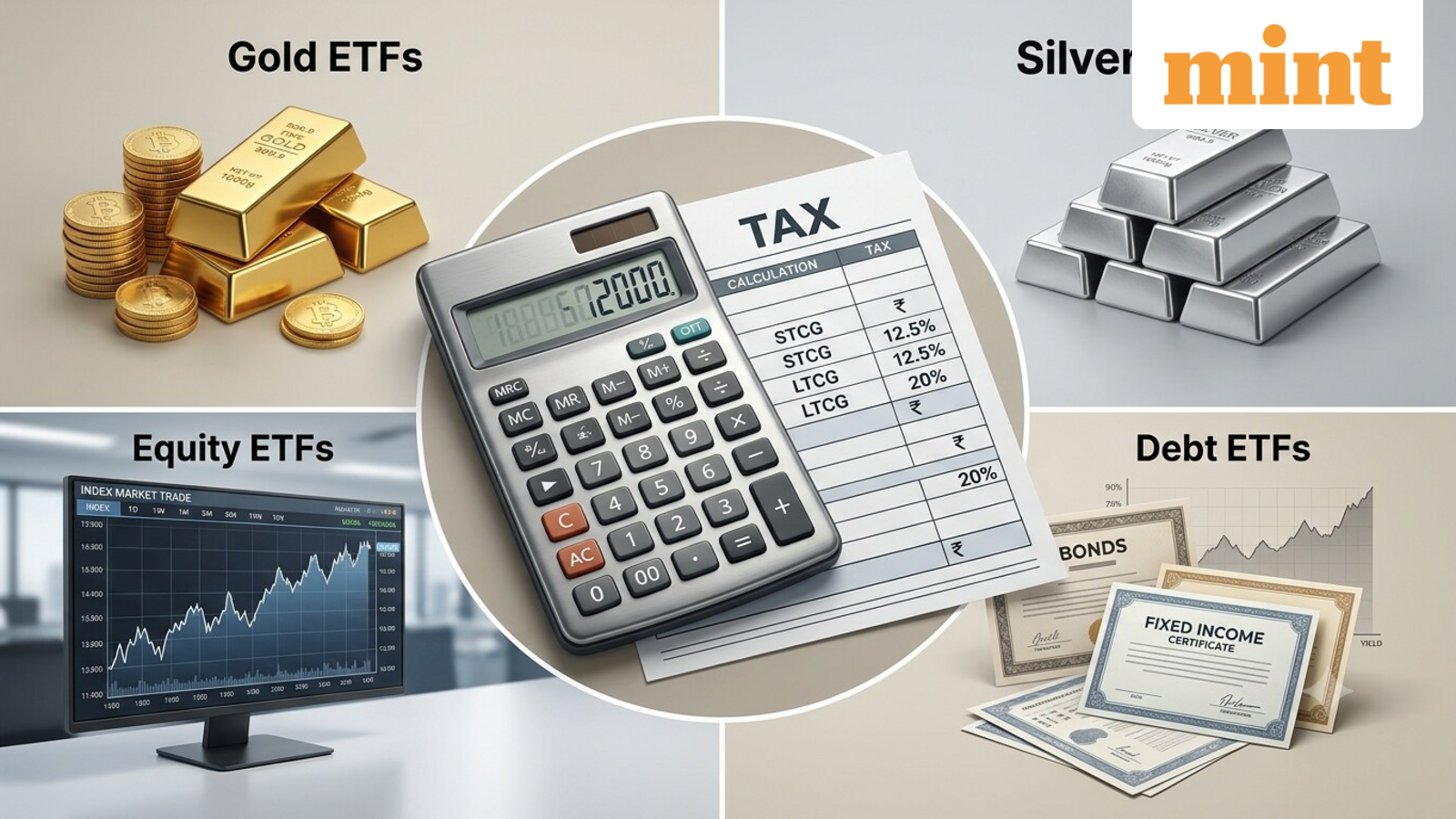
Invested in gold, silver, debt or equity ETFs? Check how capital gains tax maths differs across these mutual funds
If you have invested money in gold, silver, debt, and equity ETFs, the tax payable when you sell them can differ significantly depending on the type of ETF and how long you held it.
The holding period, nature of the ETF, and amount of capital gain determine whether the gain is taxed at a specific rate or your applicable income-tax slab rate. Here’s what you need to know about the capital gains tax rules for ETFs.
How does the 12-month rule work for ETFs?
For listed ETF units, the key cut-off is 12 months. Mutual fund units held for 12 months or less are treated as short-term capital assets, while those held for more than 12 months qualify as long-term capital assets.
The distinction is important because the tax rate can change substantially after the holding period crosses one year.
How are equity ETFs taxed?
Equity ETFs, such as Nifty 50 ETFs, qualify as equity-oriented funds as they invest more than 65% of their corpus in equity and equity-related instruments.
Short-term capital gains (STCG) on such units are taxed at 20%. For long-term gains (LTCG), the tax rate is 12.5% on gains exceeding the overall annual exemption of ₹1.25 lakh in a financial year.
For example, suppose an investor buys an equity ETF for ₹1 lakh and sells it after 15 months for ₹3 lakh. The capital gain is ₹2 lakh. After the ₹1.25 lakh annual exemption, ₹75,000 is taxable at 12.5%, resulting in a capital gains tax of ₹9,375, before applicable cess.
What happens when you sell gold or silver ETFs?
Gold and silver ETFs follow a different tax treatment. Short-term gains are taxed at the investor’s applicable income-tax slab rate.
If the units are held for more than 12 months, the gain is taxed at 12.5%. Unlike equity-oriented funds covered by section 112A, the ₹1.25 lakh annual exemption does not apply to these gains.
Consider a gold ETF bought for ₹1 lakh and sold after 18 months for ₹3 lakh. The ₹2 lakh gain is fully taxable at 12.5%, resulting in a basic tax of ₹25,000.
How are debt ETFs taxed?
Debt ETFs can have a different outcome, as the gains are taxed at the investor’s applicable income slab rate, irrespective of whether the gain is STCG or LTCG.
For example, if an investor buys a debt ETF for ₹1 lakh and sells it for ₹3 lakh, the capital gain is ₹2 lakh. If the investor falls in the 30% income-tax slab, the entire ₹2 lakh gain would be taxable at 30%, resulting in a capital gains tax of ₹60,000.
Therefore, two ETFs delivering the same profit can result in different tax liabilities depending on their underlying assets and tax classification. Investors should check the ETF’s category and the applicable rules before calculating their post-tax returns.
Disclaimer: This is purely for educational/informational purposes and should not be taken as any sort of investment advice. Always consult a SEBI-registered advisor before making any investment decisions.