Independent candidates are making their independence their biggest brand asset
The Democratic and Republican parties both have brand problems, so independent candidates across the country are using campaign logos specifically designed to let voters know they stand with neither of them. The new, must-have brand asset for independent candidates today is the word itself: independent.
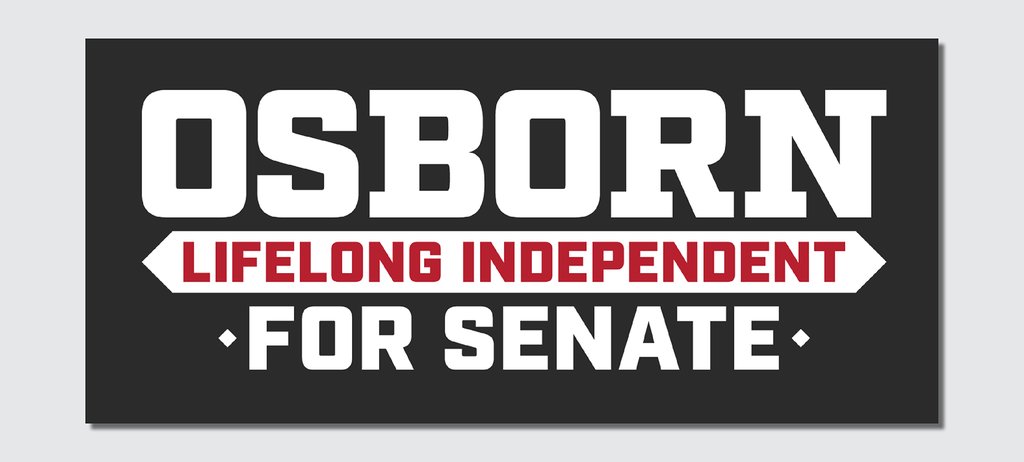
In Nebraska, the word independent has been part of U.S. Senate candidate Dan Osborn’s campaign logo since his first run for office two years ago. After losing by less than 7 points, he’s trying again, now with a slightly updated logo to emphasize that independence is no passing fad for him.
Osborn is a U.S. Navy veteran, industrial mechanic, and labor union leader who led a strike against Kellogg’s in 2021. He ran against incumbent Republican Senator Deb Fischer in 2024 with a red-and-white logo that spelled out his last name in all capital letters and a mixed-serif font. The tagline below read “Independent for Senate.”

Osborn’s 2024 run was unsuccessful—but it was the best performance for an independent in a U.S. Senate race in state history. Trying again in November, this time against incumbent Republican Senator Pete Ricketts, Osborn’s campaign kept the wordmark for his last name but updated the tagline. It now says “Lifelong Independent,” doubling down on his political identity and using the phrase as a piece of biography rather than as a simple descriptor.
Democrats cleared the field for both of Osborn’s runs, and his campaign says its internal polling has him tied with Ricketts. To actually pull off a victory, he’ll have to win most of the Democratic base as well as swing and independent voters. Most crucially, he’ll need to peel off a set of Republicans not happy with the way things are going, according to Kevin Smith, a professor of political science at the University of Nebraska-Lincoln.
“The Democratic Party brand is toxic in large parts of Nebraska,” Smith says. “If you want to win a statewide race and you are not a Republican, being perceived as a true independent at least gives you a fighting chance.”

Other red-state candidates have similarly branded themselves as proudly independent, such as U.S. Army veteran and former Idaho state lawmaker Todd Achilles, a Republican-turned-Democrat-turned-independent running for U.S. Senate whose logo spells out the first L in his last name with an Idaho state map and features a banner that says “Independent Veteran.”
In Montana, Seth Bodnar, a U.S. Army veteran and former University of Montana president, is running for U.S. Senate as an independent and polling in second place. He has a similar logo strategy. The word independent appears in an eye-catching red below his name, within an outline of the state map, which acts as a frame for the type.

It’s little wonder independents want to be known by that label today. Nearly 6 in 10 Americans have an unfavorable view of both the Democratic and Republican parties, according to the Pew Research Center, and a record high 45% of U.S. adults identify as independent, according to Gallup polling.
“There seems to be an increasing sense of frustration and loss of trust in both major parties,” says Smith, the UNL professor, which he believes translates to more people willing to give nonpartisan candidates a chance.
At a time when the parties are unpopular, branding yourself as separate and distinct can help you stand out and attract likeminded voters.

Bill Hill, an independent candidate for Alaska’s at-large U.S. House district, uses a compass icon and the tagline “Independent for All Alaskans.”
U.S. Senate candidate Brian Bengs in South Dakota, who previously ran as a Democrat, notably doesn’t use the word independent in his logo, but does use the color purple. The color has been used in the past to either distinguish a candidate from party establishment, as Alexandria Ocasio-Cortez did in 2018; or in the case of moderates, centrists, or independents to communicate cooperation between red and blue.
It’s not just independents looking to play down partisanship. The campaign for Democrat Rob Sand, who’s running for governor in Iowa, similarly uses visual branding that deemphasizes partisanship, with a logo showing shaking hands and a yard sign that crosses out the words Bluer and Redder, replacing them with Truer and Better.
Independents by nature don’t have a singular brand guide. Unlike major party candidates who can lean on standard party colors (like red or blue) or logo styles (such as the “AOC Slant” or “MAGA Box”) to signal values or affiliation, independents don’t have ready visual tropes to identify themselves. Instead, they’re spelling it out, and putting “independent” front and center.