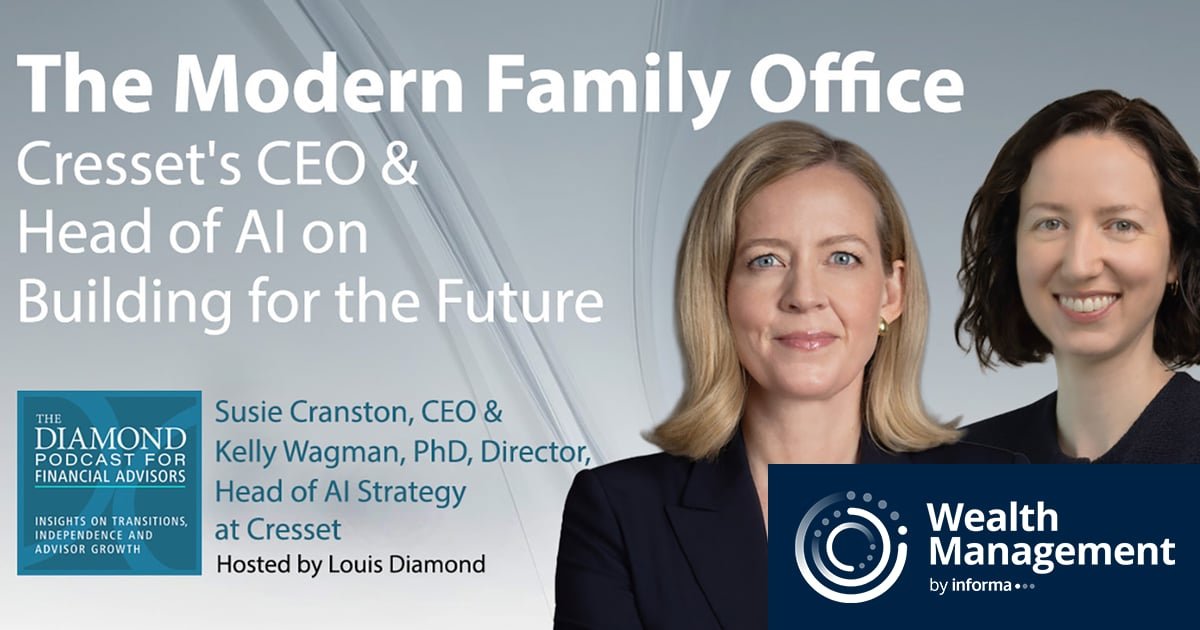
The Diamond Podcast: Cresset on AI and the Modern Family Office
What does the modern multi-family office really look like—and how might AI change what it can deliver?
Cresset has grown from an idea less than a decade ago into a national wealth management and family office firm with more than $250B in assets under management and advisement and more than 700 professionals. Yet its next chapter isn’t simply about getting bigger. It’s about finding new ways to extend highly customized advice and family office capabilities while preserving the human relationships at the center of the model.
CEO Susie Cranston and Kelly Wagman, PhD, Director and Head of AI Strategy, share how Cresset is approaching that challenge. Susie draws on lessons from helping build First Republic’s wealth management business—including the importance of a client-first culture, empowered advisors, and balance-sheet strength —while Kelly explains how Cresset is using AI, integrated data, and firm-specific tools to give advisors greater leverage.
The result is a look at a modern family office where technology may expand what advisors can deliver rather than diminish their role—and where culture, ownership, talent, and human advice remain fundamental to the firm’s vision for growth.
The Storyline
The family office has traditionally been a difficult model to scale. Its value comes from knowing a family deeply and coordinating an increasingly complex set of needs that can stretch from investments and estate planning to family governance, tax strategy, bill pay, household management, and even security.
Cresset has invested heavily in that infrastructure from its earliest days. Today, approximately 150 professionals are dedicated to family office services, supporting a broader organization with more than $250B in assets under management and advisement.
For Susie, the model also reflects lessons learned during more than a decade at First Republic. She describes how a deeply client-centric culture and empowered client-facing professionals helped create extraordinary loyalty and growth. But the bank’s collapse also left her with an appreciation for the importance of a “fortress balance sheet” and a clearer understanding of the tradeoffs that can come when banking and wealth management coexist within the same organization.
Topics Covered
-
What defines a true multi-family office—and why dedicated infrastructure matters
-
How Cresset grew to more than $250B in assets under management and advisement
-
Lessons Susie carried from First Republic to Cresset
-
Why client-first cultures depend on empowering client-facing professionals
-
The importance of balance-sheet strength and business-model structure
-
How Cresset approaches family office wealth strategy and wealth administration
-
Why AI may make sophisticated family office capabilities more scalable
-
How integrated data can improve speed, personalization, and advisor productivity
-
Cresset’s approach to building AI tools versus working with outside vendors
-
Why security, compliance, and data ownership matter in an AI strategy
-
How Cresset thinks about culture, equity, and advisor alignment
-
Equity versus cash when advisors evaluate potential partnerships
-
Independence versus joining a scaled wealth management platform
-
Why AI may increase rather than reduce the value of human advice
-
Cresset’s vision for talent, leadership, and the next decade of the firm