Mutual fund portfolio: How conservative, moderate and aggressive investors can allocate in current scenario
With investors showing growing interest in small- and mid-cap mutual funds, reflected in higher inflows, while large-cap funds have seen relatively less traction, should you rethink how you allocate your portfolio in the current market scenario?
DSP Mutual Fund’s Navigator Report for September 2026 suggests that large-cap funds are becoming more attractive as valuations moderate in this segment, while investors should remain cautious with small- and mid-caps.
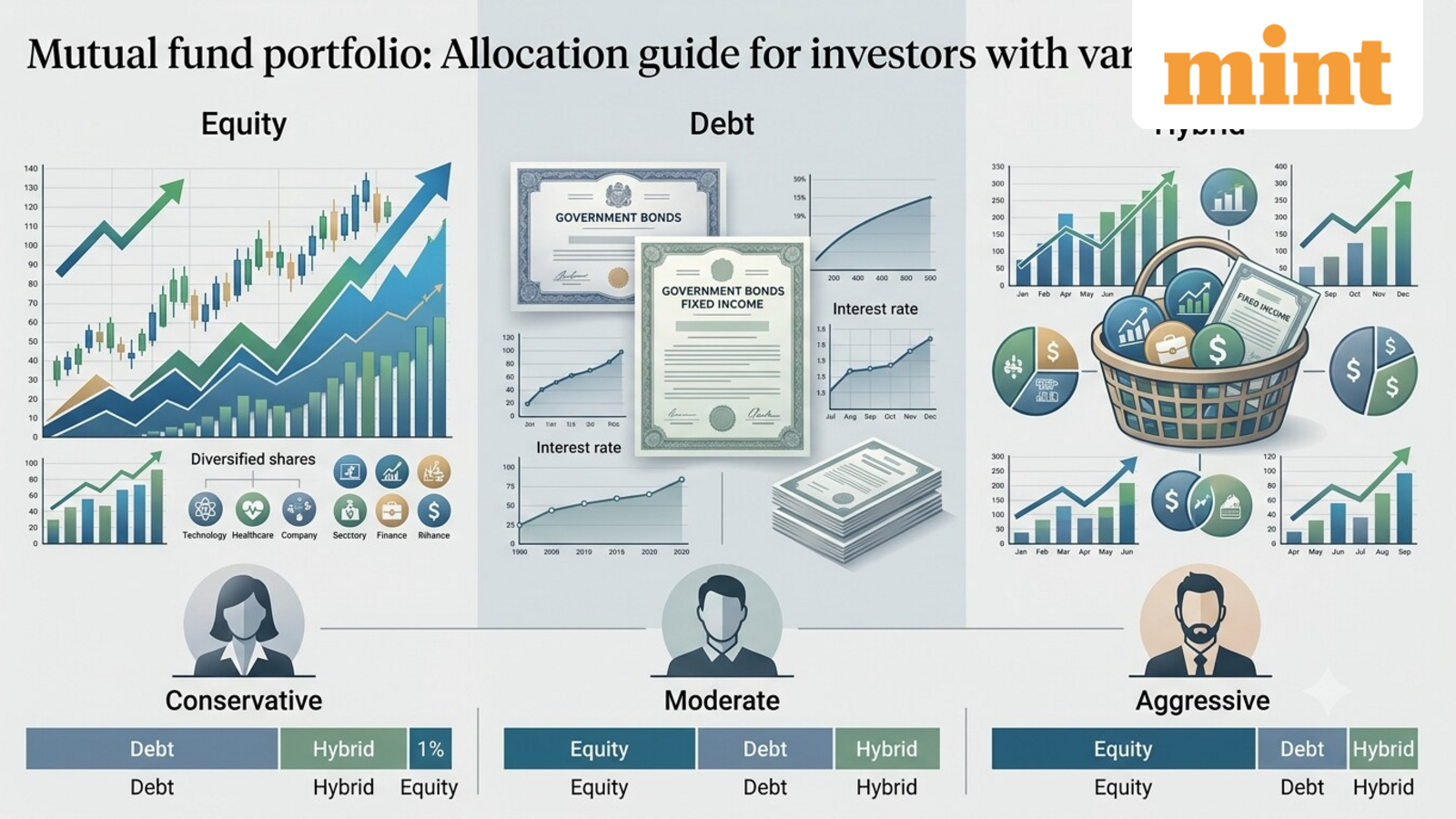
The report suggests allocating around 30% to equity funds for investors with a conservative-risk profile, 60% for those with a moderate-risk profile, and 70% for investors with an aggressive-risk profile.
What does the report reveal about large- and mid-cap funds?
The report sees improving risk-reward in large-cap funds. “Large caps are becoming attractive again. The Nifty has remained range-bound while earnings have continued to grow. Trailing P/E is now close to 19.5x, between long-term average and fair value. Q2FY27 earnings could take trailing valuations below 19x,” it stated.
However, DSP remains cautious about the small- and mid-cap funds. “SMIDs still lack a margin of safety. Activity and valuations across the broader small- and mid-cap universe remain buoyant. Even 20%+ earnings growth does not comfortably justify broad trailing valuations of 30–40x.”
While the DSP recommends staggering investments in small- and mid-cap funds and avoiding large lump-sum allocations, it sees the current valuation zone as reasonable for adding to large-cap funds, including through lump-sum investments.
DSP also sees little reason to change its stance on bonds. On precious metals, it mentioned that gold and silver still lack a clear margin of safety at current prices.
How should a conservative investor allocate?
A conservative investor could have around 30% in equity, with the remainder spread across multi-asset, arbitrage, and debt categories.
| Asset class | Category | Portfolio Allocation |
| Equity | Large Cap Fund | 15% |
| Equity | Index Fund – Equal Weight | 10% |
| Equity | Sectoral/Thematic – IT | 5% |
| Hybrid | Multi-Asset Allocation | 20% |
| Fund of Fund | Income Plus Arbitrage FoF | 20% |
| Debt | Sectoral Debt Fund – Financial Services | 10% |
| Debt | Dynamic Bond Fund | 20% |
*Source: DSP Mutual Fund’s Navigator Report (September 2026); For investors with a conservative risk profile
What can a moderate investor’s portfolio look like?
For moderate investors, the suggested equity allocation rises to 60%. Large-cap and value funds form a substantial part of the equity allocation.
| Asset class | Category | Portfolio Allocation |
| Equity | Large Cap Fund | 25% |
| Equity | Value Fund | 20% |
| Equity | Sectoral/Thematic – Healthcare | 5% |
| Equity | Sectoral/Thematic – IT | 5% |
| Equity | Sectoral/Thematic – Banking & Financial Services | 5% |
| Hybrid | Multi-Asset Allocation | 15% |
| Fund of Fund | Income Plus Arbitrage FoF | 10% |
| Debt | Sectoral Debt Fund – Financial Services | 5% |
| Debt | Dynamic Bond Fund | 10% |
*Source: DSP Mutual Fund’s Navigator Report (September 2026); For investors with a moderate risk profile
How should an aggressive investor allocate?
Aggressive investors could have about 70% in equity, with a larger allocation to large-cap funds and index funds, along with selected sectoral and thematic exposure.
| Asset class | Category | Portfolio Allocation |
| Equity | Large Cap Fund | 35% |
| Equity | Index Fund – Equal Weight | 15% |
| Equity | Sectoral/Thematic – Healthcare | 5% |
| Equity | Sectoral/Thematic – IT | 10% |
| Equity | Sectoral/Thematic – Banking & Financial Services | 5% |
| Hybrid | Dynamic Asset Allocation/Balanced Advantage | 10% |
| Fund of Fund | Income Plus Arbitrage FoF | 10% |
| Debt | Dynamic Bond Fund | 5% |
*Source: DSP Mutual Fund’s Navigator Report (September 2026); For investors with an aggressive risk profile
For mutual fund investors, the key takeaway from the current allocation framework is that higher risk tolerance does not necessarily mean putting a larger amount into small- and mid-cap funds.
The suggested portfolios maintain a significant large-cap allocation while using hybrid and debt categories to diversify risk.
Disclaimer: This is purely for educational/informational purposes and should not be taken as any sort of investment advice. Always consult a SEBI-registered advisor before making any investment decisions.