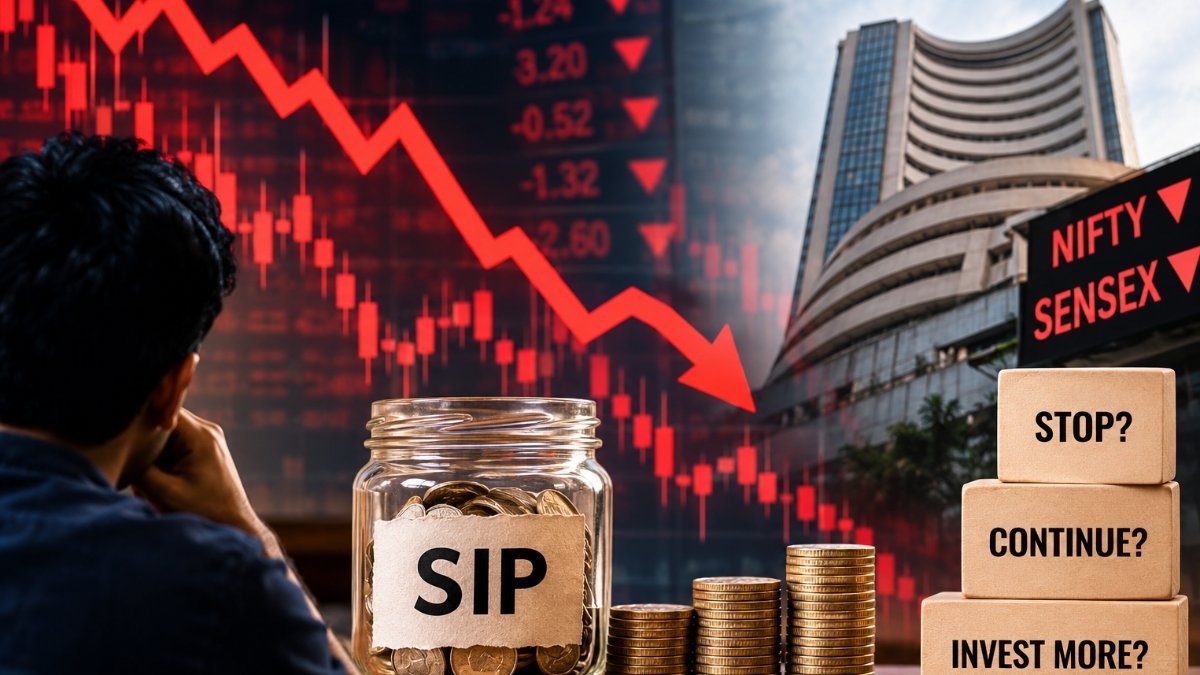
Market Down for 8 Weeks in a Row: Should You Stop Your SIP, Continue or Invest More? Expert Explains
The stock market has been under constant pressure, with the Nifty 50 recording eight consecutive weekly losses due to continuous selling by foreign investors, the surge in crude oil prices, rising US bond yields and concerns over interest rates.
/img/2026/10/sipstrategy12-34041790886574.jpeg "Sip strategy")
On Thursday, October 1, the Nifty 50 closed at 22,421.95, down around 198 points or 0.88%, while the Sensex settled at 71,909.70, declining approximately 570 points. The Nifty also touched an intraday low near 22,200, while the Sensex fell more than 1,200 points during the session. The sell-off reportedly wiped out around Rs 8.7 lakh crore in market capitalisation intraday, while India VIX surged more than 16%.
/img/2026/10/nifty600-19951790886872.jpeg "nfty")
/img/2026/10/sensex600-38971790886872.jpeg "sesnex")
The Nifty is now around 15% below its January 2026 intraday record high of 26,373.20. While the benchmark index has not entered a formal bear market, the correction has been considerably sharper across individual stocks. More than 50% of Nifty 500 stocks are reportedly down at least 30% from their respective peaks.
Since a lot of portfolios are turning red due to the ongoing market correction, mutual fund investors are wondering whether they should continue their Systematic Investment Plans (SIPs), pause contributions or increase investments to take advantage of lower market levels.
Should You Stop Your SIP When the Market Falls?
An SIP lets investors invest a fixed amount at regular intervals, regardless of market conditions. When mutual fund NAVs decline, the same investment amount purchases more units. This process is known as rupee-cost averaging, which can help average the purchase cost over time.
“Eight consecutive weeks of market decline will test any investor’s conviction and that is precisely the point. Markets are designed to reward investors who can sit with discomfort that others cannot. The instinct to pause or stop a SIP when markets fall is understandable, but it is also the single most counterproductive decision a retail investor can make. You are not losing money on your SIP, you are buying more units at lower prices. That is not a problem; that is the mechanism working as intended.” said Nitin Agrawal, CEO, Mutual Fund, InCred Money.
However, rupee-cost averaging does not guarantee returns or prevent losses. The value of mutual fund investments can continue to decline during a prolonged downturn, and investors should ensure that their investment choices remain aligned with their financial goals and risk appetite.
For investors with stable incomes, an adequate emergency fund and a long investment horizon, continuing an existing SIP may help maintain discipline instead of making decisions based on short-term market movements.
Should You Increase Your SIP During a Market Correction?
While continuing an existing SIP may suit investors whose financial circumstances have not changed, increasing contributions requires a separate assessment.
“The more interesting question is whether you should add more. For investors who have surplus capital, adequate emergency reserves, and a time horizon of five years or more, a market down eight weeks running is not a crisis, it is an entry opportunity that most investors will only recognise in hindsight. Markets do not move in straight lines in either direction. Eight weeks down does not mean nine. Stay the course.” Nitin Added.
Why Is the Stock Market Falling?
The recent correction in the market is due to many domestic and global factors.
Firstly, The ongoing US-Iran conflict is causing uncertainty & unresolved diplomatic discussions which have added to volatility in global markets.
Secondly, Foreign portfolio investors have continued to withdraw money from Indian equities. According to the BSE data, FPIs withdrew around Rs 2.50 trillion from Indian equities during the first nine months of 2026, while domestic institutional investors (DIIs) invested approximately Rs 6.28 trillion. Foreign investors reportedly sold Rs 45,536 crore through exchanges in September, including Rs 20,128 crore in just two trading sessions. Such outflows can weigh on market sentiment and increase selling pressure, particularly in large-cap stocks.
Thirdly, The US 10-year Treasury yield has reportedly risen to around 5.3%, US fixed-income investments more attractive relative to emerging-market equities.
Lastly, The Indian rupee has weakened towards Rs 96.50 against the US dollar, while India’s 10-year government bond yield has crossed 7.1%, according to data released.
Market participants are also concerned about the possibility of tighter monetary policy amid inflationary pressures. Expectations of a potential rate hike at the October policy meeting is alos adding to the selling pressure on October 1.
Top Money Mistakes Investors Make When Markets Fall
Market corrections like this can put investors under emotional pressure, leading them to make decisions that may not align with their long-term financial plans.
“The most common mistake is stopping SIPs. SIPs derive their power from rupee cost averaging, and that mechanism only works when you stay invested through the down periods. The second mistake is checking your portfolio too frequently. Watching daily NAV movements during a correction serves no purpose other than generating anxiety. An investor who checks their portfolio monthly will make far fewer emotional decisions than one who checks it daily.” Agrawal said.
“The third mistake is waiting for the “right time” to re-enter after exiting. Investors who exit during a correction almost universally wait too long to get back in. Corrections are where financial plans are tested. The investors who come out ahead are not the ones who predicted the bottom, they are the ones who simply did not make the expensive mistakes.” he further added.
Moreover the market is closed on Friday, October 2, on account of Gandhi Jayanti, investors will have a long weekend to analyse their portfolios and check their investment strategies. Trading will resume on Monday, October 5th.
Disclaimer: The views and recommendations expressed are solely those of the individual analysts or entities and do not reflect the views of Goodreturns.in or Greynium Information Technologies Private Limited (together referred as “we”). We do not guarantee, endorse or take responsibility for the accuracy, completeness or reliability of any content, nor do we provide any investment advice or solicit the purchase or sale of securities. All information is provided for informational and educational purposes only and should be independently verified from licensed financial advisors before making any investment decisions.