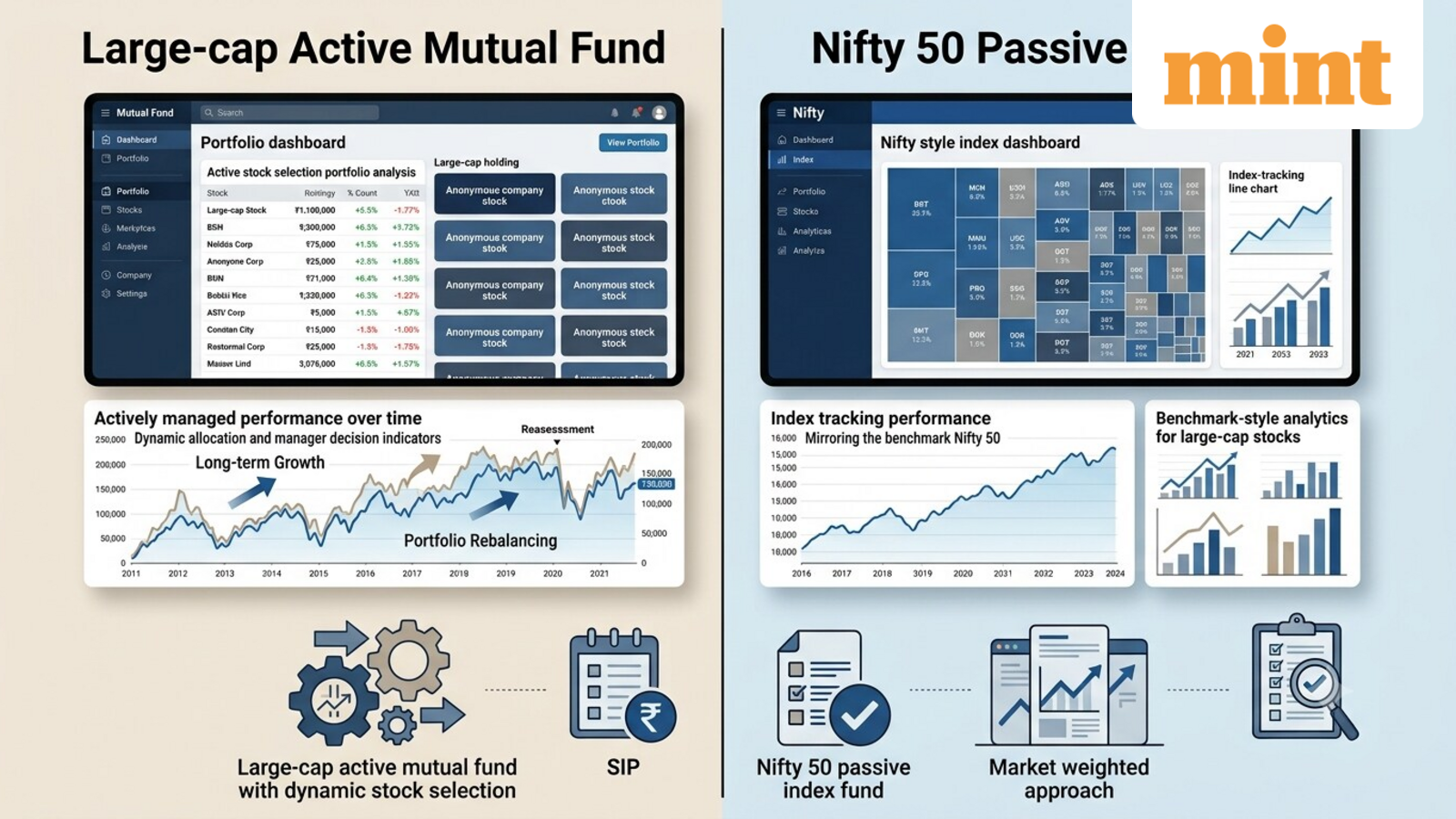
Large-cap mutual fund or Nifty 50 index? Expert weighs in on where to invest — and if SIP is better
Large-cap mutual funds and Nifty 50 index funds are two ways investors can get exposure to large-cap stocks in their portfolio.
Nifty 50 index funds replicate the 50 stocks in the index and follow a passive strategy, while active large-cap funds must invest at least 80% of their assets in large-cap stocks and generally pick stocks from the top 100 companies by market capitalisation.
Large-cap funds can hold a varying number of stocks, with some holding more than 50 stocks and others fewer, depending on the fund manager’s strategy.
But should investors choose both or keep only one, given that both offer large-cap exposure? Here’s what an expert has to say.
Should investors hold Nifty 50 index fund and large-cap funds?
Harsh Vardhan Dawar, ACA, CFA, FRM, Founder – Wealth Cafe, said investors should tag all investments in their portfolio as either passive or active, and also by market-cap category — large, mid or small cap.
He suggested that a typical 30-year-old growth investor may have:
Nifty 50 index fund or large-cap: What should new investors consider?
Dawar said a new investor can consider both these funds and allocate funds in line with his portfolio allocation. However, a risk-averse investor can prefer Nifty 50 index funds, while a riskier investor can prefer actively managed large-cap funds.
SIP or lump sum: Which route should investors choose?
For both Nifty 50 index funds and large-cap funds, SIP would be the preferred route, Dawar said.
However, an investor who actively manages their portfolio and tracks the market in terms of valuations can consider lump-sum investments, he added.
What should investors consider amid weak large-cap performance?
The Nifty 50 TRI is down 7.09% over the 1-year, and all Nifty 50 index funds/ETFs are in the red. Among active large-cap funds, only 4 schemes have delivered positive one-year returns: Taurus Large Cap, Quant Large Cap, Bank of India Large Cap and Invesco India Large Cap.
Unlike the mature markets like the US, Indian mutual funds that are actively managed are able to deliver returns that are higher than index funds. Hence, there is merit in having actively managed funds in your portfolio, Dawar added.
But he suggested that “the secret sauce even for a retail investor would be to stick to asset allocation.” This means investors should maintain their planned allocation across debt and equity, as well as large-, mid-, and small-cap investments, rather than frequently changing it.