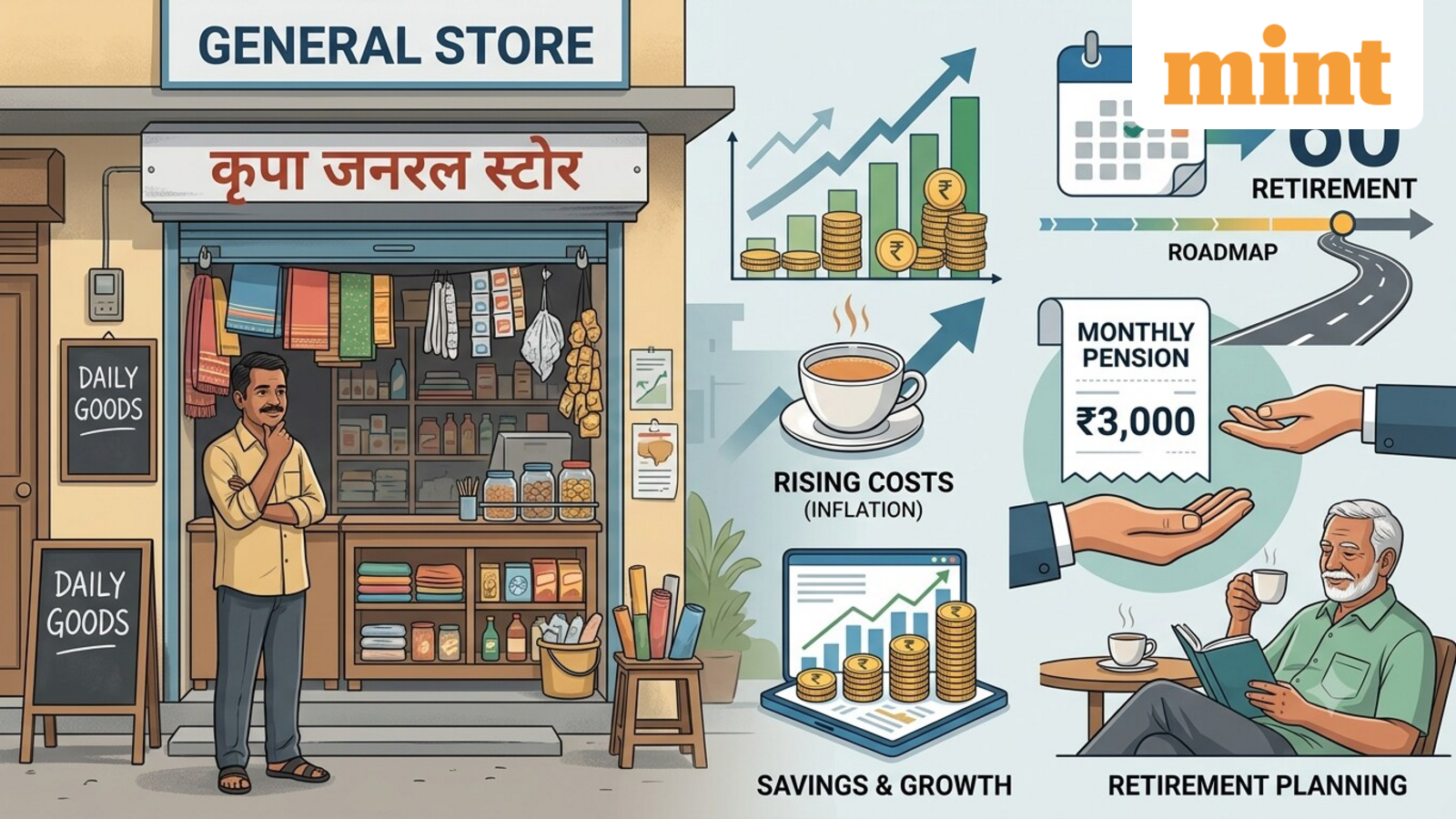
NPS for small traders: Is ₹3,000 monthly pension after 60 enough for retirement? Experts highlight harsh reality
Under the National Pension Scheme (NPS) for Traders, shopkeepers, retail traders, and self-employed people get an assured pension of ₹3,000 a month after attaining 60 years.
This voluntary scheme covers Vyaparis such as shop owners, retail traders, rice and oil mill owners, workshop owners, commission agents, real estate brokers, and owners of small hotels and restaurants, among others, with an annual turnover of up to ₹1.5 crore.
If the beneficiary dies, the spouse is entitled to 50% of the pension as family pension. But is ₹3,000 a month enough for retirement, and can traders depend on this scheme alone? Here’s what experts have to say.
Can traders depend on the ₹3,000 pension alone?
No. The pension is inadequate on its own because it is a fixed amount with no inflation adjustment, said Vijay Kuppa, CEO, InCred Money.
“It barely covers groceries, utilities, rent, healthcare and emergencies that a retirement income should cover,” he added.
Manish P. Hingar, Founder and Chief Executive Officer of Fintoo, said this NPS scheme should be viewed as a small base for retirement planning. The ₹3,000 pension does not increase with inflation. At 6% inflation, ₹3,000 received 25 years from now would be worth only about ₹700 in today’s money.
There is also no lump-sum payout at 60. If the member dies, the spouse receives 50% of the pension, or ₹1,500 a month. Children are not covered in this scheme, Hingar said.
Who should consider the NPS for Traders scheme?
This NPS scheme can be considered by people with irregular incomes or those who struggle to save regularly. It is aimed at small traders and self-employed people in the unorganised sector who are not income-tax assessees, Kuppa mentioned.
The scheme is aimed at small traders, shopkeepers and self-employed people between 18 and 40, with annual turnover of up to ₹1.5 crore, who have no pension or PF from a job. The cost is low. Depending on your age at joining, you pay ₹55 to ₹200 a month, and the government puts in the same amount, Hingar said.
Those above 40, income-tax payers, and members of EPFO, ESIC, the government-funded NPS or PM-SYM are not eligible, he added.
For those with limited financial literacy, Kuppa suggested keeping some savings in familiar options such as banks or post offices, maintaining an emergency fund, buying health insurance, and checking eligibility for government schemes such as Ayushman Bharat.
How should traders plan for retirement beyond this pension?
Hingar suggested the following approach:
- Begin with your monthly expenses at retirement. Take what you spend today and adjust it for inflation. If you spend ₹20,000 a month now, that becomes about ₹86,000 a month in 25 years at 6% inflation.
- Then work out how much you’ll need to have saved. A simple rule is about 25 to 30 times your yearly expenses at retirement. In the example above, ₹86,000 × 12 × 25 comes to about ₹2.6 crore. Deduct the pension income you expect to receive to estimate the remaining savings gap.
- For long-term growth, equity mutual funds through SIPs can be considered. PPF offers a safe, tax-free option, while regular NPS is available to self-employed people and comes with tax benefits. As you approach 60, gradually shift towards safer investments.
- Protect the plan as well. Keep an emergency fund of 6 to 12 months’ expenses, and buy health insurance and term life insurance. Keep your retirement money separate from your business, and don’t count on the shop to fund your retirement.
- After 60, you’ll want a regular income. You can choose from the Senior Citizens’ Savings Scheme, monthly withdrawals from mutual funds (SWP), and annuities.
Disclaimer: This is purely for educational/informational purposes and should not be taken as any sort of investment advice. Always consult a SEBI-registered advisor before making any investment decisions.