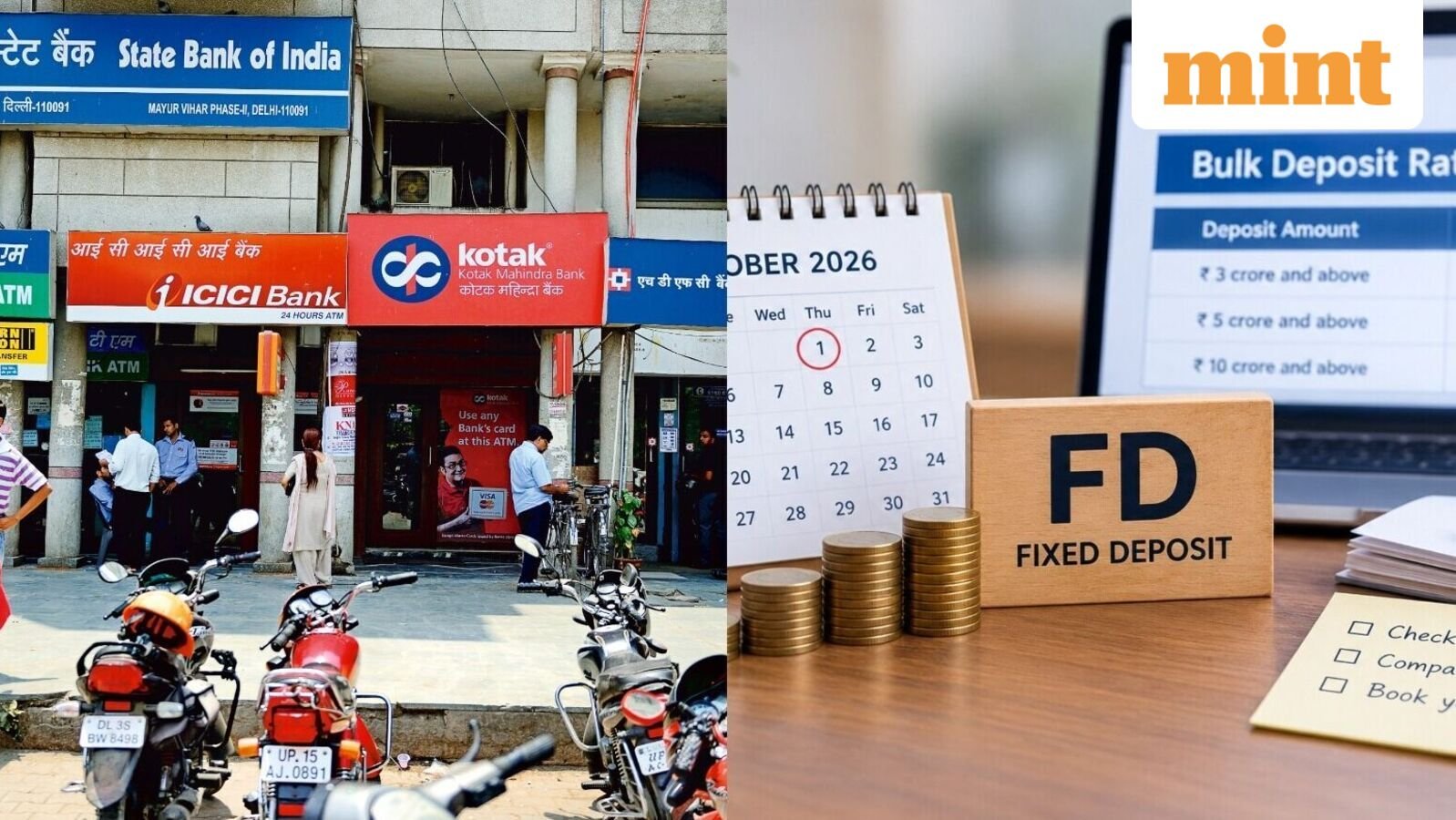
Bank FD rules: What happens to your money if a bank fails? The ₹5 lakh insurance limit, explained
We have often heard from our parents that creating a fixed deposit (FD) with a bank is one of the safest ways to grow our money. While FDs offer several advantages, including a fixed interest rate, maturity date, and maturity amount, they also carry risks, such as tying up a large amount of money with a single bank.
Have you ever wondered what happens to your money if a bank fails? According to a Moneycontrol report, the Deposit Insurance and Credit Guarantee Corporation (DICGC) provides insurance cover of up to ₹5 lakh per depositor, per bank, for eligible deposits. This limit covers both the principal amount and the interest earned. For instance, if you hold a ₹10 lakh FD with a single bank, the entire amount is not automatically protected just because it is a fixed deposit.
Multiple accounts in one bank? Your deposits may be clubbed for insurance cover
The DICGC insurance cover rule becomes even more important when a person holds multiple accounts with the same bank. For instance, if you have ₹4 lakh in savings, a fixed deposit of ₹5 lakh, and another FD of ₹3 lakh, these amounts are usually clubbed together when calculating the insurance cover. While your total may be ₹12 lakh, the insurance cover is capped at ₹5 lakh, implying that you would actually be at a loss of ₹7 lakh.
For customers who think opening several FDs at the same bank would solve the problem, that won’t work. Additionally, if a customer decides to split their ₹9 lakh in FDs into three FDs, of which two are worth ₹2 lakh each and one is worth ₹5 lakh, it will not create separate insurance covers for the three FDs. Deposits maintained at multiple branches of the same bank are also combined when determining the applicable insurance coverage.
How to protect your money?
One of the simplest ways to reduce the risk of losing your money is to distribute it across several banks. The DICGC insurance limit of ₹5 lakh applies separately to deposits held with each bank. Let’s say you have ₹15 lakh to invest in FDs; you can consider splitting the amount between three banks, which can increase the portion covered by deposit insurance compared with keeping the entire amount in a single bank.
However, there are some exceptions to this rule, particularly when deposits are held in different capacities. For instance, certain joint accounts and deposits held under different legal arrangements may be insured separately under DICGC rules. However, people should not create complicated account structures just to increase insurance cover without first understanding the ownership and paperwork involved.
Choice of bank matters
According to the report, customers planning to deposit their money in several accounts must consider their choice of bank. Before investing a large amount in an FD, depositors must carefully check whether the preferred bank is on the list of DICGC-insured banks. While the list covers commercial banks and several eligible cooperative banks, the insurance mechanism does not necessarily cover all types of financial products.